We are at the southern end of Neusiedlersee (National Park both in Austria and Hungary) in Burgenland, Austria, at the Weninger Winery. They own land across the border in Hungary as well, near the city of Sopron where they have some of their favourite sites. This area used to be part of Hungary, so in and around Sopron there is a great number of locals with German ancestry. They considered skilful, diligent, hard-working people frequently tending vines and other cultivars. Often referred to as ‘poncichters’ (bean growers) because they used to plant beans and other vegetables between the vines as a polyculture.
The Austrian Franz Weninger (Jr), at the tender age of 18, became the proud co-owner of some vineyards, near Sopron out of sheer necessity just to help his father out. His mother was not very keen on owning vineyards in Hungary to put it mildly. Franz took over part of the estate from his father after graduating from Klosterneuburg and travelling the world on internships (California and Australia). He had risen through the ranks and got plenty of coveted awards for his wines in the early 2000s using indigenous and international varieties. His family has a long-standing tradition in grape growing in the area. Since 1828 they have been winemakers.
He wanted to produce something very individual, something with the sense of place, not copies of great Burgundies or Super-Tuscans. He did not want to use French cultured yeasts, and tronçais barrels or Italian cuts of vines and Australian consultants as his father did. He convinced him that a more natural way is the right approach. Look for what is local and use what is local in every sense. He stopped applying filtration, used less and less new wood, preferred spontaneous fermentation with ambient yeasts. After a trip to Georgia, started using locally made concrete and terracotta vessels and amphoraes to the surprise of Austrian and Hungarian customers alike. Began replanting many sites to native grape varieties: Blaufränkisch and Furmint.
Then he switched to organic, then to biodynamic winemaking in 2006 which earned him a somewhat infamous reputation of being completely crazy. At the time, natural wines and biodynamic wines were just side notes, interesting experiments, but far from being universally recognised. He struggled to sell his wines as awkward grapes from Hungary were not as fashionable at the time and after the 2008 financial crisis almost everything was lost.
The turning point was 2010 with the start of the natural wine movement, something has changed. Weird and wonderful unknown regions and unknown varieties become chic and trendy. From 2011, he has been overseeing both the Austrian and Hungarian part of the estate. He is extremely committed to the land he farms, to the wines he makes with clarity, definition and elegance, where the grapes giving true expressions of the various, slightly differing soil types. Nowadays his wines seem to be popping up in top restaurants around the world.
A vine sickness drove him to start paying attention to the soil consistency. His vines were suffering from the lack of Magnesium, however there was plenty of Magnesium in the soil, but the plants struggled to take it up. He started with building up humus with manure, rather than the suggested fertilisers. ‘You cannot force-feed plants!’ – he said and set out to find an alternative way. Afterwards, to secure and store the humus they used biochar that reduces soil emissions of greenhouse gasses.
The vineyards are planted throughout with a variety of wildflowers and other cover crops that protect against erosion and help supporting bees. There are bird boxes all around and a small heard of sheep on the pastures between the vineyards. He does not seem to be as fearful of rows of trees and shrubby hedges as your average winemaker. On the contrary, he encourages insects, wild animals and green grasslands. He believes if you do not want to have picnic in your vineyard, there is no point of making wine out of those vineyards.
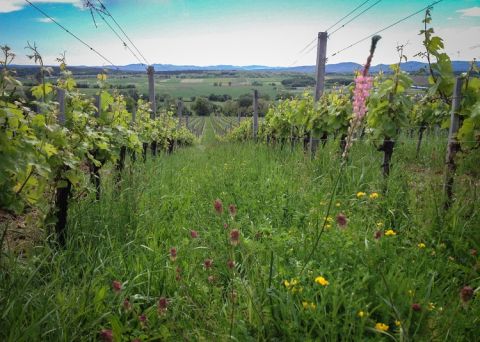
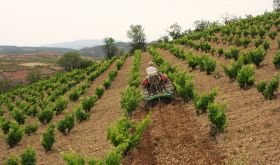
Their 'rage against the machine' campaign ensures that manual harvest is the norm and they do not buy in grapes at all. They experiment with different training systems, like pergola to off-set the effects of climate change. They do not use irrigation or much heavy machinery either as they make the soil compacted. What they use is the hard work and elbow grease of the permanent, local workforce who they support with a clever profit share scheme and regular communal lunches.
The cellars are natural, carved ones with minimal chemical cleaning and a low water consumption (less than 0.5 litre per litre of wine). For heating they use their own woods from their forests and thermal water. For cooling they use natural groundwater and the natural cooling effect of the basements and shading. They generate their own electricity with solar panels and use electric cars as well even for their regular deliveries. Their buildings are insulated with reeds that is abundant in the swampy shores of Neusiedlersee. Their bottles produced in Austria, with reusable beeswax capsules, boxed in recycled, specially folded containers instead of using plastic adhesive tapes. They even reuse their boxes and filler material too. They also support local charitable causes with frequent donations.
Franz Weninger firmly believes that less is more. The more you reduce and limit yourself just to the basics and the more restrictive your framework is, the better produce will emerge at the other end. That is why he uses no fining or filtration, minimal added sulphur before bottling. There is no lab on site either. They just go by taste and still able to produce age worthy, interesting red wines.
Somehow it feels that going carbon neutral and sustainable is very similar to going vegan. It is a practice that requires a leap of faith, mindfulness, thinking about the future and the way we lead our lives. One can realise that we need to give something back to nature to maintain a balance, an equilibrium. It is a complete, systemic change, a long and precarious process with no easy choices and definitely more, involving work.
In the current uncertain times of climate change, flash floods, scorching heatwaves and the raging pandemics possibly makes us more likely to put our money where our mouth is and just give it a go. It might not going to be as bad as we thought, and it may help the environment too. It hopefully will help to change our ways and leads us back to be in a more harmonious way with nature. The resulting wine well may be just as delicious, with a clearer sense of individuality.
Photos: are from the Weninger website as free downloadable pictures.