In the context of consumers’ rising awareness of climate change, sustainability is becoming an increasingly important consideration within viticulture and vinification practices, regardless of the size of the wineries. However, the multifaceted nature of sustainability enables wineries to choose to engage with it in the ways that most suit their unique business models. For example, the complete rejection of herbicide and pesticides might not be realistic for some big companies with broad fruit sources; these might decide to adopt the approach of social responsibility and care for stakeholders instead (see Concha y Toro sustainability report 2019). Sustainability’s breadth of definition does not make it easy for consumers to grasp how responsible wineries actually are: it is almost impossible to measure the good practices against the potential harm. Nevertheless, consumers, bombarded by all sorts of ‘sustainable’ messages from wineries, may be able to feel, through intuition, how sincere these messages actually are.
When tradition meets sustainability
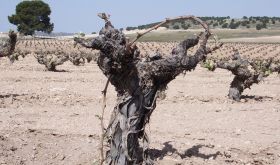
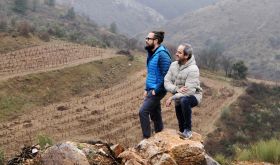
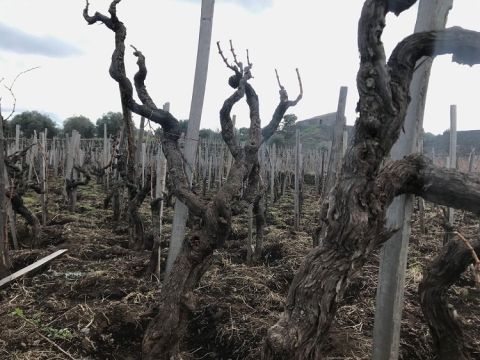
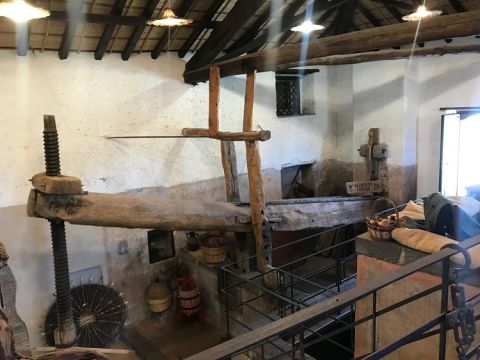
One winery that seems to embrace sustainability as a core value is Salvo Foti’s I Vigneri on the Etna, in Sicily. Salvo Foti is the wine consultant behind the early successes of Benanti (he worked with the winery until 2011) and Gulfi’s, among others. He is regarded as the godfather of Etna, who believes in the most traditional practices in the vineyard and the winery. Etna, Europe’s highest active volcano, situated in the North East of Sicily, has gradually entered the premium wine category of Italian wine, together with other regions such as Brunello di Montalcino, Barolo and Taurasi. While, the unique terroir has attracted investment from Tuscany, Piedmont and abroad, one indigenous producer stands clearly out: Salvo Foti and his project I Vigneri. He is widely regarded as the expert of Etna and the guardian of traditions. For example, he believes that Alberello – the traditional painstaking training system – is the best way for maximing grape quality as it enhances sun exposure and can preserve the longevity of the vine. He is one of the few, if not the only Etna’s winemaker, who still carries on using the Palmento system for vinification, an ancient equipment that includes a wide open fermentor and a screw press built with stone and wood. Although Sicilian authorities strict interpretation of European Union (EU) regulations has banned its use for hygiene reasons, Foti still sells palmento wine abroad and marks the wine as ‘experimental’ within the EU. The wine is clean and lively, in contrast with the ‘rustic’ palmento equipment. Indeed, somehow, the 2000 year old techniques employed by I Vigneri can be the perfect answer to the relatively modern concept of sustainbility.
Waste, soil health and more in the vineyard
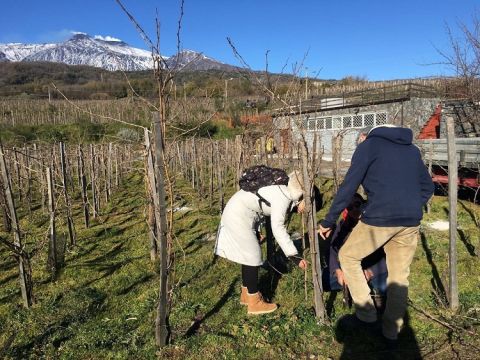
In the vineyard, Salvo and his staff are particularly conscious of potential waste production. Plastic is strictly avoided both in the vineyard and in the cellar. Instead of plastic, all branches and shoots are tied to chestnut poles with biodegradable twines. The implication of using strings is not the increase of a monetary cost but rather of a time-consuming one: since strings need to be tied one by one, it means that the operation involves a lot of tedious work that requires attention to detail. Musts are recycled to be used as fertilizer in the vineyard together with some sheep manure collected from neighbours' farms. (The use of the sheep manure from external farms is part of the reasons why Salvo Foti decided not to continue pursuing the organic certification. The sheep from local breeders, in fact, are unable to obtain the organic certification. However, he believes it makes more biological and economic sense to use local breed's manure rather than commercial organic manure.)
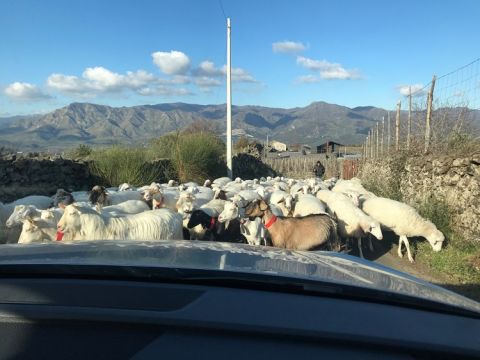
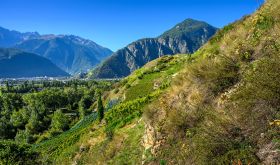
The soil health is also a great concern of the winery: Milo, the best terroir for the Carricante grape, is on the east slope of Etna, where sandy soils and 900mm of annual rainfall suggest a high risk of erosion. Hence, terracing is a must. Dry stone terraces were built according to local tradition, a savoir-faire, unfortunately, only mastered by few today. The winery actively maintains and seeks to increase natural habitats around the vineyards. Trees, woods, wild aromatic plants are preserved and planted to provide a habitat for bees and other antagonist insects. Apples, cherries, pears, hazelnuts, plums, and strawberries are also planted to reduce the impact of monoculture and increase biodiversity.
Energy saving in the cellar
Etna's climatic condition, slopes, and winemaking tradition helps reduce energy consumption in the cellar. The ancient palmento system, now abandoned by most wineries but not by Foti’s, is designed to harness the force of gravity for wine production. In fact, the pressing floor for white grapes, the fermentation and pressing floors for the red, the fermenting floor for the white and the cellaring floor are all on different levels (in this order top to bottom), making each one of them a different gravitational step. Wines are racked downstream by gravity. Besides, little energy is needed for temperature control in the cellar. The day and night temperature difference at 750m above sea level keeps the cellar cool most of the time. Additionally, the cellar is built with a ‘thermal labyrinth’ ventilation system to channel the cold North wind through the different areas. This is a great help in hot summers. The coolest part of the cellar is where barrels are located for maturation. This part is partially buried, north-facing, built with more than 1-meter thick lava stone to ensure good therm-insulation. Salvo also explained that, in order to save energy further, the winery uses pruned branches for home and office heating.

‘Human wine’ and local community
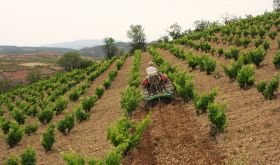
Although Salvo uses low added sulfur and low intervention, he prefers to call his wine ‘human wine’ rather than ‘natural wine’. ‘Human wine’ suggests the continuation with his ancestors’ practices, such as the use of the Alberello training system and the Palmento’s (old fashioned fermenting and pressing equipment without external energy input mentioned above). Beyond the traditional ways of growing and making wine, the term ‘human wine’ also captures the harmony and the relations of mentorship within the group of collaborators. All the collaborators are indigenous Etnei and many have been working in the winery for more than 20 years. The fact that all workers are recruited through direct relationships instead of intermediation means that the work group is like a big family. ‘Sharing personal knowledge is fundamental to our work’, explains Salvo. A high percentage of manual work not only reduces soil compaction, improves vine quality but also benefits the local economy. During my last visit in January, walking across the vineyard, I saw a group of local workers manually removing weeds and tilling the soil. They greeted me warmly as if they were receiving a guest to their own land. Salvo made a quick calculation for me: ‘in the vineyards with the Alberello system, per hectare, they [the workers] work 200 days a year (in contrast to the 90 days needed for the guyot system), with more than 80% of the work done manually. This means 80% of viticulture costs are returned to the local economy’. Salvo also sources all of his vineyard pruning tools and winery equipment from local craftsmen.
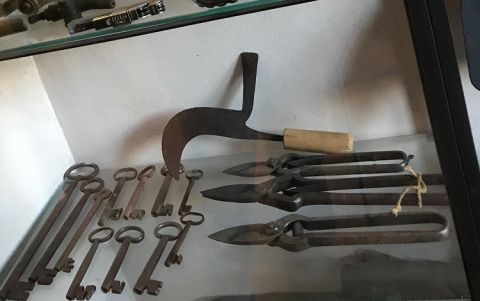
Salvo Foti is a pioneer in preserving old vines and traditional savoir-faire (palmento, alberello, terracing, etc) which he believes date back to 2000 years ago, while ‘organic and biodynamic viticulture principles came way after’. Although without any certification, his meticulous care in all aspects makes it hard not to believe that sustainability is at the core of his vineyard works, winemaking and relationship with the local community. One interesting fact is that during our conversations and email exchanges, Salvo never uses the word ‘sustainable’ to describe what he does. He might instead use ‘tradition’, ‘human’ or ‘integration instead of exploitation’. As wine lovers and drinkers, I think we do all feel the difference between a corporate marketing speech about sustainability and Salvo’s true love for the land.