The reality of climate change was particularly prevalent in 2018 when I visited the Western Cape in South Africa. Cape Town was literally counting down to ‘Day Zero’ when their reservoirs would be all but empty. Suddenly, in a city visibly marked by the harsh divide between rich and poor, everyone, whatever their social and economic status, was facing a future without access to water. My love of wine had left me with a crisis of conscience: vines need water, but are the vineyards of Stellenbosch, Paarl and Franschhoek part of the problem?
Armed with this and many more questions about South African wine I headed to Waterkloof wine estate, a certified biodynamic vineyard in the Western Cape owned by Paul Boutinot, of the hugely successful wine import business Boutinot [which he sold in 2013]. In 2004, after a 10 year global search, Paul had found the perfect location for realising his dream of producing biodynamic wine. ‘Naturally low production levels must not be countered by the use of chemical fertilisers. The transformation from grape to wine must be gentle. The wine must ultimately reflect its origin.’
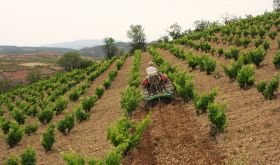
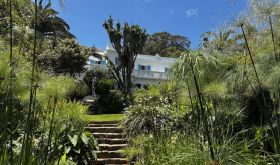
Located on the south facing slopes of the Schapenberg mountains, overlooking False Bay within a natural amphitheatre (see photo above), the first thing that hits you is the wind! This untamed force, along with the lack of rainfall, clearly creates challenges in this region. I ask Christiaan Loots, long term farm manager at Waterkloof, if he has to increase irrigation levels as a result: ‘During the last 3 years we [have] only irrigated 6-8 ha of young vines less than one season old. None of the other vineyard blocks received any water’. This is out of a total of 79ha under vine. Christiaan explains that at Waterkloof they practise ‘Dry farming’: a technique which promotes retention of the natural levels of water in the soil rather than resorting to irrigation. ‘We try to keep soil moisture for as long as possible by mulching our red cultivars with wood chips and compost. On the sandy soils, where we mostly have Chenin, Semillon and Mourvèdre, we plough underneath the vines, which locks in moisture and also cuts off the lateral capillary lines in the soil so evaporation is slower.’ Cover crops, nitrogen and potassium rich composts, and biodynamic preparations (known as ‘teas’) are additional measures that Christiaan takes to raise the carbon percentage of the soil, as carbon also acts as a sponge to hold more water.

The Waterkloof ‘veld’, the Afrikaans term used to describe a rural landscape, provides a backdrop rich in fynbos, the unique shrub and heath found in this part of the world. This has gained them champion status in the WWF Biodiversity and Wine Initiative and whilst this imposes a commitment to ensuring at least fifty percent of the estate is home to rare and indigenous flora, this is not just about paying lip service to conservation. They have learnt that by creating an environment that encourages biodiversity they are also providing a habitat for natural predators, in particular those that will eat the mealy-bugs that threaten their crops. This concept of encouraging local species over European ones is a relatively recent phenomenon. Traditionally, the local farmers whose heritage was European, not African, would plant trees that they knew from home. At Waterkloof, Stone Pine trees originating from the Mediterranean had been planted around the fields in the hope of pacifying the ferocious Atlantic winds. However it became clear to Christiaan that they did very little to curb the effects of the wind, and that in the face of the real threat of field fires they simply acted as a highly flammable fuel for the spreading flames. Over the years they have been replaced with much better suited indigenous varieties like Yellow wood, Witpeer (White pear) and Wild Olive trees. During recent wildfires, neighbouring farms were badly affected, exacerbated by the resin-rich pines, whereas Waterkloof escaped unharmed. In light of this, local farmers previously sceptical of their removal, are now considering doing the same.

In South Africa the term 'farm' is used more commonly than 'vineyard' and when you visit Waterkloof you really get the sense that you are in a working farm. As well as vines there are also goats, cows and horses, all providing manure, rich in potassium and nitrogen, which feeds into the composts used on the vines. The horses’ principal role though is to plough the fields in a gentle and sustainable way, particularly pertinent when talking about water retention, as it reduces compaction of the soil.
The winery has also been designed to have a low ongoing environmental impact. This includes a water treatment system that ensures that none of the sewage or water waste from the winery and restaurant discharges into the municipal water system. Instead, the primary effluent is treated on site in a safe and organic way. A system of tanks, sand beds and reed beds filter and separate the water and solids, resulting in clean water being fed back into the vineyard. The solid waste by-product, naturally rich in nitrogen, is used as fertiliser.

The production area of the winery is like a scene from a sci-fi movie, under the command of Nadia Barnard, the Cellar Master. This large concrete box is filled with 4m high stainless-steel tanks, so clean that they glint in the South African sun, punctuated by sleek concrete columns, pulleys, pipes and conveyor belts. Built over two storeys, to make use of gravity, this removes the reliance on pumps to move the juice and wine around, thereby also reducing the risk of over extraction or oxidation. Nadia’s low intervention winemaking compliments the efforts made by Christiaan in the field. Instead of using cultured yeasts for the fermentation she relies on wild yeasts that are naturally occurring on the farm. This can mean that the ferment can last weeks rather than days so commercially this has its drawbacks. As does the fact that yields, especially for the Sauvignon Blanc, can be as little as 3,000 tones per hectare, however Nadia feels that in this way they are making a wine that is truly representative of the place, the landscape, the culture, resulting in a full and honest expression of 'terroir'.
Through witnessing (and more importantly tasting!) the successful application of biodynamic principles at Waterkloof, I am convinced that this is the wine making of the future, a process that promotes and encourages nature’s ability to protect and heal itself. Christiaan refers to it as ‘symbiosis’, defined in the dictionary as ‘a relationship of mutual benefit or dependence’, an energy that flows through the vines, the animals and the people, that all help to create the wines we love to drink. It’s not a coincidence that Waterkloof has a cuvée called Circle of Life!