On one of the nicer days in April 2021 I took the six mile drive up to Bothy vineyards in Oxfordshire. Not the most romantic or adventurous sojourn in pursuit of old vines, but sometimes exactly what you’re looking for is on your doorstep and a little native investigation goes a long way. I’d realised that the vineyard had been planted in 1978, so on the off chance they had kept some of the old vines I got in touch with Richard, the owner and winemaker, and sure enough he told me they’d kept a row of each of the vines planted at it’s inception, this included Albalonga, Huxelrebe, Perle and Ortego, I was later to discover it also included one more vine which was right on the vineyards door step.
What I didn’t know until I got there, is after managing the vineyard for 25 years Richard and Sian had decided it was time to enjoy a retirement, so have planted a new crop on the estate and had removed all the more recent plantings of grapes in an attempt to fund their retirement. This made the collection of old vines all the more surprising. It was clearly an agonising choice to veer away from wine, and as we walked between the old vines (accompanied by Athos the Romanian rescue dog) we talked about the missing summers of a wine-makers life as they spend the nicest days doing the hardest work and the holidays that can only take place in the cool months when the vines are resting. But even then, we were stood between two sets of vines that had the laudable achievement of being older than me, with an excitable dog keeping our pace to a leisurely amble.
It hadn’t been a quick decision to take up the younger vines, but it was a familiar one. The climate had shifted. In 1978 bud burst would take place at the end of April, or the beginning of May. In 2020 bud burst had started at the beginning of April. A shift that would probably have been bearable if climates changed evenly, but on the 11th and 13th of May 2020 there had been frosts and the temperature had dropped to -5 degrees Celsius. This story was repeated to some degree for every vintage between 2010 and 2020, except for 2018. One vintage without bud brutalising weather out of ten simply wasn’t sustainable.
With all winemaking there is the balance of factors to maintain – from vineyard to vinification. The soil at Bothy is sandy, and bizarrely it is the second driest place in the UK, lying between three sets of hills that cast a triangle of rain shadows over the area. Richard was fairly sure the vines could have been un-grafted, although the original owner had grafted to be on the safe side. But with great drainage comes poor frost protection as the drier soils cool faster, so they had been highly susceptible to a decade of early budding and late frosts. Vintages couldn’t deliver enough wine to be sustainable. But obviously something made them keep the original vines from 1978.
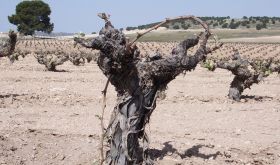
Wine makers are a subject of balance as much as the vineyard. They need a sense of romance, a good head for chemistry and a good memory; not just for their vineyard, but also for other regions and winemaking history. There are plenty of mistakes avoided because someone else has made them before. So when you look at a vine that’s survived forty-three years you see it as a link to the terroir, as a lesson from the past, and as an organism with a robust enough chemistry to have survived where others have withered, died or been swept away. The vines at Bothy are four varieties that were once the hope of a burgeoning English wine trade. The site has nurtured them through droughts, in fact the droughts of 2003 barely affected the older vines as they seemed to be able to draw from a water table that’s 20ft down. The local floods of 2008 didn’t impact them due to the excellent drainage, and even when it came time for market forces to change the direction of the land something about these vines enabled them to persist. Maybe they played on the romantic natures of Richard and Sian, or maybe they know that these old clones, these early pioneers of vinous plantings, might still have lessons to teach the next generation of growers and even become progenitors of new plantings.
I had expected to talk about the nature of the grapes from the old vines, whether they brought a certain uniqueness to the wine when they were used, what sort of wines they made or how different the flavours were to the younger grapes. We did touch on that, greater concentration, more elaborate and interesting flavours, a consistency in inconsistent years, all things that on a level most wine enthusiasts probably suspect. But mostly we talked about the preservation of history as an organism that had fed on all the years that came before it. Shaped by climate change and terroir and now the last link to a past that is becoming more different and distant. I’m not one for lauding the past as some vaunted idyll that we should all claw our way back to regardless of the improvements all around. I think we’ve made great cultural strides to level a playing field that was sent askew millennia ago, taking down or pulling up something old that’s in the wrong place, be it a vine, an assumption or a statue, shows that we can future proof and move forward. But the lessons aren’t forgotten, we keep a sample, because we can inoculate against further mistakes with a dose of what has been before. There are plenty of mistakes avoided because someone else has made them before.
These old vines at Bothy remain, and the grapes will grow and may even end up in the blend of some urban winery or nearby wine-makers cepage looking for a small quantity of old vine je ne sais quoi. They are not gone, and they are not forgotten, in fact the moment I thought to look for old vines, I looked on my doorstep and there they were.
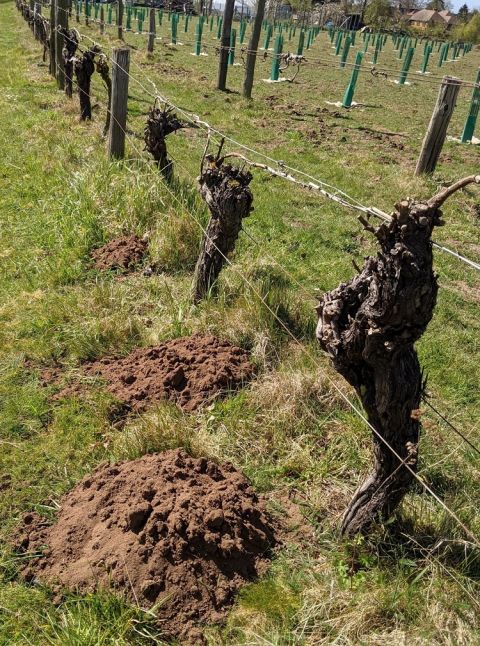
As we proceeded circled by a gregarious canine, back towards the gate we came to one more old vine, pretty much on the door step of Bothy Vineyard. It was a tangled crescent of old-wood set apart from the rest of the vineyard. It had been planted back in the 70’s by the original owner. A local botanist in Abingdon knew of a local grape variety that was grown on the walls of Abingdon Abbey, and had been for centuries. He brought a cutting to the vineyard and they planted it. It had persisted for the next forty-odd years. In the 90s it was genetically tested to try and identify it, but it didn’t match anything that had been documented at the time (maybe there would be better luck now). This vine plucked my romantic notes, and when Richard offered me a couple of cuttings I felt like a kid in a candy shop who’d just discovered the sample tray. There’s something attractive about the mysterious and persistent, the rare and in need of rescue. The idea that there may only be one of these vines left instantly made me want to be a part of saving it. Much in the same way that the dog (that was still sitting on my feet to try and keep me close at hand for head patting and general cooing) plucked the romantic inclinations, having been rescued and was now obviously thriving and social. The vines weren’t so different. With the right mix of care and nourishment they were thriving, and wine has a social aspect that can’t be denied.
Old vines can be unloved or un-appreciated, they can be seen as un-profitable or outdated by some. Others see them as important, even if they aren’t going to be a part of the immediate future, they are worth keeping around as museum stock, to look back, learn from, graft from, grow from. They can offer a variation on the available genetic stock that persists as a monoculture in some regions, it’s not hard to imagine a day in the near future where having a catalogue of genetic diversity could prove invaluable if a pathogen sweeps through the limited varieties to hand in some areas. Or if the weather becomes more variable, then the lessons from vines that are robust enough to survive the meteorological whims of a warmer era could be drawn upon to safeguard other, younger vines. I had expected to talk romantically about the importance of variety in wines when I set off on that April morning, but by the time I got home and planted two cuttings in a south facing orientation I had decided that the vines themselves held an importance beyond flavour, or beyond wine production. They represent a history that winemakers will need and they are the protagonists in a story that’s yet to be fully unravelled.
Photos provided by Sam Hellyer.