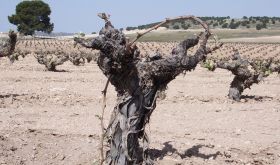
The first time I visited the Clos des Capucins in Chinon, France, there was a distinct spirituality that was sticky on my skin and on my mind—of which the 60 to 90-year-old Cabernet Franc vines were the self-appointed guardians. Not soft and dharmic in nature, but rather hard-edged and weathered, these vines made it clear that it would take many a visit, many a tasting of vigneron Fiona Beeston’s Clos des Capucins, for me to comprehend the secrets they held.

I had visited countless vineyards across the world before, as the writer-daughter of a wine connoisseur, but few had left me with such a gnawing curiosity to dig deeper below the surface of the terroir to discover what stories fertilised the light sandy-clayey topsoil and compact chalk subsoil, tuffeau, in which these vines had taken root.
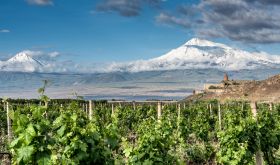
From its beginnings, an ardent faith was sown into the soil of the vineyard by the Capuchins, who founded their convent on this parcel of land perched above Chinon after receiving permission to establish themselves in France in 1574 by King Charles IX. Situated opposite the former French royal court and surveying both the town of Chinon and the river Vienne, the Capuchins planted their roots at this precise location not solely for the million-franc view, but for its strategic position as a foothold to curb a growing population of Protestants in the region.
As the old vini-adage goes, ‘to make exceptional wines, the vines require an exceptional view’—and the Capuchins were most certainly looking for a plot acclimatised for winemaking. As the most rigorous and austere of the three masculine orders of Franciscans, the Capuchins saw winemaking as a continuation of their daily prayers: the routine, the rhythm, the devotion required was a tactical translation of the principles of primitivity and penance preached by St. Francis of Assis. Still today, as you walk the empirical rows of precisely placed vines in each of the four plots comprising the vineyard, the religious sense of constancy and commitment echoes strongly.
During my visit, I was shown into a rather foreboding cellar hidden deep below the front lawn—one of the few structures remaining from the original Clos. Bunkerish in nature, the cellar was fraught with silence, as though the slightest movement risked shattering the tension held tight by a thousand secrets guarded within.

My intuition wasn’t entirely amiss: research confirmed that the Clos played host to the original Gray Eminence, Père Joseph, during the 1610s. A devout Capuchin, Père Joseph was the right-hand man of the nefarious Duke of Richelieu, chief secretary to King Louis XIII of France. Pacing between the vines of the Clos des Capucins, the Gray Eminence would scheme in secrecy his tenacious conversion of heretics (Protestants) as part of Richelieu’s larger plan to cement French domination of Europe during the bloody Thirty Years War. Such dark secrets never quite clear the air… or the terroir…
As with all religious edifices, the Clos des Capucins would be dismantled with the French Revolution: the goods were seized, the eight remaining monks dispersed, and the property sold off. Little was recorded of the production of wine until the 19th Century, when the Clos was converted into a hospice run by the Hospital Sisters of St. Augustine. An agreement from 1867 indicates that the nuns would receive a reduction in rent in exchange for barrels of wine they produced at the Clos. Archival documentation shows that at this stage both red and white grape varieties were present.
In 1889, a certain Charles Moreau sought permission from the local administration to pull up the vine stock at the Clos. Did this mark the arrival of phylloxera in the Clos? Whilst no official documentation can confirm the reasons as to why the vines were ripped up, it certainly marked the end of a tumultuous era where secrecy and spirituality snaked between the vines.

The current Cabernet Franc vines were planted between 60 and 90 years ago (no doubt to replace those ravaged by phylloxera) following a similar plan across 1.5 hectares as that mapped out by the Capuchins 400 years before. Although wine has been produced consistently at the Clos throughout the past century (who wouldn’t want to try their hand at winemaking in such an idyllic setting!), the vines have also survived thanks to a terroir fertile both in memories and an incredible biodiversity. Each of the four plots is surrounded by fruit trees, gardens, hedges—contributions from the various hands through which the Clos has passed throughout time. In this sense, the current ecosystem is not only a conversation between the elements, but also with moments of history.
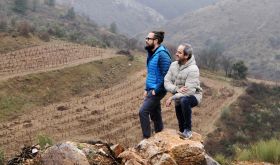
It’s almost as though these old vines have been patiently waiting for a vigneron they trust to help tell the secrets that have laid dormant in the soil beneath them. Someone who would respect the lessons they have to teach, the spirituality ingrained in their terroir. Someone as pensive and contemplative as Fiona Beeston. She explained, “I am constantly learning from the vines. They tell me what they need.” Working alone, Fiona navigates the vines in a meditative manner: listening to what they need to best express themselves each year, and not the other way around.

During a winetasting of the Clos des Capucins, I was struck by how Fiona spoke of each vintage with such individuality. It resonated with me as a tender recognition of how old vines accumulate such complex personalities across the decades, sometimes centuries, that you can’t expect them to reveal all the secrets of their terroir in every vintage. Where would be the fun in winemaking (or wine drinking, for that matter) if it were as simple as that?
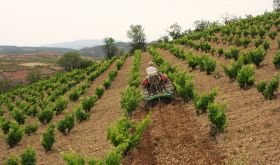
At the Clos, wild flora is allowed to bloom throughout the vineyard; a plough horse is brought in for light tilling only when the weeds get out of hand. The vines are hand-picked and hand de-stemmed with the resulting grape juice left to ferment in a large oak vat. The wine is then aged in second-hand oak casks for up to two years in the same chalk cellars used by the Capuchins. The traditions established over 400 years ago live on today…

The more I delved into the history of the Clos des Capucins, the more the osteal Cabernet Franc vines took the shape of those who tended the soil in which their predecessors grew: the dutiful Capuchins, the steely Revolutionaries, the attentive nuns. Just as the footsteps of Jeanne D’Arc still echo in the cobbled streets of Chinon below, the memories of the previous lives of the Clos continue to whisper amongst the current ecosystem of terroir and vines. These old vines have a lot to teach us, if we are ready to listen.
The photos are provided by Madeleine Rothery.