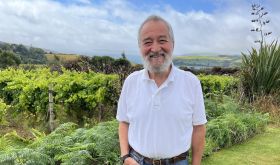
Aiden Carroll writes Aiden Carroll is a freelance writer based in London. Originally from the US, he enjoys exploring intersections of food, farming and queer identity. Alongside writing, he is currently working as a Data Intern at Liv-ex.
***
The swollen grapes drop heavily into my palm. The snips of the secateurs are satisfying, crisp like the autumn air that fills my lungs. The harvest is an easy rhythm, one which dulls the senses. As my hands glide freely from bunch to bunch, the conversation flows similarly. I speak into the vines, my words briefly mired in the dense foliage before reaching my partner on the other side. I can’t see their face, but the sounds of shuffling and snipping tell me they’re there. I speak, I wait, they speak, they wait. It’s a familiar cadence.
Kneeling before the vines, the shoots and leaves crisscross in a screen before me. For a moment I’m back in the confessional, whispering sins into the cedary air of the wooden box. I’m desperate, praying that absolution might squeeze through the holes in the partition and swathe me in peace. And yet, despite these memories, this moment in the vineyard inspires a sensation I’ve missed. Not the fear nor the guilt, but the candour. There’s something liberating in the act of the grape harvest. Perfectly balanced between focused and mindless, it demands presence and not much else. The fresh bunches between us could be empty bottles - our minds and tongues flow uninhibited all the same.
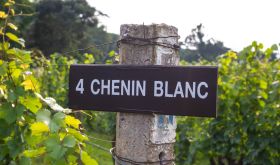
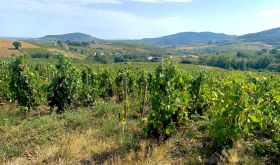
At Frome Valley Vineyard in Herefordshire, grapes are picked in pairs. Even the largest bunches can be missed, hidden beneath the dense canopy. Picking between two people ensures that no grape is left on the vine - an important precaution for a vineyard of only 1.5 hectares. Owner Jeanie Falconer assigns these pairings, placing friends old and new on either side of the vines. To the naked eye, these might seem random. But Jeanie is calculated, deciding in a moment which two souls might benefit from intermingling. My first partner was an Irishman, an ex-entrepreneur who told me about his days in the IT boom and how burnout brought him to the countryside. My second was a travelling spiritualist: a nomadic writer who gave up looking after haunted castles to till the land. The third was a mechanic looking for a weekend away, the fourth a painter repaying a debt. On and on, the parade continued. As our souls emptied and our baskets filled, honesty came effortlessly. Finally, I found myself across from Jeanie.
17 years ago, Jeanie took over Frome Valley Vineyard and the 10-year-old vines that came with her new home. While she had no experience with grapes, she carried with her a lifelong career in cultivating human connections. Former director of the European Public Policy Advisors in Brussels, she was at the forefront of international strategy during the fall of the Berlin Wall. Her work involved reaching beyond geopolitical and cultural borders. She listened to and advocated for individuals across a still-fractured Europe, picking up French in the process.
Her life reads like a travel guide: teaching in Turkey, scuba diving in Cuba and raising her three children in a tiny flat in Paris. She’s a voracious reader - books pour from every crevice of her home, bursting from the eaves. My first night in the guest room, I looked up from my bed to see the wooden beams above me lined wall to wall with classics. The literary greats gazed down at me like an infant in a crib. Food is likewise in abundance. Her farmhouse kitchen is equipped with everything but a microwave. Leftovers are repurposed, roasts eaten cold with one of the dozens of homemade jellies in the cellar. Most dishes are so delicious there are no remnants. Her roundabout driveway is like a carousel of neighbours and guests, stopping in for deliveries, orders, appointments or otherwise. Call it ethos, call it civic duty, call it Sagittarian instinct - Jeanie is motivated by a pure curiosity in the human race, an adventurer who understands that the world can feel devastatingly large and small all at once.
While 1.5 hectares might not seem like a lot, Jeanie has maximised her space and impact. She and her husband Ian moved to Herefordshire with a dedication to treading lightly on the land they raised their family upon. They tend an organic potager, which heaves every summer with vibrant rows of rhubarb, runner beans and rainbow chard. Their home is heated by a biomass boiler, and the back garden is brimming with native species of flora and fauna. This lifestyle extends to the vineyard, too. Each season’s vine prunings are reused for mulching and the boiler. Jeanie fertilises using biochar, organic material that’s been carbonised under very high temperatures. In fact, thanks to a grant from Sustainable Wines of Great Britain, she is leading one of the first major studies on biochar in vineyards in the UK. Needless to say, her life is quite busy. When her youngest left for university last summer, she turned to the WWOOF network in hopes of finding help for the growing season. Desperate for a week away from the sturm und drang of London, I’d done the same. We connected, and shortly after I found myself on a train out of Paddington.
***
I chop heaps of shallots and mushrooms on an old wooden board. The mixture of olive oil and butter sizzles in the pan, a trick she taught me to keep it from burning. Distracted, we chat about books, films, people. I run out to grab herbs from the garden while she mixes a salad. She tells me to use kitchen shears but I pluck the sage and thyme straight from the stems, getting the oils on my fingers. I press my palm to my face and inhale deeply as I sneak back inside. She’s poured me another glass, something from an unlabelled bottle. It’s tart and feisty, a satisfying prickle on my tastebuds chased with a cool minerality. I toss in the herbs with the arborio, deglazing with the same bottle. Another glass for her, a few more drops for me. She gestures to the cellar with a wink - I run out again.
I didn’t care much for white wine before my time in Herefordshire. With parents who met and fell in love to the tune of Cabs and Zins in Paso Robles, my adolescent wine education started (and ended) with the understanding that good wine punched you in the mouth and drew blood. I realised quickly that if I wanted to enjoy the (literal) fruits of my labour at Frome Valley, I’d need to expand my palate.
Over the past 17 years, Jeanie has experimented with several grape varieties in an attempt to find the right fit. Herefordshire lies at a northerly latitude unique even for UK viticulture (about 52° N.), nestled near the Welsh border amidst the rolling Malvern Hills. Cloud cover and rain are typical fixtures of the growing season, making ripening particularly difficult. Even Pinot Noir barely manages a pink tinge. Today, Jeanie grows mainly Germanic white varieties (Huxelrebe, Bacchus, Reichensteiner), which fluoresce delicately on the vine and the nose. If there were a UK equivalent of the Provençal garrigue, it might resemble Jeanie’s garden: hints of elderflower, heather and wild blossom overlaid with the not-unpleasant aroma of a grazing pasture. The scent of the flowers wafts throughout the vineyard, where the family’s flock of Wiltshire Horn rams mow the native grasses between the vines.
The vineyard borders the Falconer family’s small orchard, which they employ in brewing their own apple juice and cider. The varietal aromas of apples and pears in Jeanie’s sparkling wine are so distinct they inspire fantasies of the vines and fruit trees uprooting themselves under the cover of night, cavorting under the stars like the faeries of the Malvern Hills. The sparkling wine is made in the traditional method, fermented dry and aged in-bottle for a crisp, spritely finish. There’s a pastoral refinement to these wines, almost like a Beatrix Potter drawing - a familiar portrait of the countryside with just a touch of whimsy.
***
We’ve spent the evening in the garden, tasting the most recent vintage. Jeanie is surrounded by friends, sharing in a humble banquet of produce she’s plucked from the earth that morning. She talks about biodynamics in her vineyard, how the sap in the vines is drawn up and down with the waxing and waning of the moon. It reminds me of the little I know about astrology, the moon’s influence on the ebbing of our internal tides. Jeanie wants to hear her chart. A Sagittarius - an explorer, insatiably curious. On a lifelong quest for knowledge, troubled and motivated by the understanding that we are ultimately finite. Interested in everything and everyone. We toast - another empty bottle. The next full moon is in two days: biodynamics tells us to sow seeds, astrology to release what is unwanted. We all ready ourselves for growth.
Jeanie is a follower of the biodynamic calendar, a lunar almanac that incorporates constellations and planetary alignments. The calendar indicates optimal planting times for various crops, cycling through the four umbrella varieties of flora: fruits, roots, flowers and leaves. Like fire, water, earth and air, the four continue in an uninterrupted cycle of waxing and waning influence from the cosmos. While there is some science behind it, it’s also quite spiritual. Biodynamics, like astrology, provides context. Neither is necessarily essential for growth. But it’s an opportunity to tap into something deeper, to recognise our place within an ecosystem. We need only to look so far as terroir in wine to recognise the fruit we bear is not flavoured by our labour alone. We’re tinged by the soils we root in, the rains that befall us and the days and nights we endure.
Like many others, my first memories of wine were at church. I’d let the wine touch my lips, eyes shut tight as I’d wait for the flood to burn my tongue and cleanse from within. In spite of this, Jeanie taught me how to drink - wine and life - in ample sips. I stepped away from religion years ago because of dogma, but I’d been missing some degree of spiritual fulfilment ever since. I never thought I’d find it on my knees before a wall of vines, or anointing myself with oils from the herbs outside the kitchen window. I felt renewed every day, nourished by homegrown communions and cleansed in the Herefordshire rain.
I think that Jeanie looks at the vineyard as an opportunity to see the world - the massive world which she has striven to make an indelible impact upon - as something tangible. Frome Valley Vineyard is a small but significant centre of biodiversity, a microcosm with human connections that tangle and entwine like the tendrils of her vines. It’s no surprise that Jeanie sees the vineyard as rife with opportunity. She might not have come from a life in winemaking, but she understands better than anyone the benefit of blending to create something more complex and enriching.
The Falconer family cider is cheekily branded as Pelerin - the French term for a peregrine, the king of falcons. Funnily enough, pelerin also means pilgrim. Jeanie spent so much of her life wandering the world in the hopes of understanding it just a little more. Today, she’s established a space for others to do the same. My train out of Paddington, once meant as an escape, is now in hindsight more of a pilgrimage. The harvest Jeanie convenes is a global crossroads, a gathering of souls who have journeyed afar for the grapes that can liberate your mind before they’re ever fermented.
It would be poetic to anoint the vineyard as Jeanie’s final stop, to see a lifelong journey of adventure end at a humble garden gate. But that Sagittarian instinct burns incessantly. There are always new roads ahead. For as long as she’s here, though, the harvest will continue. And you can trust that someone will be there, just beyond the vines.
Image: Vectorig via Getty Images.