Melanie Webber writes Melanie Webber is a certified wine educator and wine writer who helps wine industry professionals achieve their wine certifications and wine lovers deepen their appreciation and understanding of wine. She holds the globally-recognized Diploma in Wine and Spirits from WSET as well as the French Wine Scholar and Spanish Wine Scholar certification from the Wine Scholar Guild and is certified by the Wine & Spirit Education Trust to teach WSET Level One, Two and Three Awards in Wine. Melanie’s MWWine School is an approved program provider of Wine Scholar Guild and WSET courses in Asheville, North Carolina and San Luis Obispo County in California. Melanie has helped hundreds of industry professionals and wine lovers achieve their certifications. Melanie writes about wine under the BottlePoet handle, and is part of the founding team of the world-renowned Garagiste Wine Festival.
Finding Wet Stone
Why My Favorite Wine Person is the Wine Student
This spring, days after organizing my late brother’s memorial service, I was in Asheville, North Carolina preparing, with a heavy heart and little enthusiasm, to teach a WSET Level One Award in Wines class. In fact, the wind had blown so far out of my sails in my grief that I was not even sure I wanted to keep teaching wine classes.
Then, I received this in an email from a student who had attended my WSET L2 Award in Wines class in Paso Robles, California a month earlier: “Wet Stone! I found it! I finally found the smell!” Attached to the email was a picture of her feet on wet flagstone.
I had been running the class through a tasting of Chablis, when she had asked “What is wet stone and how do you smell it? How do you taste it?” It is a difficult question to answer, especially given the controversy around minerality. We discussed how sometimes the ‘given’ vocabulary for wine just isn’t enough, how blackcurrant and gooseberry have little relevance for the non-British wine student (I reference crème de cassis or a leafy blackberry for blackcurrant, and the pungency of cat pee for gooseberry, but neither is really adequate). And, we agreed, that given how euro-centric so many wine descriptors are, a broadening of those cultural horizons would not go amiss in today’s wine world.
As we talked, a gentle rain started to fall outside, and I suggested that the students go out and have a smell. But the rain was too diffuse, the Paso air too warm and muggy, and the asphalt too tarred to find that slick, electric, rocky aroma that, once you find it, sings out ‘wet stone’. For this student, it just didn’t resonate.
So, it was a joy to receive her email. She was ecstatic that, with her feet firmly planted on wet stone, the dots connected. Her epiphany, supported by her new wine knowledge, she said, would help guide her as she inventories her late father’s extensive wine cellar. My hope is that it will help her form a new connection with him, even though he is no longer here.
And there it was, just like that. My favorite wine person. The Wine Student.
In fact, the Wine Student has been my favorite wine person for the last 5 years, ever since I taught my first wine class. Whether it is the newbie whose world has just opened up into the panoply of possibilities one ruby-tinged glass can offer or the industry pro, elbow deep in winery/vineyard work, who well knows those possibilities but wants to open the wine aperture wider.
A day after I received the wet stone email, I visited a newly-opened North Carolina winery. A tiny jewel nestled in its own emerald green valley, ringed by the Blue Ridge mountains, the winery grows and vinifies Cabernet Franc, Gruner Veltliner, Saperavi, and more. It was the middle of the week, and a few customers were sipping wine in reclining wooden chairs, admiring the brash red roses at the end of each vineyard row. We were greeted by the winery’s tasting room manager who, to my surprise, was one of my students from a class I had taught a few months earlier in Asheville. She had lived her whole life in North Carolina and knew nothing about wine when she joined the winery to help run their marketing, branding and tasting room. My class had helped open up the cellar door for her, quite literally. She poured an impressive Gruner Veltliner and a shimmering Cabernet Franc and there it was again, my favorite wine person: a student fresh to wine joy, in her home state in a sleepy hollow transformed into careful rows of vines reaching for their moments of clarity toward the sun above those smoky mountains.
A couple of years ago, my WSET Level One Award in Wines class in Paso was still in partial pandemic mode: students masked, noses locked out, desks far apart, windows wide open and fans whirring. There, perched at the front of class behind a mask, was a pioneering Central Coast winemaker that I had known and admired for years. A winemaker for a major brand, she had made a name for herself with her own label through her brilliant crafting of Carignan.
“What on earth are you doing in my level one class?” I asked, “surely this is far too basic for you?”
“Part of my job is to be able to communicate well about wine and that is why I am here,” she said.
I always confess to my students, many of whom work in the wine industry, that in spite of the fancy titles after my name, I am ‘travel and book learned, glass-by-glass,’ and have not spent hours working hands-on in a vineyard or winery. So, it is a little intimidating in a class that starts with the simple exercise of peeling a grape to explain the components of wine – acid, sugar, tannin – and what wine balance means, to have an award-winning winemaker taking notes in the front row. This particular class had a proportion of Gen Z cellar rats, young men who were Natural Wine evangelists, eager to display their knowledge, fueled with the bravado of their gender and, eventually, humbled into discovery by the enormity of the ‘winecylopedia’.
The winemaker, on the other hand, quietly absorbed the class, taking advantage of the opportunity to view wine from a different perspective, through a different aperture. Unpretentious, always curious, and retaining the strength of her convictions, she excelled through WSET Levels 1, 2 and 3, challenging and sometimes stumping me with questions, but never once making me feel inadequate, and always glad to share her hands-on knowledge with the other students. Through almost every wine region of the world, and over 130 wines tasted, nose to palate to language center in the brain, the dots connected, and a common language developed. Sometimes we sang in unison, sometimes she struck brand new chords, but it was always a sensory symphony of discovery, deepened by the individual experience she brought to the tasting.
My Wine Students. My favorite wine persons.
As ChatGPT’s rapid ascendency threatens to throw language into generic boilerplate, stealing the bumps of educational discovery out from under us, there is something pure and true about what happens when a wine student first unravels and deconstructs what is in the glass, gaining confidence to describe those aromas/flavors in a way that reveals and elucidates. Unlike AI, it can only happen in that moment of smelling and tasting, because it has to, and it is a moment that can be, well, simply poetic.
This is why I will never pull that delight of discovery from the lips of my students. If they are smelling blue cheese in a glass of Cabernet Sauvignon, carrot peelings in a glass of Sauvignon Blanc, or crushed emerald dust in a Verdicchio, who am I to deny it?
While I work to calibrate our common language, it is that discipline which leads to breakthroughs that inch that language aperture wider. When I was training as a stage actress, many moons, ago, I was told – “learn your lines to forget them,” make them such an organic part of your sensory system that when you are onstage you fly into the life of the character. So it is with the discipline of learning wine language – a foundation that is there to support epiphanies for students, who can then let those words soar.
For many of my students, these classes are their first time ever tasting a Tokaji Aszú or a Fino Sherry. The way their wine language takes flight as the finish of a Tokaji Aszú lingers, changes, moves Carpathian-size mountains of flavor across their palates or the way the sharp, briny, nuttiness of a Fino Sherry swims upstream to make a newbie’s nose shrivel, even as he/she objectively assesses it as good quality, makes me feel like I am experiencing those wines for the first time.
My Wine Students. My favorite wine persons.
There is something transformative in a wine class. The world outside disappears as each student finds centuries in a glass or the cracking pop of a new age sensation. In a wine class, politics don’t matter, identity doesn’t matter, nothing matters but sensory experience informed with the hard work of memorization and analysis.
I tell my students that if you are used to being the smartest kid in the class, able to wing it across subjects – wine education will bring you down to earth and then send you airborne. You cannot learn wine without memorizing, without connecting multiple dots, nor can you learn wine without opening up the aperture, and letting the mystery in.
And so, seeing that aperture open for my students helps me, offers hope that I too can let light in on the darkness of grief. I taught my first class in the wake of my mother’s death and now, as I am preparing to teach across the rawness of the loss of my brother, I am reminded of how much my students have to give and how redemptive teaching can be. How, like a glass of wine, it can transport. How comforting it can be to lead a student into that joy of discovery, of that wine, cultivated from the ashes, risen through earthly deposits of thousands of years of humanity and matter, continuing an eternal cycle as new life strains up from old, through walls of ancient rock into lush, purple jewels….
And how it can speak to the fresh zing of a raindrop on a metamorphic rock, or on a modern flagstone, felt and tasted and smelled in a glass today….
The smell of wet stone, finally found.
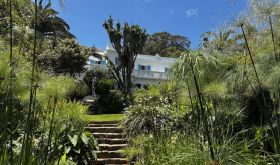
The photo is by Athena Nash.