Sarah Jackson writes Sarah Jackson qualified as an architect and is a townscape consultant in London. She writes about urban landscapes and leads architectural walking tours, focusing on townscape, infrastructure and contemporary architecture. Sarah has no formal wine qualifications but enjoys trying to learn.
Treasure of the walls
Ode to Chasselas
I had the perfect introduction to chasselas – a chance tasting flight at Les 11 Terres, a community wine bar in Epesses. I was in Lavaux for the walls, walking the terraces, enjoying the views. It was an overcast April day; I had had too much sun and needed a rest in the shade.
Three small glasses of white. Why not? The first crisp and refreshing, the second bigger, cleaner, the third richer still, apple-ier almost, with a slight fizz on the tongue. As soon as I had the next, I forgot the last – poor taste memory – but each was delicious, each notably different, and definitely wine I wanted to drink again.
Julien brought out the bottles – Epesses La Perreyre, Calamin Saint-Paul, Dezaley Chemin de Fer – each made within a kilometre from where I was sitting. This is wine miles zero, hyper local wine borne from the lands I had just walked through. I scanned the labels to find the grape varieties. Julien laughed, and, eyebrows dismissively raised, “Chasselas. All chasselas.” Of course. And before I could question him further, “It’s the terroir…”
Mmm terroir. Terrifying. I get that terroir is the alchemy between soil, topography, climate and craft, a form of intuitive knowledge for those who work the land. But I simply don’t understand how the same grape, from the same place, with the same weather, with similarly skilled makers, can produce wine of such variety.
Back on safer territory, and back to my specialist interest and reason for being in the world heritage site of Lavaux. Walls. Walls and heritage, even better. Add wine, bingo. I’m an architect, and I spend a disproportionate amount of my time thinking about walls.
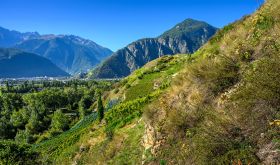
Lavaux is all wall. I am mesmerised by their extent and ingenuity. The land is steep – sometimes 45-degree steep – and the walls work impressively hard, retaining pockets of vineyards behind. They were built by monks from the 12th century when they cleared the wooded slopes and terraced the land. Terraces follow the contours, the steeper the land, the more numerous the walls and the tighter the mosaic of productive soil. It’s a complex visual landscape. Look up to a defensive cliff, look down onto fresh green fairy steps, skipping to the lake. And the view. Always that view. A ridiculously beautiful stop-stare view of the mountains, the sky and Lac Leman.
But up close, Lavaux walls are a bit of a mess. The stones, a dolly mixture mishmash deposited by the Rhone glacier as it carved out Lac Leman, are rough cut, slap dash mortared, often concrete patched, with no regular coursing or uniform coping stone. My assumption that a 900-year-old stone walling tradition would have a level of craft consistency was misguided. It’s not what Lavaux walls are about.
“The walls are the very treasure of the winemakers” emphasised Laika, as we walked the walls the next day. It was early in the season – a good time for walls – maintenance had been done (“it’s a winter job”) and the vines were thin enough to see the bare bones of the terraced land. Laika works for Lavaux Patrimoine Mondial, an organisation that supports the UNESCO world heritage site, and she helped me see the walls in a different light.
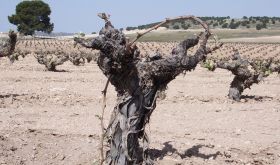
Chasselas is everywhere. It is too early for grapes, but the vines are bursting with promise and hope. New growth chasselas leaves are lusciously thick, almost reptilian, with an orangey copper tinge. The vines had just had their first guyot prune and were stretching out sideways along wires, flaunting, shimmying, maximising their exposure to the sun and breeze.
“It’s a shy grape,” claimed Laika, “chasselas takes its personality from the soil.” We walked past a huge slab of puddingstone or poudingue. It looks like a rough stoney concrete, and it sort of is, a geological concrete, a conglomerate of alpine pebbles cemented by a silica glue. Puddingstone is the bedrock of Lavaux, and its distribution creates natural boundaries and influences the composition of soil and its depth.
Through Dezaley, past the two former monastic barns, Clos des Abbayes and Clos des Moines, home to the original forest clearing, wall building, vine planting monks, past bands of exposed puddingstone, past the most cliff like of terraced walls, pulsing out heat from the sun. It is severe and austere – Dezaley comes from the root word ‘desolate’ – and the soil here is poor. The land is demanding, but forcing the grapes to work hard reaps reward; this is the territory of Grand Crus.
We walk on, towards the concrete scar of the motorway and railway, towards the tight, red roofed village ahead. At the end of a diagonal puddingstone sweep, Laika points towards the skyline. “Follow the water channel line down from the Tour de Marsens,” Laika waves her arms, my eyes follow, “we’re crossing into Calamin.” Another Grand Crus. “There was a landslide. It brought soil which is clayey and deep.” The soil looked just the same to my urban eyes, but it was noticeably puddingstone free, and the landscape had subtly changed; it is wider, softer, more open. There are fewer walls. It is less steep.
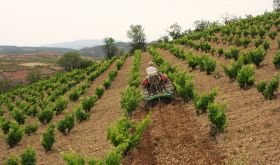
We walk up community plots, through a gate to the playground, to the centre of Epesses. Laika nodded to a man in a tractor,“15th generation,” she said. Pressure, I thought. There is obvious continuity here, but it’s tough, and not all either want to, or can, live off the land. Growers and makers own and rent small plots in multiple places. Some still grow vines in bare soil, but others encourage companion planting of lush greens. Viticulture practice is evolving to reduce monoculture, but Laika admits “it takes a generation for things to change.”
Back to Les II Terres, to a celebratory glass of Chemin de Fer. Salut! It is buzzing. Julien busy pouring, growers, makers, drinkers chatting – a community lifeline, a hub where ‘chasselas is king’. Salut to chasselas, to terroir, to Les II Terres! Treasures of the walls indeed.
With thanks to Laika Collinassi Michot from Lavaux Patrimoine Mondial, and Julien Spielmann from Les II Terres.
The photo is the author's own. Caption: 'Chasselas is king, Les 11 Terres, Epesses'.