
When John Szabo MS asked the team at JancisRobinson.com if we’d partner with him on his annual Volcanic Wine Awards, we admit to being initially sceptical. Volcanic soils come in so many types, and appear in so many places, and the grapes grown on them are interpreted by so many different people, that it seems a bit like a fool’s errand to try to qualify what exactly makes a wine ‘volcanic’, or if there’s even such a thing.
But then when we thought back to some of our favourite wine regions – Santorini, Etna, Tokaj, Walla Walla and the Willamette Valley, the Mayacamas, Madeira, Pico, the Canary Islands …
Well, at least the tasting wouldn’t suck. It would in fact be something to really look forward to.
And so, we signed on. Josh Greene, Corey Warren and Colangelo & Partners in NYC got to work behind the scenes gathering wines and setting up the tastings. Then, for three days in February, Szabo, our own Sam Cole-Johnson and I sat down with some of the best sommeliers and wine educators in New York and tasted through 267 wines, all presented blind by region, to see what we could find out.
What makes a wine volcanic?
There’s really no such thing as a volcanic wine; there are only wines from volcanic soils. And the world of volcanic soils is endlessly diverse. Some volcanic material seeped from the earth (igneous rocks, in general); others were spewed violently into the air (pyroclastic rocks); some is on the side of volcanoes, and some is miles away from any known volcanoes, having been moved there by river or landslide, or other catastrophic land-reshaping occurrence.
And yet (to quote Jancis) …
As we tasted the wines – silently, in flights of 4–6 wines – and then talked about them, some descriptors kept coming up, whether we were tasting Garganega from Soave or Furmint from Hungary, Cabernet from Napa or Pinot Noir from Oregon’s Dundee Hills. Salinity, power, concentration, minerality.
A quick note on minerality, since it’s a term that’s fashionable to hate: we know the vines don’t suck up minerals from the soil like so many tapioca balls in bubble tea. As Alex Maltman (quite rightly) likes to remind us (see Tam’s review of Taste the Limestone, Smell the Slate), geological minerals in the ground are different to the soluble mineral nutrients that become available to plants once dissolved.
That said, there’s no question that soils affect vines in myriad ways – in their water-holding capacity or their heat-holding capacity; in the availability of nutrients in the soils and the health of the soils overall. For example, the amount of available nitrogen, a mineral element essential for vine growth, is often quite low in volcanic soils. This can affect the grapes in a way that makes it difficult for them to ferment – and that slow, stressed fermentation can result in reduction – which can lead to scents of struck match/stuck flint/smoke/ash, all notes that came up frequently in our tastings. (See more on reduction and volcanic soils in Ferran’s article on Canary Island wine.)
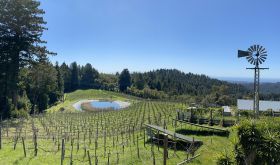
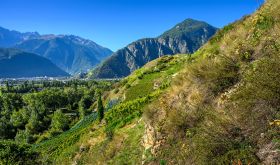
It’s also true that volcanic wine regions are often some of the most dramatic. Think Santorini, Etna, Mt Vulture. Many of them are UNESCO protected landscapes – for instance the Biosphere Reserves of Somma–Vesuvius in Italy and the Three Sisters in Willamette, Oregon; the World Heritage sites Chaîne des Puys in France and Etna in Italy; the Global Geoparks of Vulkaneifel in Germany, Pico in Portugal and Lanzarote, Spain. They stand apart because of their landscapes and the plants and people that have come to thrive in them. Many are difficult landscapes – wind-blown, thin-soiled, sun-beaten, sometimes with the extra frisson of the occasional ash shower or threat of lava. It is not surprising, perhaps, that the wines that come from these landscapes are sometimes dramatic themselves – gritty and determined, with a salty edge (or powerful, concentrated and saline, to put it more elegantly.)
The Chairman’s Selection
Over the last five weeks we’ve reported on all the wines we tasted that the panels awarded a medal or an honourable mention; you can read more about them here.
However, after everything was tasted, the panel chairs came together to taste the most compelling wines of each flight. These are the wines that stunned us with their power and concentration, their sense of minerality, their structure and potential for longevity. We then awarded the best of those wines a Chairman’s Award. (Although two of the three panel heads are female, we retained the name for the sake of continuity.)
Are they the most volcanic? That we can’t say for sure. But we can say that they are profoundly transporting and delicious, and inspire further research on volcanic wines.
Panellists
We were extremely lucky to be able to welcome a who’s who of NY-area wine talent to come taste with us. A heartfelt thank you to all of the following panelists who lent us their expertise and impressions; their input was essential to the selection process.
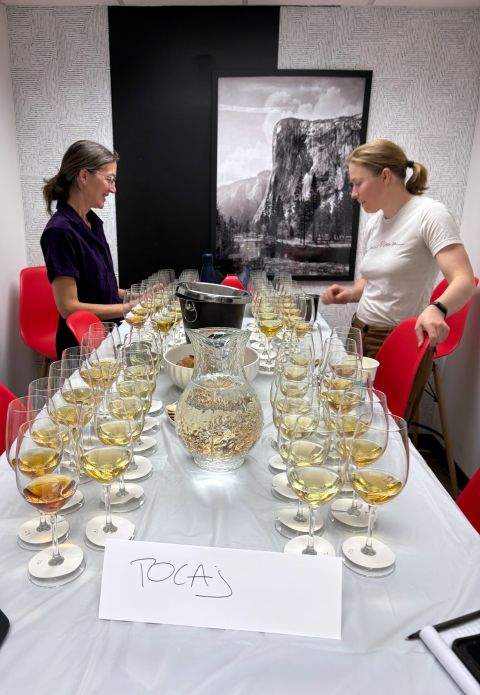
Chairs: John Szabo MS (WineAlign.com), Sam Cole-Johnson and Tara Q Thomas (JancisRobinson.com)
Panellists
- Rebecca Banks, beverage director, Keith McNally restaurants; wine educator, International Wine Center
- Tim Buzinski, professor, wine and beverage studies, Culinary Institute of America, Hyde Park
- Scott Carney MS, dean of wine studies, Institute of Culinary Education
- Vitalii Dascaliuc, La Compagnie and instructor, Astor Center
- Gabriela Davogustto, Clay
- Mariko Kobayashi, Chambers Street Wines
- Jhonel Faelnar, beverage director, Na:eun Hospitality (Atoboy, Atomix, Naro)
- Christy Frank, Copake Wine Works
- Karen Goodlad, chairperson, Department of Hospitality Management, New York City College of Technology
- Arthur Hon, Lei NYC
- Stephanie Johnson, SteepleJack Wine
- Amy Racine, beverage director, JF Restaurants
- Wanda Mann, Wine with Wanda and East Coast Editor, The SOMM Journal
VWA Chairman’s Awards 2026
White wines
- Argyros, Cuvée Monsignori 2022 Santorini
- Dal Cero, Tenuta Corte Giacobbe 1er Runcata 2017 Soave Superiore
- Gaia, Thalassitis 2024 Santorini
- Inama, Vintage Collection 2016 Soave Classico
- Krispel, Hochstrandl Sauvignon Blanc 2018 Vulkanland Steiermark
- Olivella, Summa 2023 IGP Catalanesca del Monte Somma
- Passopisciaro, Passobianco 2024 IGT Terre Siciliane
- Planeta, Eruzione 1614 Edizioneduemilaventitre Carricante 2018 Sicilia
- Suertes del Marqués, Vidonia Listán Blanco 2024 Valle de la Orotava
- Vassaltis, Gramina Cuvée des Vignerons Assyrtiko 2023 Santorini
- Zsirai, Szent Tamás Furmint 2020 Tokaj
Red wines
- Animaetnea, Animardente Rosso Contrada Santo Spirito 2021 Etna
- Tenute Ballasanti 2023 Etna
- Feudi di San Gregorio, Piano di Montevergine Riserva 2018 Taurasi
- L’Ecole No 41, Cellar Selection Ferguson Vineyard Cabernet Sauvignon 2022 Walla Walla Valley
- Lingua Franca, The Plow Pinot Noir 2023 Eola-Amity Hills
- San Pedro, Sideral 2023 Cachapoal Andes
- Storybook Mountain, Estate Reserve Zinfandel 2021 Napa Valley
Sweet wines
- Donnafugata Ben Ryé Passito 2023 Pantelleria
- Grand Tokaj, Szarvas Aszú 6 Puttonyos 2014 Tokaj
- Oremus, Aszú 5 Puttonyos 2017 Tokaj
- Santo, Vinsanto 2020 Santorini
- Sauska, Aszú 6 Puttonyos 2019 Tokaj
Find full details on the Volcanic Wine Awards in John Szabo MS’s introduction to the awards, and more detail on volcanic wines in our volcanic-wine hub. You can also find reviews of all the wines tasted in our tasting notes database. Many of these wines will also be shown at the International Volcanic Wines Conference in NYC on 10 June 2026.