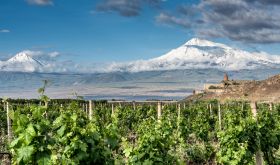
All over the world crops are being picked earlier and earlier. Grape harvest dates in particular are in transition. In the supposedly cool Mornington Peninsula south of Melbourne, old hand and star winemaker Tom Carson of Yabby Lake reports that the vintage there is a full four weeks earlier than it once was. On the other side of the world in Châteauneuf du Pape, they used to pick well into October in the 1950s but nowadays many grapes are picked in August.
Give or take a terrible spring frost, summer hail or winter flood, summers in wine regions are getting hotter and hotter, ripening grapes earlier and earlier. In Europe, one country known for its fine wines is in the eye of the storm: Austria. As wine producers Austria and Germany have had much in common, but Austrian wines are always rather softer and lower in acidity than German ones. In cooler times, this was an advantage but, having tasted about 50 Austrian whites from the 2017 vintage recently, I suspect Austrian vine growers are starting to regard their warm climate as a bit of a curse.
In London earlier this month the Austrian Wine Marketing Board chose to show an official generic assortment of Austrian wines at a seated tasting rather than hosting the usual melee of producers showing off their full range. The first 2017 I tasted, admittedly straight after a dozen rather creditable, if varied, sparkling wines – so wines with generally higher acidities than still wines – was a Langenloiser Alte Reben Reserve Grüner Veltliner from the excellent Bründlmayer. It was almost shocking in its softness and low acidity, and many of the succeeding 2017 whites seemed really quite evolved already, despite Grüner Veltliner’s reputation for producing wines worth ageing.
As the tasting progressed, my palate adjusted, and I found a few wines where light, not unpleasant, bitterness on the finish seemed to provide the white wine stimulation that would normally come from acidity so when I saw Willi Klinger, the head of the Austrian Wine Marketing Board, I remarked on the effects of what seemed to have been a particularly hot summer in 2017. I had noted, for instance, that in the vintage guide in the immensely detailed 128-page book Austrian Wine in Depth at each taster’s place, 2017 had been allotted an all-red disc to signify one of the three hottest years since 1992. (The others were 2011 and 2003.)
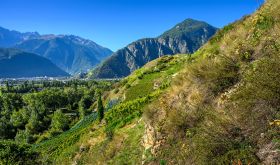
He grimaced and pointed out that 2018 was even hotter, suggesting that, perhaps to allow for this, 2017’s colour might be amended in future editions to three-quarters red and a quarter blue, like 2015 and 2012. Austria’s best grapes have traditionally been picked in October, to wait until they are fully physiologically ripe, but in 2018 many growers had to pick in September in order to preserve acid levels. Thanks to global warming, some quite mountainous, less traditional parts of Austria are being revived as wine-producing areas, particularly Kärnten/Carinthia around Klagenfurt.
While most of the 2017 whites shown were relatively low in acidity, one wine stood out for its remarkable level of freshness: Bernhard Ott’s Ried Rosenberg Reserve Grüner Veltliner from Wagram, conventionally associated with particularly full-bodied wines. As is the Teutonic way, we were supplied with an analysis of all the wines so I could see that, analytically, the Ott wine was actually lower in acidity than the Bründlmayer one. Knowing that Ott is a particular fan of natural compost (he was once contacted by the authorities because they couldn’t understand how one farm could use so much) and is certified biodynamic, I thought that might provide the explanation for the wine’s vivacity. (Biodynamically grown vines seem to be extra healthy and to produce particularly well-balanced wines even at relatively low alcohol levels.)
Klinger corrected me by reminding me that Austria has one of the highest proportions of fully sustainable viticulture in the world: 13% of all Austrian vines are grown either organically or biodynamically, and the proportion for general farming is even higher.
Because this London tasting was restricted to indigenous Austrian grape varieties (except for the Chardonnay lurking in the new long-aged sparkling wine Grosse Reserve g U category the Austrians were so anxious to show off, g U standing for geschützte Ursprungsbereich, or protected designation of origin), we didn’t have a chance to see Austria’s Rieslings. They can also be excellent and are generally fresher and higher in acidity than the country’s signature white wine grape Grüner Veltliner, so they may be in a better position to withstand hot summers. That said, I thought the most successful of the full-bodied, full-on, often ready-to-drink Grüners would make great partners for the sort of spicy dishes that are so popular. I hope those in charge of the many fine wine lists in Britain’s most ambitious Indian restaurants will look out for 2017 Grüner Veltliners.
As well as five flights of six Grüners, one of which comprised off-piste wines that had, for example, been aged in amphorae, we were also served flights focused on the Austrian white wine grapes Neuburger, Roter Veltliner, the Gumpoldskirchen grapes Rotgipfler and Zierfandler; red wines, from the 2016 vintage and older, based on Zweigelt and St Laurent (no French Pinot Noir) plus no fewer than four flights of Blaufränkisch, the freshest and by far the most successful Austrian red wine grape; and one flight of the sweet whites for which Burgenland is so famous.
The Neuburgers, a natural crossing of Roter Veltliner (unrelated to Grüner Veltliner) and Silvaner, were pretty impressive – unlike the fancier versions of Austria’s basic red wine grape Zweigelt. As an unadorned deliverer of juicy, young, fruity wine, Zweigelt can be delicious, but on this showing, it should be left alone and drunk early.
Klinger was in valedictory mood, with (semi) retirement in view. This would be his last London tasting, he told us. And he recounted with glee how, during his record 13-year reign, the value of Austrian wine exports had grown by an average of 6.5% every year. They benefited enormously by Grüner’s being flavour of the month with New York sommeliers about 10 years ago but then there was the predictable backlash. Thanks to Klinger’s tenacity, perhaps helped by the charm of the popular Austrian resident sommelier Aldo Sohm at Le Bernardin in New York, the US has steadily become Austria’s third most important export market, after Germany and Switzerland.
Klinger may not be tall, but he will leave big shoes, and a complex web of new Austrian appellations, behind.
PARTICULARLY DISTINGUISHED AUSTRIANS
WHITE
Alzinger, Ried Steinertal Smaragd Grüner Veltliner 2017 Wachau
Hirtzberger, Rotes Tor Smaragd Grüner Veltliner 2017 Wachau
Knoll, Ried Kreutles Smaragd Grüner Veltliner 2017 Wachau
RED
J Heinrich, Ried Goldberg Alte Reben Reserve Blaufränkisch 2012 Mittelburgenland DAC
SWEET
Kracher, No.1 Rosenmuskateller Trockenbeerenauslese 2016 Österreich
Michael Wenzel, Furmint Beerenauslese 2016 Burgenland
The image of a sunset in Burgenland, copyright AWMB / Lukan, is from the Austrian Wine website.