Côtes du Rhône is France’s second-most-productive wine appellation after the common-or-garden Bordeaux appellation that is bottom of the heap dominated by the famous classed-growth châteaux. Every year about 130 million bottles of wine are labelled Côtes du Rhône. Most of them come from the roughly 25,000 ha (62,000 acres) of land allowed to use that appellation in the southern reaches of the Rhône Valley in south-east France.
It’s almost 85 km (50 miles) from Avignon in the extreme south to Montélimar in the north, with the much grander appellations of Châteauneuf-du-Pape, Gigondas, Vacqueyras and Cairanne in between. Côtes du Rhône sprawls over four very different departments in the south – from south to north: Gard, Vaucluse, Drôme and Ardèche – and extends over both banks of the wide river. No wonder there is such variation in style of all those bottles of Côtes du Rhône wine produced each year.
The great majority is red, based on Grenache Noir grapes – fruit bombs high in alcohol, vaguely sweet-tasting and from the productive, warm south of the appellation. This is the sort of wine, typically made by cash-strapped co-operative cellars and sold by big bottlers, that has been spotted on offer in French supermarkets for less than €2 a bottle.
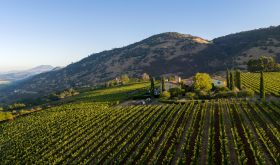
But in the north-west of the southern Rhône conditions are very different. Avignon is only about 40 m (130 ft) above sea level on relatively flat land. However, a cluster of small family domaines in a stretch roughly between Bagnols-sur-Cèze and Viviers on the right bank of the river have vineyards that are up to 250 m (820 ft), which makes a huge difference to how cool nights can be.
Simon Tyrrell of Les Deux Cols reports, for instance, that they only began to pick grapes in the first week of September last year, by which time the (superior) co-operative Les Vignerons d’Estézargues – also in the Gard department but much further south – had finished its harvest. He points out that, south of the Tave tributary on the right bank of the Rhône, the landscape is like the typical garrigue of the southern Rhône. But it is much more rugged to the north where the influence of the Cévennes mountains to the west and Les Monts d’Ardèche to the north is strong. This has inspired him to suggest that it would be helpful for consumers to split the Côtes du Rhône appellation into sub-appellations roughly related to these departments, listed anticlockwise from the north: Ardèche, Gard Nord, Gard Sud, Vaucluse and Drôme.
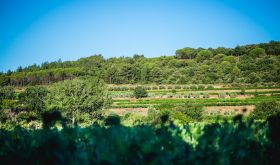
The area that he calls ‘the north-west corridor’ is also very heavily forested, another cooling factor, although this comes with the threat of predations from wild boar. The forests that tend to surround vineyards here are also important in promoting the biodiversity that today’s vignerons are increasingly realising is so important, and has been missing from some of France’s most famous vineyards, especially in Bordeaux.
Perhaps not surprisingly, in view of ancient geological activity, there’s a marked difference between the soils of the left and right banks of the Rhône, with more sand in the north-west corridor than on the stonier left bank, merging into clay towards the north-west. Soil texture can of course have a considerable effect on the wine grown on it. Sand can be a challenge in dry areas because moisture drains so fast through it, but the north-west corridor is much rainier than the arid heartland of the southern Rhône so this is no great problem.
I recently tasted a selection of wines from six independent, small-scale producers in this under-sung corner of the Rhône valley and was impressed by their quality, and very obvious lack of conformity to the Côtes du Rhône stereotype, being much fresher, more transparent and obviously hand-crafted.
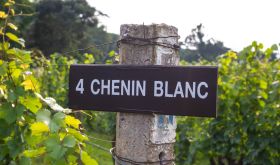
As further south and east, Grenache dominated the reds but, in the north of the north-west corridor, the Syrah so closely associated with the far north of the Rhône valley wine region (Côte Rôtie et al) obviously prospers, too – unlike in the warmest parts of the south. And, of the 17 wines I tasted, five were white, representing a much higher proportion than the 8% of white wine produced in the Côtes du Rhône appellation as a whole and therefore indicating a cooler vine-growing environment.
Alain Gallety is the northernmost producer in this group and made arguably the most-refined wines of all, with Syrah playing an important part in the reds. I was most impressed by the all-Syrah La Syrare 2022, labelled as a Vin de France but see that it is not underpriced – unlike most of these wines. The red and white Cuvée Gallety wines made from a Grenache/Syrah blend and a Marsanne/Roussanne blend respectively are great value considering their finesse. The fastidious Kermit Lynch of Berkeley is Gallety’s US importer; Vinatis are offering Gallety wines at keen prices in the UK.
The similarly organic Domaine Saladin, run by 22nd-generation sisters Elisabeth and Marie-Laurence Saladin, is a little further south in the village of St-Marcel d’Ardèche. Their savoury Paul Grenache 2023 is already drinking beautifully and has been freshened up by the 10% inclusion of the zesty, pale-skinned Clairette grape, a favourite of mine, which features heavily in several of the white wines made in the southern Rhône’s north-west corridor. The Saladins, who boast on their website of having been local ‘winegrowers and peasants’ since 1422, also grow cereals and almonds. Most unfortunately, the domaine lacks a UK importer, but their wines, too, are imported into the US by Ideal Wine & Spirits.
The commune of St-Marcel d’Ardèche seems to be a hotbed of female wine talent, for it is on an isolated site here, surrounded by olive trees, beehives and lavender, that Hélène Thibon manages the Mas de Libian estate that has been in her family since 1670 (making the Thibons parvenus, of course, compared with the Saladins). She has gone the full biodynamic hog with a horse dedicated to one of her most-difficult-to-work sites. The white Mas de Libian, Cave Vinum 2025 particularly took my fancy with its expressive blend of Viognier, Roussanne and Clairette. But the Khayyâm 2024 red blend was also impressive and had obviously been made with a very gentle hand, contrasting with the high-octane reds from further south.
Simon Tyrrell commutes to this part of the world from his job with Irish wine importers Tindal. With Charles Derain he organically farms eight sandy hectares of old vines for their Les Deux Cols label. The wines are sold by Lea & Sandeman in the UK and I’d love to compare the just-bottled La Degève 2024 Grenache with one of the popular Spanish Garnachas from the Gredos mountains near Madrid. The Rhône version seemed drier, denser and more ‘serious’. They also buy in a bit of Roussanne, Clairette and Cinsault fruit from a grower in Sabran to the south for their Atelier des Sources label, also available from Lea & Sandeman.
The sixth producer of the wines I tasted, Domaine La Réméjeanne, is the most southerly. But the wines, the delicious white Chèvrefeuilles 2025 blend and delightfully approachable 2023 Figaro red Grenache, were not remotely heavy.
Funnily enough, the last time I looked closely at this corner of the wine world was a couple of years ago when David Pearson, who ran the famous Opus One Franco-American joint venture in Napa Valley before moving to LVMH’s Joseph Phelps Vineyards there, told me how inspirational he found a visit to the vineyards of Valvignères south-west of Montélimar and how he had thought seriously about growing wine there himself.
There are no superstar wine producers in the north-west corridor, which has been dominated by co-operatives, but others possibly worth investigating include Domaine de l’Agramante, and Jérôme Jouret whose wines are sold at 40 Maltby Street in London.
Cooler southern Rhônes
Whites
Dom La Réméjeanne, Les Chèvrefeuilles 2025 Côtes du Rhône 13%
2023 is £11.95 The Wine Society
Mas de Libian, Cave Vinum 2025 Vin de France 13%
2024 is £16 The Wine Society, £23.55 Les Caves de Pyrène
A Gallety, Cuvée Gallety 2024 Côtes du Vivarais 13.5%
£19.86 Vinatis. A 2021 oaked white is $22 from US importer Kermit Lynch
Atelier des Sources, La Lumière 2024 Côtes du Rhône 14%
£25.95 Lea & Sandeman (available from late July)
Reds
Mas de Libian, Bout d’Z*n 2024 Côtes du Rhône 13%
£11.50 The Wine Society, £19.60 Les Caves de Pyrène
Les Deux Cols, Ô Font 2024 Côtes du Rhône 14%
£18.95 Lea & Sandeman
Atelier des Sources, Le Retour Cinsault 2024 Vin de France 12.5%
£21.50 Lea & Sandeman
A Gallety, Cuvée Gallety 2022 Vin de France 13.5%
£22.86 Vinatis. 2021 is $36 from US importer Kermit Lynch
Mas de Libian, Khayyâm 2024 Côtes du Rhône 13%
$19.99 K&L, California. 2023 is £24 Les Caves de Pyrène
Dom Saladin, Paul 2023 Côtes du Rhône 14%
€21.60 Cave de Famille, France
Dom La Réméjeanne, Figaro 2023 Côtes du Rhône 14.5%
€23.90 Vinossimo, France
Les Deux Cols, La Degève 2024 Vin de France 14%
£38.50 Lea & Sandeman
A Gallety, La Syrare 2022 Vin de France 13.5%
£58.11 Vinatis
For tasting notes, scores and suggested drinking dates see The heights of the southern Rhône. For more international stockists, see wine-searcher.com.
Back to basics
Principal appellations of the southern Rhône |
| Côtes du Rhône is by far the most important in terms of quantity of wine produced. Various villages have been identified as producing wine deserving of the Côtes du Rhône-Villages appellation and, for them, there is a continuous promotion process to become appellations in their own right – Lirac, Gigondas, Vacqueyras, Cairanne, Vinsobres, Rasteau and others have already benefited from this process. Tavel, famous for its full-bodied rosé, was given its own appellation in May 1936, the same day as Châteauneuf-du-Pape. However, the rules for the latter had been drawn up in the 1920s as the prototype for all controlled appellations for French wine. Costières de Nîmes can be great value. Muscat de Beaumes de Venise is sweet. |
Our southern Rhône coverage – well over 100 articles – can be found here.