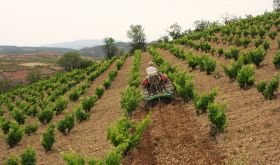
In South Australia, we experienced five cooler vintages in a row from 2020 to 2024. Then came the unicorn 2025, the warmest, driest and earliest vintage of my 56-year winemaking career.
What to expect in 2026?
The climate cycle has not inverted to begin a sequence of hotter vintages starting with the 2025 vintage! 2025 remains a unicorn as 2026 unfolds as a late, moderate and dry vintage.
SAM (the Southern Annular Mode) has reasserted its dominance over the climate of the southern coast of Australia and more specifically over South Australia and Tapanappa’s vineyards.
For much of the 2026 growing season SAM has been positive. Positive means the Antarctic vortex, the huge column of spinning air over the South Pole, reaching up from the stratosphere, has been strong, sucking the easterly-moving weather systems of high- and low-pressure cells down into the Great Southern Ocean nearer Antarctica. The dominant counter-clockwise-revolving high-pressure cells deliver cold south-easterly winds onto our vineyards, air drawn from the lower reaches of the Great Southern Ocean.
We harvested Pinot Noir from our Foggy Hill vineyard on the cool Fleurieu Peninsula on 26 March, a full month later than the harvest in 2025 on 27 February.
As well as the cooling effect of a positive SAM, all our vineyards had double average rain for the early growing season in October and November. The rain filled the soil profile and kept it cold, delaying early shoot growth, contributing to the delayed harvest.
The 2026 Pinot Noir crop was smaller than average at four tonnes per hectare, because bunch and berry size were small, caused by the partial failure of flowering and by the very dry conditions through the summer. Harvested in the cool conditions of mid autumn, the fermenting wines already have intense colour and vibrant fresh fruit aromas and flavours balanced by high natural acids and tannins. 2026 is destined to be recognised as a high-quality cool Pinot Noir vintage.
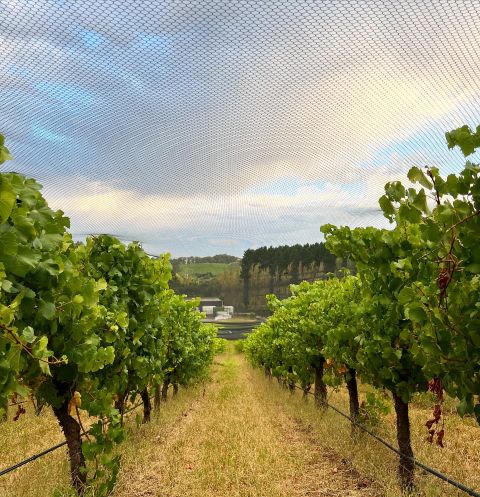
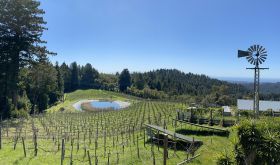
Back at the ranch, in the Piccadilly Valley, the Tiers Chardonnay is still under bird nets (pictured above), ripening slowly in the cool Autumn conditions.
Tiers will be harvested on 9 April, again a full month later than the 2025 harvest time of 7 March. Piccadilly Valley has had more summer rain than the Fleurieu Peninsula and berry size has not been so restricted. Bunches and berries look plump and firm supporting an average crop level of seven tonnes per hectare.
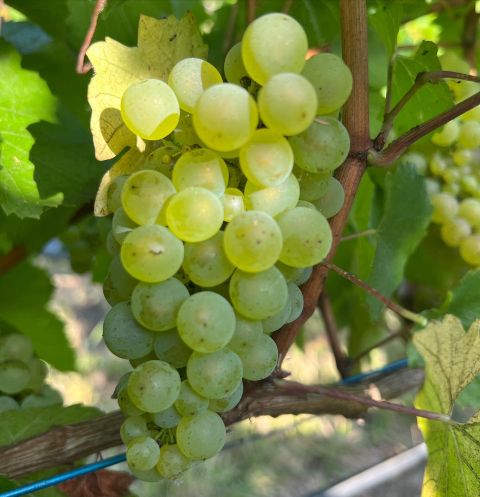
The berries (pictured below) have a translucent pale green-yellow colour and the seeds are visible through the skin in an almost otherworldly way, a reflection of the cool growing season and the Tiers terroir.
Why have my vineyards experienced cooler growing conditions in six of the past seven years? Such a sustained sequence of cool seasons hasn’t happened since the 1990s.
Research of tree rings and ice cores at the Australian National University in Canberra has determined that SAM is in the most extreme positive phase for the past 1,000 years. This has been attributed to the increase of greenhouse gases and the later depletion of ozone in the stratosphere, increasing the strength of the Antarctic vortex.
Also, the massive explosion of the undersea Tongan volcano in 2022 significantly increased the moisture levels of the normally dry stratosphere, strengthening the vortex.
If that strong stratospheric vortex condition is maintained, perhaps the new norm for South Australia will be for cooler and drier growing conditions and vintages in the future. I am for that!
What have I learned after 56 vintages that might inform the future?
Foremost, stick to what the vineyard site does best despite the swings of mood and fashion in the marketplace. Chosen as an ideal Chardonnay terroir in 1978, the Tiers vineyard continues to deliver exceptional and unique Chardonnay, and I hope will do so way beyond my lifetime.
Second, a great terroir will maintain its distinguished expression through large vintage variations. Tiers Chardonnay from the very warm 2025 vintage with a growing season heat summation of 1,620 °C days is an easily recognisable sibling of the very cool 2023 Tiers Chardonnay with a heat summation of 1,093 °C days. The Tiers Chardonnay terroir expression persisted despite the 2025 vintage being nearly 50% warmer than the 2023 vintage. 2026 heat summation is likely to be about 1,200 °C days.
Third, no vintage of the 56 I have experienced has been the same as any other. Every vintage brings a surprising and new matrix of climatic conditions. That’s what makes wine so interesting. Each vintage of a wine is a reflection of the unique vintage conditions, endlessly fascinating to savour and to ponder as to why.
What of the future?
Most of the business operations of the Tapanappa wine company are now in the hands of the next, very able generation. But I have not relinquished my vineyards or my winemaking role. Currently, I have the best of all worlds, growing and making my wine without administrative responsibilities!
Perhaps the hardest lesson of all is about to be learned on the eve of another birthday.
When is the right time to hand over the reins and allow the next generation to grow the grapes and make the wine for Tiers and Foggy Hill, something they inevitably will have to do one day anyway?
‘The answer is blowing in the wind.’