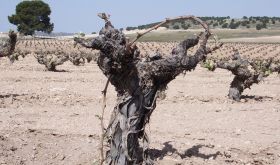
Few wine consumers will have considered this but it is a question currently worrying some grape and wine producers. Trunk diseases kill grapevines and spread from vine to vine in vineyards. They are encountered in every region of the world where grapes are grown, and generally they are on the increase. My picture here shows a vine in the Cognac region showing symptoms of Botryosphaeria dieback. The cordon and part of the trunk are dead, but the vine may be 'cured' by training the healthy sucker shown in the middle of the picture so that it replaces the old cordon and removing diseased parts.
The bad news
There are three major grapevine trunk diseases – esca, eutypa dieback and Botryosphaeria dieback (see Esca and friends) – all of them caused by different fungi. Esca is a major problem in European vineyards and has been increasing since the fungicide sodium arsenite was banned as a health risk. Like esca, eutypa has been known for centuries whereas Botryosphaeria is not so well understood nor recognised by many growers, but it can be very destructive. There is no universally agreed control strategy for these diseases.
The fungicide sodium arsenite has been in the news recently. The daughter of a French vine-grower near Bordeaux has mounted a case in a criminal court regarding the death of her father in 2012 from lung cancer. He sprayed sodium arsenite on his vines for 42 years before it was banned as carcinogenic in 2001.
All of these trunk diseases are spread mainly by airborne spores in winter – especially in rainy weather – from infected pruning wounds. The diseases are insidious: there are few conspicuous symptoms until the vines approach death, and by then many other vines are also infected.
Different varieties vary in their susceptibility, with Ugni Blanc/Trebbiano Toscano and Sauvignon Blanc among the most susceptible, and Cabernet Sauvignon moderately susceptible. Of particular concern is the fact that many if not most of the new planting stock produced by grapevine nurseries around the world show symptoms of some trunk diseases, which can lead to infection in new vineyards.
My recent visits to the Loire and Cognac regions confirmed the degree of damage, especially evident in older vineyards. I was also amazed at the degree of infection in some research vineyards! My impression was that growers were not always aware of all the diseases present, nor what to do about them. Some observers, including myself, have compared the current situation to that existing in France in the late nineteenth century when the predations of the insect pest phylloxera seriously reduced wine production until grafting on to phylloxera-resistant rootstocks was widely adopted and vineyards were replanted.
The good news
Reports of unhealthy vineyards from around the world have encouraged interest in the study of these diseases, and an international group of trunk-disease scientists was formed in 1998. They have now had their ninth meeting, in Adelaide in 2014. Many studies have shown that pruning wounds can be protected by fungicides, both natural and synthetic, and the painting or spraying of such preparations on pruning wounds is gaining popularity in some regions [as I found in California earlier this year – JR].
We are all familiar with vineyards where individual vines are trained to a single trunk. However, in nature, and for the last 40 million years or so, vines have been multi-trunked. This practice is used commercially in places with severe winters such as upper New York state to replace cold-damaged trunks, thereby reducing production losses (Richard Hemming took this picture on his recent trip to Washington state, where winters can also be fatally cold for vines).

The sucker shown at the base of the trunk can be used to form a new vine if the old trunk is damaged by freezing. This very traditional method known as trunk renewal can also be used to overcome trunk diseases.
Studies in Australia have shown that eutypa can be controlled by taking healthy suckers from the base of the plant to replace diseased trunks higher up. This technique works with the other trunk diseases as well.
The trunk-disease problem is particularly acute in the Cognac region of western France and last December major producer Hennessy announced it was dedicating €600,000 to related research. Last month they hosted a conference of European and other trunk-disease experts where I presented a paper proposing an old method to fight the disease. Trunk renewal has been shown to be a simple, cheap and effective way to control the trunk-disease problem. The technique is widely advocated in Australia and New Zealand but in Europe awareness and adoption of it is much less established. There seems no reason for this.
Will wine production decline because of trunk diseases?
In my opinion the answer is in the balance, and the next 10 to 15 years will be critical. There is an urgent need to have the problem recognised more widely, and for practices such as trunk renewal and the protection of pruning wounds to be more widely adopted. Fortunately the International Wine Office (OIV) is taking an interest in the trunk-disease problem and this should assist its global recognition and control. The issue was recently raised in the French parliament, and parallels were drawn with the phylloxera crisis of the late 19th century (see this report in French). The phylloxera problem was solved by replacing the diseased root system, and I believe the trunk disease problem will be solved by replacing the diseased trunk.
The elephant in the room, however, is the continued production by vine nurseries of plants showing symptoms of trunk diseases. They seem to have no management strategies to overcome problems that are now all too evident.