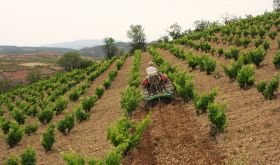

Frost damage in France
As reported in my last newscast on 28 March, France was hit by frost in the late hours of 26 March and the morning of 27 March. Vineyards in Champagne, Burgundy, Alsace and Savoie were suspected to have been affected. On 30 March Vitisphere reported that while Alsace and Savoie escaped relatively unscathed, damage in Champagne and Burgundy is significant. Jura and Provence have also been affected.
For Champagne, 2026 looks to be one of the worst frost years in recent history. Maxime Toubart, president of the General Union of Champagne Winegrowers, told Vitisphere that at least 20% of the appellation saw 100% damage. Sébastien Debuisson, director of the technical and environmental department at the Comité Champagne, added that even the least affected areas of the appellation saw 5 to 15% of buds destroyed.
In Burgundy, the most affected region was Chablis, where temperatures dropped to -6.5 °C (20.3 °F) the morning of 27 March and plummeted again on 29 March. Thierry Mothe, vice president of Chablis AOC, was quoted saying, ‘We don’t know what will be left in the small buds. The larger ones are already brown, soft, and dead. We’re never sure what’s in the secondary buds.’
In Jura, Hervé Ligier, president of the Arbois AOC, shared that damage is variable across the appellation, but Chardonnay is the worst affected as it budded three weeks earlier than usual.
The Var, where Provence is located, saw frost on the morning of 27 March and the morning of 3 April. The Var Chamber of Agriculture reported that 114 ha (282 acres) of vineyard have been affected, with average losses estimated at 24%.
France’s battle over copper fungicides
Copper, the most widespread treatment for downy mildew and one of the only treatments approved under organic practices, is – until viable alternatives are developed and approved – a necessary product for viticulture. On 15 July 2025 France’s National Agency for Food, Environmental and Occupational Health Safety (ANSES) failed to renew marketing authorisations for 20 out of 22 copper-containing fungicides that were up for renewal and put tight restrictions on the two that it did approve.
At the end of February, France’s National Confederation of AOC Wine Producers (CNAOC), the National Federation of Organic Agriculture (FNAB) and the National Interprofessional Association of Organic Wines (France Vin Bio) announced their support of all companies challenging the ANSES ban.
On 31 March, Cosaco – a global manufacturer of agricultural copper salts which had filed a lawsuit against ANSES – successfully argued for the reversal of ANSES decisions banning or restricting four of its copper-containing fungicides. The administrative court of Melun partially suspended the ANSES ban on these products and ordered ANSES to ‘re-examine the applications for marketing of these products for use on vines within two months’. If the marketing authorisations are renewed, these products should return to shelves later this year.
Champagne exports down
On 7 April the Comité Champagne announced their 2025 export numbers. In total, Champagne shipped 266 million bottles – 152 million bottles to international markets and 114 to French markets. This is a 2% decline from 2024. The US remains the top export market for Champagne followed by the UK, Japan, Germany and Belgium. Of the top 5 international export markets, only the US saw a decline in volume of sales – dropping by 3.4%. With regard to category, Brut Champagne continues to be the most successful category and accounts for 77% of market share.
Georgian wine exports up
On 6 April Georgia’s National Wine Agency announced export numbers for the first quarter of 2026. In total, Georgia exported 17.3 million litres of wine worth $53.2 million. This is a 5% volume increase and a 7% value increase over the same period in 2025.
UK wine production boom continues
On 25 March WineGB published its 2025 harvest report. Favourable weather conditions in 2025 resulted in a 39% increase in production over 2024 and a 1.24% increase in production over the 5-year average. Quality is expected to be very good.
Juvé y Camps joins Corpinnat
Juvé y Camps, one of the most respected and recognised sparkling wine producers in Spain, announced on 1 April that it had left DO Cava to join Corpinnat, a collective brand for high-quality sparkling wine from Penedès.
This is a huge blow to DO Cava, which has been losing producers to other sparkling-wine organisations for over a decade. Frustrations with the appellation began approximately 15 years ago and centred around the fact that the DO – which is concentrated in Catalunya but covers a vast area of vineyards as far afield as Extremadura, Rioja and Valencia – offered producers no option to declare a more specific region of origin and had a low barrier to entry in terms of quality standards. High-end Spanish sparkling wine producers, most of whom are in Penedès, demanded a way to distinguish their wines from affordable everyday Cava. After years of proposing changes to the DO with no success, groups of producers left the DO to establish ‘Classic Penedès’ in 2014 and ‘Corpinnat’ in 2019. With top producers rapidly abandoning the Cava appellation, DO Cava finally, in 2021, established subzones and raised quality requirements for producers wanting to use these subzones … but, if Juve y Camps is any indication, the demanding standards of Corpinnat and the quality represented by the organisation is still a strong enough draw to lure producers away from the more recognisable DO.
Global wine sales decline hits large beverage companies
The IWSR recently released data showing that sales of wine declined 6% in volume in 2025. While this is a negative for all wine producers, large wine companies seem to be especially hard hit.
On 8 April Winetitles reported that Casella’s brand Yellowtail had recorded its first loss in 13 years. Sales to the US fell 17% in 2025 and the company suffered a loss of $5.5 million.
On 9 April, The Drinks Business reported that wine and spirits sales for Constellation Brands fell by 58% to $194.2 million – largely due to brand disposals (Woodbridge, Meiomi, Robert Mondavi Private Selection, Cook’s and Simi were sold to The Wine Group).
Meanwhile, Treasury is fending off rumours of looming bankruptcy due to a $649.4 million loss in the first half of the 2026 financial year, and Pernod Ricard and Brown-Forman have confirmed that they’re negotiating a merger.
That’s all for this episode of the wine news. I’ll see you on 24 April. If you enjoy this newscast and would like to see it continue, please become a member of JancisRobinson.com. And if you have breaking news in your area, please email [email protected].
This is a transcript of our regular five-minute news broadcast, which you can watch below. You can also listen to it on The Wine News in 5 Podcast. If you enjoy this content and would like to see more like it, please become a member of our site and subscribe to our weekly newsletter.