
On a warm spring evening in a now-defunct Berlin wine bar, more Heuriger than hip, I ordered a glass of the house pink. It arrived pale red in the glass, a few shades closer to cherry than the anticipated baby-pink rosé. Crisp rhubarb corners on the palate, eye-watering acidity. Angular, dry, edgy, everything I had come to believe Berlin to be. It was a Rotling (with a long ‘o’ that rhymes with ‘boating’). Over a decade ago, and the beginning of a long chase.
Rotling is a German exception with a logic all its own. Where EU law generally prohibits blending finished red and white wines to rosé, Rotling sidesteps the rule entirely: red and white grapes are co-fermented before the wine exists. The results run the gamut from barely blushing to deeply flushed, depending on variety, proportion and contact time. It is pink not because it is less than red but rather because it is more than white. And the style’s deep historical roots are finding a modern audience, particularly in Franken, where a new wave of winemakers is rewriting what the region thought it knew. One of those wines recently found me.
‘You had me at Rotling’, I wrote to Emily Campeau of Wein Goutte after opening the debut vintage of Newstalgia: a 2023 made from 60% Müller-Thurgau, 40% Domina, co-fermented and bone dry. The name nods to the wine’s traditional roots, made new again by two people who came to Franken from elsewhere and fell in love with what had been left behind.
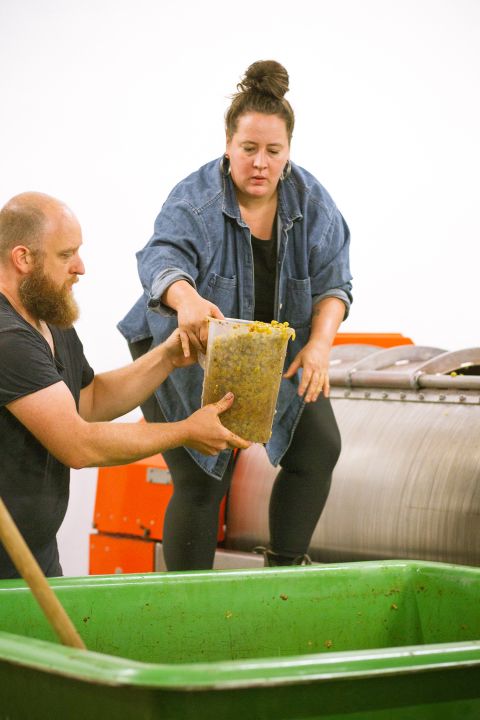
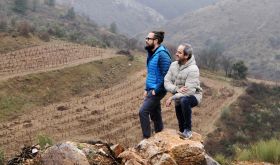
Emily Campeau and Christoph Müller met during the hot harvest of 2018 in Burgenland: both trained chefs, both already deep in wine – Müller through oenology studies and harvests at estates including Clemens Busch and Franz Weninger, where by 2018 he was already a cellarmaster; Campeau as wine director at Restaurant Candide in Montreal, after arriving at Weninger’s that same harvest as an intern. In winter 2021 they moved together to Hüttenheim, at the edge of Franken’s Steigerwald, to an existing winery called Weinhof am Nussbaum. Owners Linda and Erhard Haßold were looking for successors for their 3.5-ha (8.6-acre) organically farmed estate and guest house. Campeau says, ‘other farmers in the village were very sceptical when Erhard converted to organic in 1991, but we are glad he stuck to his beliefs’. For Campeau and Müller, with dreams of a large farm and fresh produce, organic was non-negotiable. The two couples agreed on a gradual transition sharing grapes, equipment and labour. In June 2025, Campeau and Müller completed the succession.
Newstalgia came from an idea Müller had carried from home, and a fortunate coincidence. A native of Württemberg, where Rotling thrives as Schillerwein, he had long wanted to make the style as a nod to his roots. In 2023, a friend offered to sell Wein Goutte grapes from a vineyard in organic transition. Because mingling organic fruit and fruit in transition would cause problems with labelling, Campeau and Müller decided the grapes would be separated into their own wine, and Rotling had its moment.
For Newstalgia, they build what Campeau calls ‘the cake’: alternating layers of destemmed Müller-Thurgau and Domina (a cross of Portugieser and Pinot Noir), about 45 cm (18 in) deep, stacked six to a bin, for a three-day co-maceration. ‘The slow destem allows most berries to stay whole’, Campeau explains, ‘which makes the extraction very, very soft for the red colour, and doesn’t pull too much tannin from the white, either.’ It’s aged for 11 months, split between stainless-steel tanks and used 500-litre oak, then six months in bottle. Total SO2 is under 20 mg. Each bottle is sealed with organic beeswax from Müller’s village in Württemberg and stamped with a motto. Mine said simply ‘you are loved’.
In the glass: vibrant cranberry and hibiscus, wild strawberry, a savoury baseline and grace notes of wild mint. Slender and snappy slightly chilled, with a surprisingly gentle acidity for all that refreshing red-fruit energy and only 11.5% alcohol. Something like a Spanish clarete in its disposition and depth, a red wine infused with white-wine transparency and lift.
As chef-turned-winemakers, Campeau and Müller seem to make wines that have a natural affinity for the table. The kitchen at Hüttenheim spills over with fresh harvest from the garden every summer: glorious tomatoes, buckets of purple peppers. I can easily imagine this alongside a spiced beef salad with cherry tomatoes, cucumber, basil and wild mint. It could also easily carry grilled pork belly, the smoky depth of pimentón de la Vera, the warm, fermented tang of a good kimchi. Alone, the pomegranate-toned fruit is crisp and edgy. At the table it softens, expands, and grows more serious.

Übergangsjacke is the German term for the jacket you need in the in-between time when mornings and evenings are cool but the afternoon is warm. In Germany, it is more philosophy than garment. After 23 years here and multiple Übergangsjacken to my name, I am advocating for an Übergangs wine. The one you reach for when the lilacs are still only tiny purple polka dots on leggy wood, the peonies tight pink fists on slender olive stalks. When the tulip magnolias have fallen but the dogwoods are still biding their time. When it’s almost warm enough for a Kabinett on the balcony, but sitting in the shade is still uncomfortably fresh. When it’s 20 ºC (68 ºF) in Bonn and I’m on the phone with my father walking into a New Hampshire snowstorm. That space, between seasons, between red and white, is where Newstalgia lives its best life.
It won’t please everyone who reaches for a pink wine expecting creamy strawberry contours and soft watermelon dreams. Good. There’s more than enough of that already.
Seeing as many are still unable to find Franconia on a map, the depth of Newstalgia’s fan base speaks for itself: available in continental Europe directly from the producer (€15), in the UK through Sager and Wine, and in the US through Vom Boden, New York.
Emily Campeau is also a very talented writer and photographer who’s been a finalist in our annual wine writing competition several times: see her past entries on English vintner Sophie Evans, Quebec, Palomino and the bottle of wine that sparked the love of wine that eventually led her to become a winemaker. And for more off-piste wines from Franconia, visit our tasting notes database.