
Neville Abraham recently launched his fascinating autobiography Each and Every Highway: A life in wine, restaurants and other unlikely places with a large party in the upstairs room of the just-reopened Simpson’s restaurant in London. Guests included many of those who contributed to the increased popularity and enjoyment of wine and restaurants, and the two together, over the past 40 years in the UK.
There were wine merchants, restaurateurs, wine writers, and restaurant writers like me. Then there was one man, Peter Harden, who did not quite fit any of these roles but someone who is something of a one-man band, still responsible for Harden’s restaurant guide, launched initially in 1991 with his older brother Richard. (See Peter’s review of Abrahams’ book.)
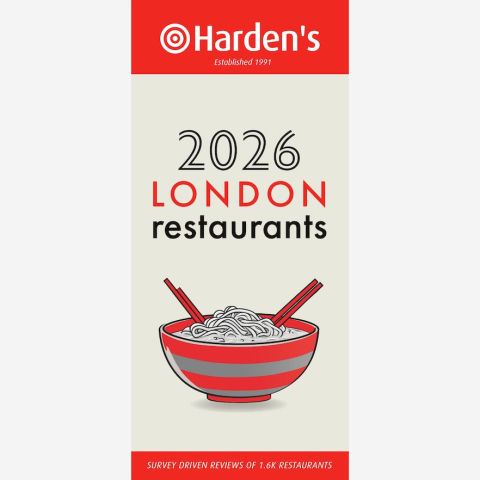
Such guides, including the Egon Ronay Guide, The Good Food Guide, the AA Guide and of course the Michelin Guide, were still extremely influential then. But Harden’s was and is radically different, relying on the views of restaurant-goers rather than professional inspectors. It initially concentrated on London and Harden still publishes a guide to 1,400 restaurants in London (and a guide to a further 1,400 restaurants in UK cities outside the capital). It’s a slim paperback – able to fit into a jacket pocket – in a distinctive light-red cover. As the late Edmund Penning-Rowsell once wrote about wine merchant Philip Tite’s slim wine list, it’s ‘discreet enough to be read in church’!
The guide opens with a list of explanations of the three headings which its editor considers to be the most important: ‘f’ for food, ‘s’ for service and ‘a’ for ambience, and a description of how each category is rated, from 1 (poor) to 5 (exceptional). This is followed by a page on how the guide is written and an explanation of why, in a world increasingly dominated by online reviews and influencers, it is the active, human curation that the guide supplies that is increasingly vital for those looking for independent but critical advice.
There follow six short paragraphs that explain how ratings are determined; how they are written; how reporters are found (anyone can take part); the risks that can ensue from such an open system; and a dismissal of the system of the professional inspectors used by other guides. Fighting talk!
This was undoubtedly the Hardens’ distinctive contribution to the world of restaurant guides. By relying on the opinions of those who had enjoyed the restaurants (or not) it established a unique voice, one that paid the bills. And as the cost of eating out – not to mention drinking out – has increased significantly over the past 35 years, this has greatly protected Harden’s, while rising costs have eaten into the profitability of the competition.
Preceding the 260 closely typed pages in the 2025 London guide is a review of the current restaurant scene and a list of the openings and closures of the previous year. This analysis lists 132 openings and 84 closures in 2024. In a historical context this was a low level of openings and a relatively high number of closures, with modern British and modern Italian restaurants among the most popular cuisines among new restaurants. There was a relatively modest increase in the most expensive establishments, and a modest decline in the importance of French cuisine among them.
See the guide’s top 100 UK restaurants – all voted for by actual, bill-paying diners, a phenomenon I heartily approve of.
Peter Harden, almost 60, is slim (having managed to lose more than 13 kg in six weeks, he reported, thanks to a combination of a set of scales; cutting out carbs; asking himself, ‘am I still hungry?’; and having good snacks to hand) and has an affable, easy manner. He obviously feels comfortable in his world of interpreting data, the world that spawned his restaurant guide.
Over a lunch after Abraham’s book launch he explained, ‘It was the late 1980s and I was single and working for a bank in New York. It was the era when the Zagat restaurant guide, founded in 1979 by Tim and Nina Zagat, was widely used. I happened to be back in Chester in the UK in a wine bar on Watergate Street with my brother Richard when the topic turned to how well such a guide would work in London. It wasn’t just the Zagat guide. There were also the Marcellino’s guides in Düsseldorf which were popular at the time. I left my job, I came back to the UK, and we published our first London guide on 1 November 1991’.
The Hardens borrowed considerably from the Zagats: the format of the book, the rating system of consumer reviews, and their approach (the Zagats sold to Google in 2011 and in 2018 their guide was sold on to The Infatuation, a restaurant app currently controlled by J P Morgan). In another significant change, Richard and Peter parted company and, while Richard remains a shareholder, the brothers have not spoken in 14 years. ‘It’s more to do with us being brothers than anything to do with the business’, Peter explained with a touch of sadness. He still sends Richard a Christmas card.
Over the past 35 years there have been significant changes both in the publishing and restaurant worlds, which Harden, a traditionalist, immediately acknowledged. ‘In the 1990s there was still the Net Book Agreement in place and branches of W H Smith, which sold a lot of guides, was still a force to be reckoned with. Then came the internet boom and the rise of social media and influencers, of course. I sometimes worry that we have not done enough to keep pace but I wonder how much photos of the restaurants, or even of the dishes, would add to Harden’s guide?
‘And the changes have been as enormous in restaurants. The rise of the chef and the TV chef. Open kitchens? I wouldn’t mind seeing half of them bricked up. The demise of the newspaper restaurant reviewer and their replacement by influencers. The media space has changed completely. But I think that the biggest change and what I miss the most is the slight amateurism of the past. The restaurant business has become a big, professional business with a great deal of private-equity financing. And this changes the focus. What I miss about restaurants is that it was possible in the 1990s to slip into Gotham Bar and Grill, sit at the bar and eat and drink very well. Today, chefs want to trap you into sitting for four hours and 14 courses.’
Of course he is always being asked to name his favourite restaurant but refuses to answer. ‘Definitely as a young man, meals at Peter Luger and Gotham in New York [were favourites]. In the UK I can still recall dinners at Le Gavroche and at Hambleton Hall, a meal at Texture restaurant when Agnar Sverrisson was the chef (although there were too many foams), and at the Waterside Inn. And Chez Bruce, of course.’
But, he continued, ‘The list of legendary restaurants where food is not really the point is legion, be it La Coupole, the 21 Club, Conran’s restaurants back in the day and Jeremy King’s restaurants past and present. The list is endless. You could love dining at such icons without loving their food.
‘Richard Caring’s successes are an exemplar of the vitality of design not food. Service meanwhile is the “secret sauce”. Few seek out a restaurant on account of its service, but we are nervous chimp-descendants at the end of the day and our anxiety levels significantly affect how much we enjoy any experience. The enjoyment of formidably good food is ruined if it’s delivered late or gracelessly. Good service smooths our concerns and invisibly boosts the experience generally. It’s one reason Chez Bruce is so enjoyable as Bruce started his career in the front of house.
‘To me it’s the overall view that’s the most interesting thing. And in big cities like London in particular, the overall view includes so many different fascinating casts of characters whose own presence is itself intriguing. I’m interested in the extent the food is the driver for people going [to a restaurant]. But I’m most interested in why people go, and in particular whether they are getting the deal they bargained for. Where food is indeed central to the mission and why people seek a particular establishment out, then I hope we give that same food sufficient attention. I’ve introduced more sample dishes and commentary on the cuisine itself into our write-ups in recent years to reflect this.’
Towards the end of our lunch Harden turned more philosophical, perhaps the consequence of the good lunch and our half bottle of 2019 Jura Savagnin from d’Angerville’s Domaine du Pélican. ‘I firmly believe that our choice of restaurant guides is intensely generational. It was the Egon Ronay Guide for our parents, then The Good Food Guide, then Michelin. Which will be the future? Perhaps the restaurant business is too disjointed to attract the huge sums of money that impelled Hyatt to spend £53 million on the hotel recommendation site Mr & Mrs Smith?’
According to Harden his restaurant guide will continue. ‘I’m a firm believer in the wisdom of crowds, the principle which underpins the whole process and can so easily be corrupted. It’s not about my opinions; I’m just the guardian of the process. But’, he added wistfully, ‘it would be nice one day to turn the lead into gold.’
Harden’s 2026 London Restaurants £17.99
Each and Every Highway by Neville Abraham, £20
Every Sunday, Nick writes about restaurants. To stay abreast of his reviews, sign up for our weekly newsletter.