
Do you have friends who like wine but don’t know all that much about it? Or perhaps that description applies to you. If so, read on.
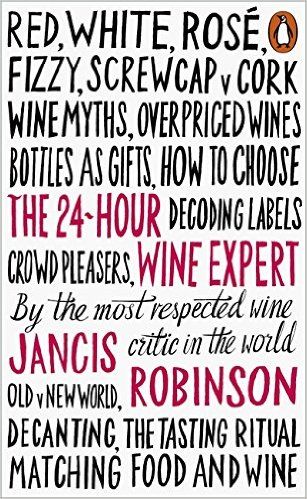
My most recently published book is my shortest-ever wine book, one that was in many ways the most difficult to write. It’s designed as a distillation of my 40 years immersed in wine into a handbook for those who would never dream of buying a big reference book but want to grasp the most important practical things.
The idea is that it offers a shortcut to wine expertise, an escape from any potential wine-related embarrassment, and can be fully digested in no more than 24 hours. It includes suggested tasting exercises – comparing a Sauvignon Blanc from New Zealand with a French one, for example – preferably with a group of friends. You can learn far more by comparing two wines than by sampling just one at a time.
The main point of wine is to give pleasure, not to generate social confusion and angst. For example, I spell out the point of the restaurant ritual of giving the host a small sample from each bottle before it’s poured (and it should be each bottle, not just the first one). I suspect many customers, and even waiting staff, are thoroughly confused about it. It is not done so that you can check whether you like the wine or not. Its purpose is for you to check two things once you have been presented with the label so you can see the wine is the one your ordered. A smell of the wine is generally enough to check whether that particular bottle is one of the nowadays-small minority that is technically faulty. The most common fault today is the mouldy aroma associated with a tainted cork.
But you are also being given a chance to check the all-important temperature of the wine, which you can do either by tasting it or feeling the glass.
If the red is too warm, you should ask for an ice bucket, or if the white is too cold, ensure it is left out of one. The optimal serving temperature for white burgundies, for example, is about 15 °C, very similar to the ideal serving temperature for red burgundies.
Our 24-year-old daughter Rose actually came up with the idea of the book. Her friends are regular, enthusiastic and intelligent wine drinkers but had never had any formal wine training and were always asking her questions about wine and wine lore. ‘Your mother’s a wine writer. Ask her’, they would say.
Because of that, in between jobs, she thought she would write a guide to wine for her age group, with a little help from her mamma, and so she convened a focus group of friends who, lubricated by my wine leftovers, told her exactly what they wanted to know. As it happened, a job at Vogue intervened so she never wrote the book, but her input was invaluable, not least as quality controller. It was Rose who read the manuscript, reminded me what was missing, and censored the odd word or figure of speech as being hopelessly quaint or obscure.
Because of her the book is less about geographical detail (although there is a gallop around the wine world at the end to supplement the descriptions of the most important grapes) and more about the mechanics of wine lore: how to taste, choose, serve and buy wine, what’s good value, major misconceptions about wine (such as that all wine improves with age, for instance) and a guide to wine jargon. And of course there are lists, the sine qua non of slim volumes.
I was extremely lucky with my editor, Cecilia Stein, who was absolutely the target market for the book: a lawyer-turned-publisher who loved drinking wine and really wanted to know more about it. Her questions constantly brought me up short. We had a tussle over how to describe natural wines – not least because there is no official definition of these fashionable liquids whose makers eschew all additions, including preservatives, not always to their benefit in my view.
She would occasionally annotate my text ‘I don’t understand this’ and leave me baffled because I didn’t understand what could possibly be confusing. We got in a tangle, for instance, over ‘vintage’, a word that can mean both the year in which grapes for a wine were harvested and the period and act of picking them, and ‘bottle age’. A wine is said to have bottle age if it has evolved because of time spent in the bottle – but it is nothing to do with the exact age of the wine.
Thanks to the democratisation and current global popularity of wine, particularly among younger people, wine is a much less elitist drink than it used to be, but there is no getting away from the fact that wine as a subject is potentially complex. If you choose, you could like me devote your life to trying to understand every last little thing about it.
But there is absolutely no need to do so in order to make the most from every glass of wine that comes your way. In the book I have tried to identify and elucidate all that’s necessary to be a confident wine drinker, unintimidated by the wine snobs who are much less powerful than they were but can still be found perpetuating myths such as that a battery of different sorts of wine glasses is necessary for wine appreciation, that only white wine goes with fish, or that wine has to ‘breathe’ before being served.

One thing that putting the book together highlighted was the question of geographical appellations and other quality designations. Traditional wine textbooks devote quite a bit of space to explaining these for each country – how, for example, in France the ‘best’ wines qualify for AOC or appellation contrôlée, while below this category are wines once described as VDQS then Vin de Pays and, the lowest of the low, Vin de Table.
These categories have recently been revised throughout Europe so that the old AOC is sometimes called AOP nowadays, VDQS has been abandoned, IGP has taken over from Vin de Pays, and Vin de France replaces Vin de Table. But in current reality, these categories are much less important than they used to be. They are no longer accurate signifiers of likely quality. Many a wine producer today, particularly the younger ones, choose to operate outside the straitjacket of the AOC regulations (which dictate how grapes should be grown, picked, and turned into wine – and impose tasting tests on the results). They prefer the looser embrace of a wine sold as a Vin de France. I therefore decided not to devote too much of my precious space to the topic of quality designations which are currently in a ferment all over Europe.
SOME TOP TIPS
Get to know your local independent wine retailer (most have much better quality wines than supermarkets do – see our detailed guide to Where to buy). Tell them which wines you have so far liked and ask them to recommend alternatives.
You need only one shape and size of wine glass, even for champagne and strong wines. The most important things are that it is plain, has a stem and goes in towards the rim so that you can safely swirl the wine and maximise its aroma.
For the same reason, fill wine glasses no more than half full.
When choosing a wine to go with a particular food, relax. Getting it wrong is not fatal. Matching weight of the wine to that of the food is generally more important than the wine’s colour.
Some very good wines are now stoppered with screwcaps.
Weight of bottle is not indication of wine quality.
The 24-Hour Wine Expert is published by Penguin and costs just £4.99. It is published in the US by Abrams in a slim hardback that corts just $12.95 and has been translated into multiple languages. Find out more at www.24hourwineexpert.com.













