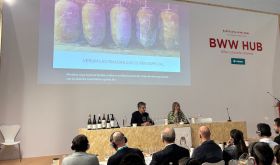
As someone who has attended several International Cool Climate Symposia since the 1988 one organised in Auckland by Dr Richard Smart (here today, I’m delighted to see), I take my hat off to the organisers of the very first serious academic conference devoted to wine production to take place in the British Isles. They have managed to amass a line-up of absolutely first-class, cutting-edge authorities from around the world who will be sharing their knowledge and latest findings with a most impressive line-up of delegates – from as far afield as New Zealand and Patagonia.
This event in Brighton in the lead up to English Wine Week that kicks off on Saturday will, I’m sure, be of immense interest to anyone who makes wine in the growing number of wine-producing regions in cooler parts of the world. And the symposium is of particular interest to wine students who want to keep up to date, and to many a serious wine lover, simply because so many of the world’s finest wines are made in relatively cool climates.
Those of us in cooler climates may occasionally complain of our chilly winters and sodden springs, but we are extremely fortunate in this era of climate change that in terms of wine, and in terms of much else, we have actually benefited from rising temperatures. Certainly English wine has been a prime beneficiary of global warming, along with vintners all over the northern limits of northern-hemisphere viticulture. But of course we all need to be aware of the continuing effects of climate change and to adapt truly sustainable strategies to manage them, and all aspects of wine production.
It is no coincidence that Britain is hosting this hugely significant event that effectively celebrates the coming of age of England and Wales as wine-producing countries. Perhaps the end result of all the knowledge shared on platforms and in less formal settings over the next few days will be to encourage wine producers in many more cooler vineyard settings around the world – not least in the new wine regions of northern Europe. Could Copenhagen or Stockholm be a future setting for a Cool Climate Wine Symposium?
This Brighton event began long ago, in 2000 at the Cool Climate Wine Symposium in Melbourne, when Chris Foss of Plumpton College and the late and much-missed Mike Roberts of Ridgeview bumped into each other and hatched the idea of suggesting that the event be held in the UK. Four years ago in Tasmania their offer to host the event was finally accepted and when they asked me to come on board at the end of the Tasmanian event, I was of course immediately supportive.
But what I am particularly thrilled by is the dramatic progress made by the English wine industry even in the short period since then. It was a little surprising and especially rewarding to participate in a blind tasting late last year in which English sparkling wine ‘triumphed’ over a series of top-quality champagnes. A group of us, including some fine French sommeliers, tasted a dozen sparkling wines blind, knowing only that some were champagne and some were English – all selling for roughly the same price. In the event, it turned out that only four of the wines were English, but two of them occupied the top two slots once the scores were added up. A triumph for Perfidious Albion! And what I was particularly pleased by was that I was writing about my favourite fizzes not ‘I think this is champagne so I’ll give it a high score’ but ‘I think this is a particularly good English wine'. I love the fact that English sparkling wine is (a) made with such competence and consistency nowadays and (b) that it has its own discernible, ultra-refreshing, hedgerow-in-a-glass style.
I congratulate the relatively new, and delightfully creative wine magazine Noble Rot, whose editorial team organised this important tasting. This is just one tiny bit of evidence in the case I’d like to make for our little country’s playing an oversized part in the world of wine via the influence it exerts in terms of both wine writing and wine trading. Until recently we have not been much of a wine producer but, partly thanks to our native language admittedly, we have been disproportionately important in terms of the books, magazines and now online writing about wine that originates in the UK.
Again, substantially because we have not been major wine producers, we Brits have long played a far bigger part in the world’s wine trade – especially the fine-wine trade – than you would think looking at the map, or even population statistics. It is right and proper therefore that we should have our own major global forces in wine education – the Wine & Spirit Education Trust, the Institute of Masters of Wine, and Plumpton College close to here that has played such an important part in organising this Symposium.
It is partly because of the excellent work undertaken at Plumpton that we Brits can now hold our head up high and actually boast about the quality of English wine. (I used to say that the most serious disadvantage English wine suffered was the English, who refused to believe their wines could be any good. Not any more! We Brits are now a little bemused by but thoroughly proud of our native ferments.)
Sparkling wines such as those made by Bolney, Gusbourne, Hattingley Valley, Hush Heath, the Laithwaite family, Nyetimber and Ridgeview (ICCWS sponsors) have really put English vineyards on the world wine map, and have encouraged serious investment – not least by the Champenois (see An awfully big English adventure). But English still wines continue to make significant progress, too. Oz will be talking more about them in his inimitable way. I for one would not be at all surprised to have my socks knocked off one of these days by an English Pinot Noir, Riesling or Sauvignon Blanc. I have already nominated a Sussex Pinot Gris and a Kentish Gamay as wines of the week on JancisRobinson.com.
The English wine scene can draw on many strengths. Its climate is increasingly favourable to good-quality wine production. I don’t want to get into what might be called Geology Wars, but it is surely appropriate to mention our famous swathe of chalk, so usefully similar to that of the Champagne region. English wine producers are also, as I have already argued, surrounded by one of the world’s most vibrant and influential communities of wine trade and wine media – even if some quarters of the wine trade, especially the on trade, have been slow to realise just how good English wine can be.
In the UK Vineyards Association, English wine now has a thoroughly professional representative trade organisation with clear goals, strategy and a properly rewarded executive. In English Wine Producers there has long been a very well run, efficient marketing organisation.
And in Plumpton the industry has a first-class training establishment, the only one in Europe offering university-level wine courses in English. Its graduates are spread around the world in all manner of wine-related occupations, including being well-respected winemakers all over France (sweet, that) and in Germany, Portugal, Cyprus, Canada, California, South Africa, Australia and New Zealand to name just a few destinations for Plumpton alumni.
Plumpton now has a proper wine research centre, thanks to all manner of donors, with England’s most ambitious new wine estate Rathfinny getting the investment ball rolling.
One shameful development, however, is that Plumpton’s WineSkills Programme has had to be abandoned because DEFRA, the relevant government department, has rescinded its funding of it – at the very time when the English wine industry has reached new heights of accomplishment and fame.
There is another area in which our government, through DEFRA, is sorely lacking in its support for something of which Britain can now be thoroughly proud, something I find friends all over the world – not least in France – keep asking about. For some mysterious reason, DEFRA has failed to renew its membership of the OIV, the world’s massively important International Organisation of Vine and Wine (cost of membership is just a modest five-figure sum). Holland, Belgium, Sweden, India and Azerbaijan are all members. Why not the UK? This means that Plumpton can’t participate in international research projects, leaving it marginalised from the world of wine academe. And it also means that the British, and English wine producers in particular, have no voice whatsoever in international wine negotiations and regulation. This is surely a great shame and it would be only sensible to remedy this.
These two small steps for DEFRA really would make a major difference in terms of continuing the admirable progress of this small industry. (You will be relieved to know, by the way, Minister, that today I will not mention the punitive levels of duty imposed on English wine.)
We all, wherever we are in the world, need to continue to work towards making better and better wine, keeping an eye on responsible pricing, while growing exports and encouraging wine tourism. This symposium can only encourage that via its many opportunities to learn, and develop useful networks.
I’d like to take this opportunity of thanking and congratulating all of the wide range of producers and consultants who have played a part in this exciting golden age of wine throughout the world, but particularly those in the United Kingdom – and I think it appropriate here to single out the parts played by Plumpton, under the aegis of Chris Foss, in putting England on the world wine map, as well as my fellow Master of Wine Stephen Skelton who has done so much to champion and improve English vines and wine.
Finally I'd like to point out that last September saw Plumpton reach new heights of international fame. It earned its place as a new entry in the latest, fourth edition of The Oxford Companion to Wine (along with Sweden, Norway, Nova Scotia and Malleco, not to mention natural wine, minerality, urban wineries and Hong Kong) although I’m sure that Chris thinks it should have been there long before.
I wish you all an excellent time at this ninth International Cool Climate Wine Symposium.