
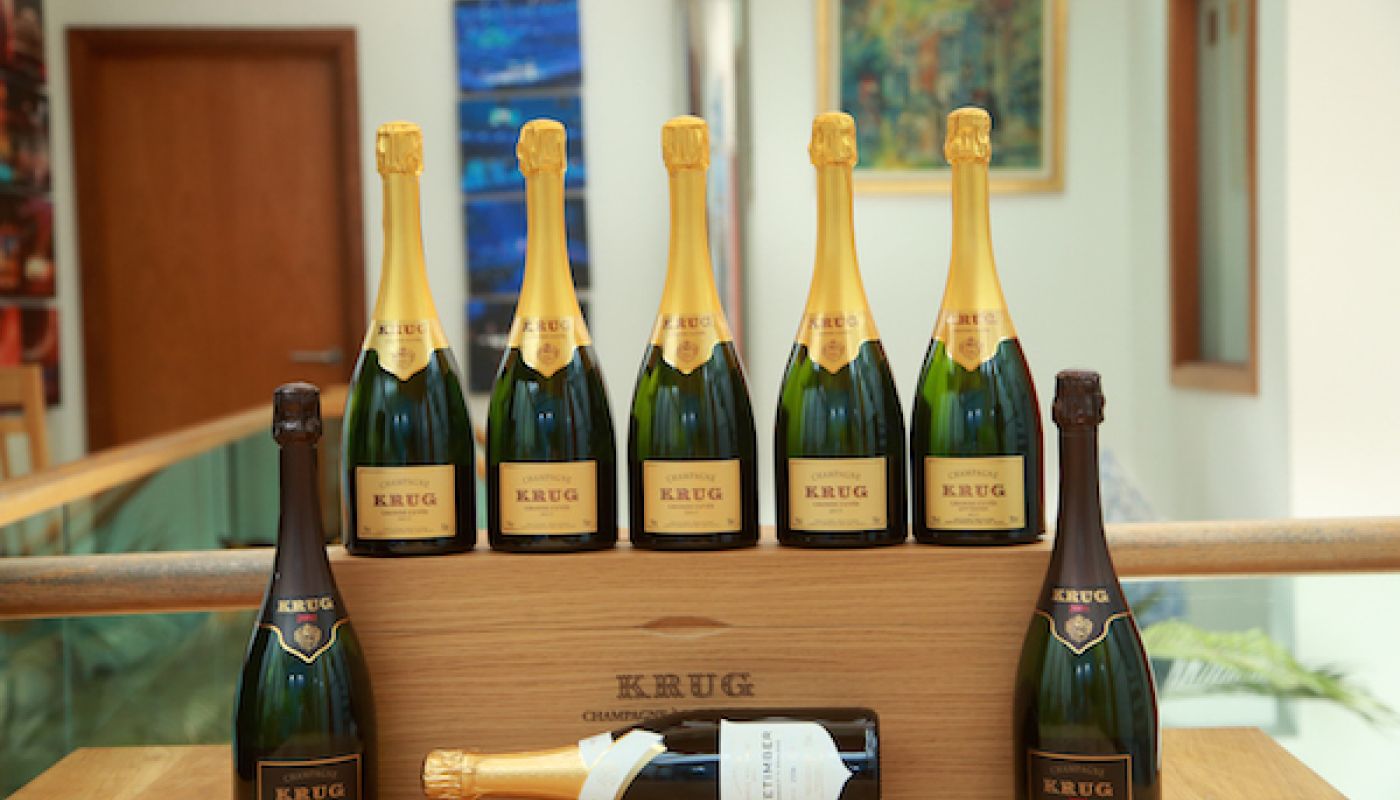
A common complaint by champagne lovers, including this one, is that, unless a champagne carries a vintage year (which only a tiny minority of champagnes do), it is impossible to tell what’s in the bottle – even though the producers make a new blend every year.
As befits one of the great names of Champagne, the house of Krug decided several years back to do something about this. Since 2012 every bottle of their non-vintage Grande Cuvée, blended annually, has carried an ID code on the back label that can be read with a smartphone, or accessed on krug.com, and gives access to a plethora of information about each blend.
Most non-vintage blends are made mainly with the most recent year’s harvest, generally supplemented by the addition of a proportion of older wines that are deliberately held in reserve for blending. No champagne blend has more ingredients than Krug Grande Cuvée, typically well over 100 different wines from more than 10 different vintages to add zest and depth to the latest year’s crop, which, in Krug’s case, usually constitutes between 50 and 70% of the blend. It would be impossible to squeeze all the information on to a label.
I was at a blind tasting comparing Grande Cuvée and vintage Krug in Hong Kong in 2011 that laid the ground for the concept of these codes. Since then five ‘editions’ of coded Grande Cuvée based on vintages 2003 to 2007 inclusive have been released. (Krug have recently started to add an edition number to the front label as well as the six-digit code on the back – much more elegant and memorable.)
To my knowledge, the full set of these coded Grandes Cuvées, so revered that they cost well over £100 a bottle, had never been compared blind until champagne nut Nick Baker of London champagne specialist retailer The Finest Bubble invited me and his marketing manager Carol Sturch to a particularly sybaritic tasting just before Christmas.
We not only ‘looked at’ (as wine trade jargon has it) these five prestige cuvées, Nick Baker also included in our tasting the two most recent vintage-dated Krugs, 2002 and 2003, so that we would have a chance to compare a wine that was 100% 2003 and a non-vintage blend based on 2003.
(It would have been interesting to have included the Grande Cuvée based on 2002 in our tasting too, but of course in the pre-code era, it was almost impossible for anyone outside the Krug team to identify it.)
Unbeknown to me, acknowledging The Finest Bubble’s recent diversification into English sparkling wines, Baker decided to slip in one of the most expensive examples, Nyetimber’s 2010 from a particularly auspicious part of their vineyards in West Sussex that they call Tillington single vineyard.
And just to keep us on our toes – or get us in the mood? – he had his colleague pour us blind one of the Grandes Cuvées before we even went to the tasting table. I deduced that this was the blend based on 2004 because it was obviously relatively mature and yet seemed drier and more savoury than I would have expected of a wine based on the heatwave vintage of 2003. It really opened out in the glass and would be my choice of Grande Cuvée for drinking now.
To my surprise, however, my favourite Grande Cuvée was the youngest one, that based on 2007, not a particularly celebrated vintage for Champagne. It was clearly youthful but had the loveliest spread of flavours on the finish – although perhaps this is not so surprising considering a grand total of 183 different wines went into the blend.
The interesting thing about Grande Cuvée is whether it reflects the characteristics of the principal vintage or whether chef de caves Eric Lebel deliberately suppressed, disguised or minimised them in his carefully chosen final blend. With the early harvest of 2007, for instance, he apparently had to depend on older wines to add substance on the palate while with the lower-acid base of 2003, he deliberately increased the proportion of younger Chardonnay reserve wines to add zest.
The old saw from champagne houses used to be that the reason they gave no information about what was in their non-vintage blends was that they were utterly consistent from year to year. That just won’t wash in a world full of wine geeks and it is to Krug’s credit that they have so explicitly acknowledged variation between the blends.
Another tenet of Krug philosophy is that the non-vintage Grande Cuvée and vintage Krug are of equal standing and quality – even though the vintage version, being made in much smaller quantity, attracts a premium.
In this blind tasting, however, I gave my highest marks to the two vintage Krugs, the majestic 2002 launched early last year and the massively intense, still vibrant 2003 launched in 2014.
And the English wine (of whose presence I was completely ignorant)? It got my lowest mark but that was still a very respectable 17.5 out of 20 – even though admittedly I thought I was tasting a Krug champagne. It did seem particularly embryonic so, when tasting it blind, I assumed it was the youngest Grande Cuvée based on 2007. (I thought that the lovely wine actually based on 2007 was the one based on the more glamorous vintage 2006.) The English wine was certainly fairly simple relative to the array of Krug champagnes, but then it was much the youngest wine of the tasting. It certainly wasn’t laughably outclassed.
The Grande Cuvée based on 2003 seemed the least vital of the Krugs, fading a little on the finish. But then it had been disgorged back in 2011. This was the wine in the tasting with the highest proportion of Pinot Noir: 51%.
The Krug family have always been great champions of the other Pinot, Meunier. The wines with the highest proportion of Meunier, and two of my favourite wines – the vintage 2002 and the Grande Cuvée based on 2007 – each contained as much as 31% of this oft-scorned grape variety.
The Grande Cuvée based on 2006 tasted relatively rich and opulent. It is certainly ready to enjoy. Its counterpart based on 2005 was reasonably recognisable with its tension, youthful acidity and balance but perhaps had slightly less density, drama and finesse.
So what did we learn? That all the Krugs are made to an extremely high standard but there really are differences between the different bottlings of Grande Cuvée. On the basis of this relatively small tasting, vintage Krug seems to have a longer life than Grande Cuvée.
I went straight from this hedonistic exercise, clanking a couple of bottles of leftovers for our family Christmas, to the annual drinks party given by some friends nearby. The sparkling Saumur didn’t quite do it for me.
RANKING KRUGS
Scoring or ranking such wines seems utterly unnecessary but, for what it’s worth, this was my order of preference, with each wine’s ID code.
Vintage 2002, 414071
Vintage 2003, 113015
Grande Cuvée based on 2007, 163rd Edition – 315051
Grande Cuvée based on 2004, 160th Edition – 212018
Grande Cuvée based on 2005, 161st Edition – 312036
Grande Cuvée based on 2006, 162nd Edition – 214032
Grande Cuvée based on 2003, 159th Edition – 211021
Nyetimber, Tillington Vineyard 2010













