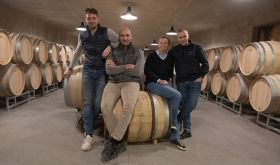
‘Making good wine is just the beginning. Selling it is what’s difficult.’ So says Silvana Ballotta of Business Strategies in Florence and she should know.
A common, and to my mind justified, complaint of wine producers outside Europe is that their EU counterparts have long been cosseted by official subsidies to guarantee a minimum price, bribes to pull out inferior vines, and have even been paid to have their unwanted produce compulsorily distilled into industrial alcohol.
But in 2008 all this changed. In a policy switch, the EU decided that the funds that used to be poured metaphorically into the European wine lake should be spent on actively promoting European wine outside Europe, creating new markets and making it more competitive with the likes of Australian Shiraz and California Chardonnay.
A total of €522 million a year were spent on promoting or advertising European wine outside the EU in the 2009–13 promotional period. And now, rather amazingly considering how many misappropriations have been uncovered, the EU has increased the total sum available for the current period 2014–18 by 121% to €1.156 billion a year. Annual wine exports from the EU are worth about €8.6 billion.
France, for example, is to be allotted €280.5 million each year between now and 2017, very much less than the other two big wine producers of Europe, Spain and Italy. Perhaps this more restricted budget is in response to the discovery, as part of the EU audit of how money was spent, that ‘one beneficiary presenting an amount of €3,405 was classified as "informative travels for journalists, importers, market coordinators, etc. to the area where the wine is produced”’ but turned out to be the cost of three VIP tickets for the tennis championships at Roland Garros, 'which cannot be considered as a wine promotion action’, as the report concludes drily.
The French were also rapped over the knuckles for claiming €2.4 million between 2009 and 2012 for the promotion of champagne, a name that is already world-famous and has been fiercely protected for years.
The country that had the most money to spend last year, €353 million euros, was Spain, although the EU censured Spain for giving far too high a proportion of funds, 88%, to six big companies that already had a presence on distant export markets. The whole point of this initiative is to make life easier for small and medium-sized companies.
Spain’s budget has been cut substantially from this year but Italy has a total of €334 million to spend every year up to 2017, which will be good news for Silvana Ballotta. She has worked at the World Bank and, most usefully, the EU, in the past and her own business started out organising joint ventures with the Japanese and Chinese, shipping out machinery and expertise to Asian forests. But from 2009 she has been helping smaller Italian companies find EU matching grants to promote their wares outside Europe. (The deal is that the EU funds 50% of approved projects.) She speaks disapprovingly of the €14 million euros that some of Italy’s biggest companies managed to claim in 2009.
Her work has typically involved grouping small companies into a larger entity so as to qualify for the minimum EU grant of €100,000, and nursing them through the process of attacking Asian and American markets and, crucially, helping them account for themselves afterwards. The Veneto (Prosecco, Amarone, Soave, cheap Pinot Grigio) takes the lion’s share, then Sicily, Tuscany and Piemonte.
‘Getting the money is the easiest part', she says, ‘but 10 out of the 15 people in our office spend their time auditing. If there’s a missing boarding pass, or comma in a report, then things are very difficult. And if they forget the EU logo, the EU won't pay.’ Indeed, there seems, in Italy at least, to be much more emphasis on the process than on the results.
Wine exports from the EU to Asia have been increasing, but it is difficult to argue this is as a result of the sort of initiatives that Silvana and her like have been organising. She does realise what a blunt instrument she is working with. ‘We find wine producers filling in forms proposing a campaign in, for example, Shanghai, getting the grant, and then asking “where's Shanghai?” Typically they get the money and then we have to nurse them through how to spend it. And we have to be careful that everything is co-ordinated and the recipients aren't all vying with each other, or all trying to court the same importers. Many of them don’t speak languages, get the funds to go to an Asian wine fair and just sit there. Not even a prostitute sits and waits.’’
The most obvious beneficiaries of the new EU strategy have been the organisers of wine fairs in Asia, since Asia has the least saturated target markets, and the most obvious, or easiest, way to make contacts is at a wine trade fair. These have mushroomed throughout China. Rare is the month when I am not invited to one of China’s third cities for the wine event of a lifetime. Hong Kong Vinexpo, the Asian version of Bordeaux’s wine trade fair, started off with just one floor for everything but had grown to such an extent last year that Italy alone occupied a whole floor.
A more recent Chinese problem has been organising grand dinners to accompany the fine Barolo and Brunello they were representing. ‘You can’t serve lamb with pineapple sauce with fine Barolo', explained Silvana. They are opening an office in Shanghai, to be run by a Chinese woman who used to represent Château Mouton-Rothschild but is keen to move on from Bordeaux to the wines of Italy.
In the US, the approach is very different because Italian wine is so well known to Americans, and the trade fairs that are vital in Asia and Russia are less important. They tend to focus their efforts there on tastings for the increasingly important sommeliers. They know they can depend on any half-decent restaurant to come up with suitable food matches.
EU funds may be used for advertising and at one stage, apparently, it was the summit of many small producer’s desires to see their wine feature in a glamorous ad in one of the world’s handful of important wine magazines. But now that the bills have been paid, most of them are questioning the value of this particular approach, according to Silvana.
She sees potential in Central and South America, even though Brazil has protectionist measures in place which require any exporter to partner with a domestic producer. But, if all goes as expected, the next target market will be the UK, which the EU is expected to add to its permitted spheres of subsidised wine promotion any moment. Good news for the organisers of UK wine fairs, presumably.