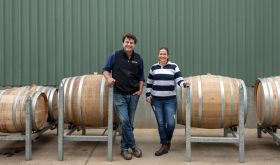
30 September 2014 This article was syndicated. The picture shows a Riesling roadshow in China with, left to right, the late Etienne Hugel of Alsace, Erni Loosen of Germany and Peter Barry of Australia with their Chinese fixer attempting to stir up Asian enthusiasm for the world's greatest grape – see Riesling revolution in China.
I am sometimes asked by people who exaggerate my importance what it's like to have real influence in the wine world. Whenever this happens I mention Riesling. For roughly 35 years I have been talking up Riesling, describing it as the world's greatest white wine grape. Every few years in some corner of the wine world there is talk of a Riesling renaissance. In Alsace in the 1980s, in Australia in the 1990s, in the United States in the late 2000s, and yet it stubbornly refuses to take off to become an international trend. Riesling – so often mis-spelt and mis-pronounced (it's Reece-ling) – seems destined to be a minor player everywhere other than in its native Germany.
I am slowly, in my old age, coming to terms with this. I know that Riesling can transmit terroir more sensitively than any white wine grape I know, making it truly the counterpart of the Pinot Noir that is so often grown alongside it. I also know that Riesling is just as good at history as it is at geography. Its wines can last just as long as those made from Cabernet Sauvignon. (I know; I once organised a tasting of the same senior vintages of Mosels and Médocs.) I also appreciate the way that, thanks to its extraordinary extract in many cases, Riesling can deliver so much flavour without that much alcohol and, perhaps because of this, it goes so well with food – far better than a typical Chardonnay.
But I increasingly get the feeling that I will be taking this knowledge to my grave, unshared with the great mass of wine drinkers. I used to want to convert them all to the virtues of Riesling but more and more I realise that Riesling just has too strong a personality to appeal to enough consumers to gain global traction. The problem with Riesling is that, unlike Chardonnay and Pinot Grigio, it has a very powerful flavour. And there are so many wine drinkers who have been put off it either because they associate it with residual sugar (which people purport to hate even though there can be a lot in mass-market brands of Chardonnay and Pinot Grigio) or because with age some Rieslings take on a sort of petrol or kerosene note. And even when it is young it has a much more powerful flavour than most white wines – which some people are bound to dislike.
It may be that, partly thanks to the transformation in German wine production and climate, German Riesling is now available in a much wider range of styles, many of them highly accomplished, than was once the case, but there are still many people who just don't like the taste of this particularly assertive grape.
This is such a shame since the quality of Riesling has never been higher. German Riesling has been transformed from the sugarwater of the 1970s and 1980s to being a wonderfully appetising wine at all levels of sweetness, including, crucially, bone dry. In fact 60% of all German Riesling is now either trocken or halbtrocken (dry or half dry) and is just as suitable as, some would say more suitable than, a fine white burgundy with food. It is not just that there is more will and skill in Germany devoted to making truly fine, fully ripe wine from Riesling but climate change has helped too.
In the late 20th century German producers went through a phase of pushing the ripeness of Riesling to the limit so that we saw some examples at 14% alcohol, sometimes labelled Auslese trocken. Fortunately they seem to have seen the error of their ways and, as virtually everywhere in the wine world now, most producers are preoccupied by trying to make properly balanced wines.
Across the Rhine, wine producers in Alsace have been feeling the pressure of competition from Germany's newly minted dry Rieslings and accordingly have been organising high-profile events devoted to the virtues of Alsace Riesling. They have also been fine-tuning their beloved regulations so that the consumer can rely on Alsace delivering Rieslings that really do taste dry.
Austria, another significant European producer of Riesling, went through the same process as Germany at more or less the same time. There are a few vintages in the late 1990s in which some Rieslings (and in particular some of their signature Grüner Veltliners) were so alcoholic that they tasted oily and flabby. But in this century Austrian winemakers are making real efforts to make more refreshing wines and were mightily relieved to see the 2013 vintage return to more normal ripeness levels after two rather hot years in 2012 and 2011.
Thanks to the 19th-century influx of religious refugees from Silesia – part of Poland today but German then – Australia has more Riesling in the ground than any country other than Germany. From where I sit, South Australian Riesling has been going through a bit of an identity crisis recently. Just as Australian Chardonnays were sent to Weight Watchers in no uncertain manner and were dramatically slimmed down, typical Australian Rieslings seemed to go through a particularly austere phase. A few years ago I rather despaired. It seemed as though the fruit had gone into retreat, trapped in a steely metal suit of armour. But I'm delighted to say that from about 2010 the fruit has returned and Clare and Eden Valleys, not to mention odd spots in Western Australia and Victoria, are now producing some of the world's finest dry Rieslings.
It took New Zealand quite a long time to get the hang of well-balanced Riesling. Many of them used to be a bit sickly. But now, riding the Pinot Gris-inspired wave of current enthusiasm for 'aromatics', it is not too difficult to find fine New Zealand Rieslings, and I am a huge admirer of Framingham's examples at all sweetness levels from Marlborough in particular.
But the country in which there has been the most obvious Riesling revolution has been the United States. Erni Loosen of the Mosel – that rarity, a flamboyant German – got together with Washington state's leading producer Chateau Ste Michelle and launched a joint venture to produce local Eroica Riesling, which was so successful in the marketplace that even California growers started to plant Riesling. The total area of California Riesling vineyard more than doubled between 2003 and 2012, and in Oregon, located between California and Washington, there is almost as much Riesling as Chardonnay.
Everyone got very excited about this new development for Riesling, which has emerged as the signature grape variety for the Finger Lakes in New York and the vignerons of Michigan, too. But there are worrying signs that this new US Riesling movement may be running out of steam. Even Loosen's man in the US Kirk Wille admits that sales of both domestic and imported Riesling are now falling and that 'Riesling remains a one-customer-at-a-time proposition, so it’s more difficult to sell than Pinot Grigio, say, or certainly Chardonnay. I think a lot of trade are getting worn out from the trying and are turning their attention to other “new” things, like wines from Georgia or Slovenia.'
Oh dear. Looking at international sales figures, I see that only Norwegian wine drinkers really understand the virtues of Riesling. Like me.