See also Sociando-Mallet – 54 tasting notes, with scores and suggested drinking dates and the ensuing discussion about Sociando-Mallet on our members' forum.
Among the many arguments for abandoning or revising the famous 1855 Bordeaux classification that ranks the top 60 or so wine properties in the Médoc in first down to fifth growths, one of the most compelling is the performance of Château Sociando-Mallet, a name completely ignored by the classification – although it has, admittedly, come to the fore only in the last two decades.
It was the famous 1982 vintage, celebrated throughout Bordeaux for the quality of its red wines, that really put it on the map. The Grand Jury Européen is an assemblage of experienced, mainly French and, apart from those few times I participated, all-male palates that are regularly exposed to a series of top wines blind. In their assessment of more than 100 red bordeaux 1982s in Las Vegas in 2001, Sociando Mallet 1982 was placed second only to the super-charming Ch Pichon Lalande 1982, ahead of all the first growths. In 1996, Sociando-Mallet was included in a survey by the same group of tasters of 23 of the greatest red bordeaux style wines in the world, and was voted favourite of them all in the next ‘great’ vintage, 1990 – 12 places higher than its second growth near neighbour Ch Montrose, whose 1990 is particularly celebrated. Averaging the scores for all three vintages tasted in this survey – 1983, 1985 and 1990 – Sociando-Mallet again took second place overall to second growth Pichon Lalande. In Merano in 1999 the Grand Jury placed Sociando top in its blind tastings of 132 top bordeaux of the 1996 vintage, and the 2000 and 2001 came top of important comparative tastings organised by France’s only wine magazine, Revue du Vin de France.
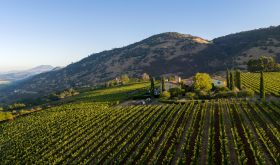
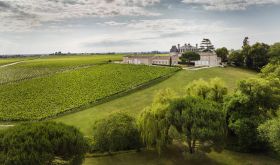
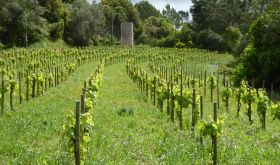
The property lies between the one-horse village of St-Seurin-de-Cadourne and the wide Gironde estuary, just three miles north of the most northerly classed growth, Château Calon-Ségur in the much more vinously famous village of St-Estèphe. The key to why its wines are so much better than those of its even closer neighbours is that, like virtually all of the finest vineyards of the Médoc, it likes on a gravelly croupe, one of the extremely gentle mounds that stop the Médoc being completely flat. It is famously said that the Médoc’s best wines are produced by vines that have a view over the Gironde. Château Sociando-Mallet has the best view of the Gironde of any Médoc château I have visited. You can see for miles both across and up it, with the massive citadel of Blaye across the water dominating the view. Those gravels, from the geological era known as Guntzian, are so well-drained that they encourage deep roots and ensure that the vines suffer no excess of water. Underneath the gravels is a mix of clay and limestone that keeps the soil, and resulting wine, fresh.
Although some records from 1633 make mention of ‘noble soils’ here belonging to a Basque family called Sossiondo, the property’s illustrious modern era did not begin until 1969 when a wine merchant in the local town of Lesparre, charged with finding a wine château for a Belgian client to buy, saw the potential of this particular property. Jean Gautreau, 42 at the time, paid 250,000 francs (‘too much’, he says) for what was then just five hectares of vines, a garage, a dilapidated fermentation vat or two and no cellar. He now says he paid too much, but he was congratulated on his purchase by the legendary cellar master of Château Latour, Jean-Paul Gardère, and by Jean-Michel Cazes of Château Lynch Bages.
His merchant business, which he sold only in 2003, allowed him gradually to improve and expand the property so that today, through judicious acquisition, it encompasses 115 hectares of which 85 are planted with vines. (The fact that this fluidity of boundaries is far from uncommon in the Médoc is another argument for a revision of the 1855 classification.) He has also, needless to say, built a modern vat room, a handsome barrel ageing cellar, a serviceable ‘château’ that looks disconcertingly alpine and, of course, a glamorous modern tasting room with a terrace that takes full advantage of that spectacular view.
It was here that a small group of us gathered earlier this month to taste our way through every wine that Jean Gautreau had ever made, to celebrate his 40th anniversary at Sociando (the Basque spelling changed over the years, and it was once owned by a Monsieur Mallet). I was curious enough about these wines to think it worth flying to Bordeaux specially to taste them as they are much better known/more available in France and the US than in my native Britain.
We tasted from old to young, following the evolution of this highly-evolved property and I must say that, considering the 1969 vintage was made with only the barest of equipment and knowledge (M Gautreau had no previous winemaking experience), it was miraculous testament to the quality of the vineyard. This was not a great year for Bordeaux by any means. And most 1969 red bordeaux are long dead and buried, but this first wine was still really quite charming, admittedly in a very traditional style but it still had fruit and delicacy. In fact the consistency and longevity of the range was most impressive.
Of all the Château Sociando-Mallets from 1969 to 2008, the only vintages I would not drink with pleasure are the 1973, 1977 and 1984 – all of them notoriously poor vintages throughout Bordeaux. The 1972, from another reviled vintage, was really rather nice, even if it tasted heavily chaptalised, sugar having very obviously been added to bulk up the final alcohol level from underripe grapes. And the 1975 is surely one of the best 1975s of all for current drinking. The Sociando style is clearly very classic with considerable stuffing but very marked tannins too so that all these wines seemed designed for almost as long a life as the finest first growth even if none of the wines was as subtle and elegant as a great first growth can be. But they have a very distinct robust style that shone through the whole range admirably, especially since during the 40 years they represented, so many Bordeaux proprietors have fallen victim to the latest fads in winemaking and wine styles.
One unusual distinguishing mark of Sociando-Mallet is that the owner is personally present and in charge of production. Of Médoc classed growths this can be said only of Anthony Barton of Châteaux Léoville- and Langoa-Barton. Having failed to persuade his wife to quit the fleshpots of Lesparre for the life of a chatelaine, Jean Gautreau still lives there, just seven miles away and, with the help of his longstanding oenologist Vincent Faure and dedicated maitre de chai Patrice Laujac, he is able to oversee the minutiae of what goes on in his impeccable vineyards and cellars. Another distinction is that Sociando’s vines are pruned severely in winter rather than being trimmed in summer to adjust the crop level to the vagaries of that particular growing season.
A special Jean Gautreau bottling was introduced in 1995, made up of what they reckon are the best 15 barrels made each year with Cabernet Sauvignon predominating. (The vineyards are planted with almost equal proportions of Cabernet Sauvignon and Merlot with five per cent of Cabernet Franc.) They can be pretty brutal in youth but may well soften into something miraculous with more years in bottle. These wines generally cost about the same as a very modest classed growth.
CHÂTEAU SOCIANDO-MALLET
Favourite vintages (in order of preference)
2000, 1982, 1975, 1998, 2005, 2003, 2008, 1990, 2001, 1996
Over-performing vintages (in chronological order)
1969, 1986, 1987, 1991, 1992, 1994, 1997, 2006
See also Sociando-Mallet – 54 tasting notes, with scores and suggested drinking dates.