When I arrived to taste the 2019s at Meursault’s most famous wine cellar, that of Domaine des Comtes Lafon, something strange happened. Dominique Lafon had to go searching for a spittoon. Normally at this time of year, the problem would be ensuring it was not overflowing, but this year Burgundy has seen a distinct shortage of tasters.
Usually when I’m trying to sort out my Côte d’Or tasting schedule towards the end of the year, prime tasting season, it’s a nightmare. Vignerons’ diaries are jam-packed by appointments with importers and commentators from all over the world and one has to juggle and adapt like mad. This year, when I decided in the second week of September to go and get a feel for the 2019 vintage in early October, I sent out emails with a suggested day and time to 24 wine producers and got 23 immediate and unqualified acceptances. (A combination of COVID, rebuilding and timing of racking led Jeremy Seysses to suggest ‘this is not a good time to visit Domaine Dujac, much as I would like to host you!’)
It was all eerily quiet when I got there and in many cases I was tasting these 2019s with producers for whom this was their first tasting of their range. There was the odd whisper that my fellow wine writers Neal Martin and Allen Meadows were expected but of wine merchants there was no sign. As Pierre-Yves Colin-Morey of Chassagne-Montrachet put it, ‘Last year we had too many visitors. This year too few.’
He was one of several wine producers who expressed fears that the Burgundy bubble that has inflated prices so markedly may be on the point of bursting, or may even have burst. Around 2012 the world’s wealthiest wine collectors started to turn their attention from Bordeaux to Burgundy, where quantities of individual wines are so much more limited. This has had an inevitable inflationary effect. During my visit to his cellar in Marsannay, Sylvain Pataille incredulously showed me a picture of a bottle of Domaine d’Auvenay’s 2013 Bourgogne Aligoté, the most humble white burgundy of all, priced at €490 in a Paris shop window.
For Colin-Morey, ‘Burgundy is at a very critical phase in its evolution. We’re all waiting for people to buy again. We have to put up with this stage and wait for it to pass – but it’s got to pass!’
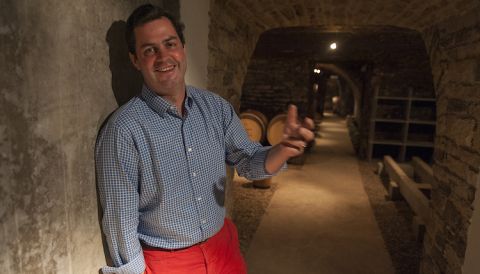
Louis-Michel Liger-Belair of Vosne-Romanée (pictured above in trademark red trews by Jon Wyand), who sees 2019 as ‘like 2009 but with better acidity’, remarked that they usually make their allocations in March and in previous years have been swamped by emails and calls from potential purchasers anxiously enquiring how many bottles they should expect. This year that didn’t happen. And the fact that Domaine du Comte Liger-Belair used to sell 40% of its wine to restaurants, now shuttered or shattered, has also forced a change in the way it sells its burgundies, costing up to £4,500 a bottle. ‘We’ve moved from collectors in their seventies to thirty- to forty-year-olds who have a wine fridge and buy only here and there. DTC [direct to consumer] is so much more important now, and our sales network could be global. We were already working on it but COVID has pushed us to accelerate that programme.’
The well-travelled Liger-Belair is already selling more proactively than most of his peers. The wine that he had deliberately kept back to see in the important shop window that is a top restaurant’s wine list, he is releasing to restaurants straight from his cellar as mature bottles, with perfect provenance, in threes or sixes. In order to discourage them from reselling the bottles on the open market, the restaurants have to send back the corks in order to get replacements. The scheme is so far confined to France but Liger-Belair may extend it.
He is currently offering his 2012s to restaurant customers – not exactly fully mature but at least more evolved than most burgundies you find on restaurant wine lists, even in Burgundy itself. Alex Moreau of Domaine Bernard Moreau in Chassagne bemoaned to me the fact that ‘people don’t know what mature burgundy tastes like nowadays. You go to restaurants in Beaune and there is just 2016 and 2017 on the wine lists.’
But what is 2019, the vintage that will be offered soon, like? I loved most of the wines I tasted – but then I tasted almost exclusively at the best addresses. The wines were charming, full of fruit yet with great energy too. A warm 2019/2020 winter possibly hastened the development of the 2019s languishing in barrels in the cellars of the Côte d’Or. They are the product of a particularly hot summer – even hotter than 2020, even if not as dry and not as early-picked – so it’s a bit of a mystery how they seem to have hung on to the acid levels which usually plummet in the heat.
When I discussed 2019 with the talented micro-négociant Benjamin Leroux he asked rhetorically, ‘why did they keep their freshness, especially the whites, that seemed to cope with the heat super-well. For the moment I have no idea.’ The general theory is that everything, including acidity, was concentrated in the distinctly non-juicy grapes that characterised 2019.
His whites were exceptionally successful and if I absolutely had to say which colour I favoured in 2019 on the basis of all the wines I have tasted so far, I would probably say – extremely reluctantly – white, whose yields were generally much lower than the reds, often shrunk by frost. But Meursault classicist and white-wine specialist Jean-Marc Roulot confessed he was no great fan of the 2019s, which he likened to 1990s – ‘too rich’.
On the other hand, his great friend and neighbour Dominique Lafon seemed delighted by how approachable the 2019s are and caricatured British burgundy lovers who always seem deeply suspicious of any young wine that tastes good. And it’s true that some 2019 reds will strike some palates as too sweet.
This may well not be the longest-lived vintage – but then, as Moreau pointed out, demand means that burgundy is being drunk younger and younger anyway. No one I spoke to thought that the 2019s would close down and go through the sullen phase that can bedevil some vintages.
More good news. As Freddy Mugnier of Chambolle-Musigny observed happily, ‘we’ve eliminated mediocre wine – the average quality is so much higher than it used to be’. I would concur, and I would also suggest that the biggest improvement has been at the bottom end of the quality and price range. I lost count of the delicious 2019s carrying the lowly Bourgogne appellation that I tasted, and these seemed so much better value than the grands crus that demand three- or even four-figure sums per bottle and many a long year of ageing.
Once the UK merchants make their offers over the next few weeks I hope to see some examples from really very respectable addresses for as little as £25 a bottle. That, believe me, is a steal in a burgundian context.
Over-performing 2019 Bourgognes
If no grape is cited, the whites are Chardonnays and the reds Pinot Noirs. Aligoté is coming into its own in these hot summers.
Whites
Dom Michel Lafarge, Raisins Dorés Aligoté
Dom Sylvain Pataille, various hand-crafted Aligotés
Reds
Dom Marquis d’Angerville, Passetoutgrains (a field blend of 50/50 Pinot Noir/Gamay)
Dom Perrot-Minot, Gravières des Chaponnières
Dom Cécile Tremblay, Bourgogne Côte d’Or
See this guide to my tasting notes.