One should of course be wary of mentioning national stereotypes but these observations were volunteered jointly by a Belgian and a Dutchman as we tasted wine together in Belgium near the Dutch border: ‘Belgians have a very different approach to the Dutch. They love to go out and spend. In a restaurant they’ll probably kick off with some champagne, whereas the Dutch are quite miserly and are more likely to go for the house wine.’
In the world of wine, Belgians have long enjoyed an elevated reputation for connoisseurship. For years in the early 20th century Belgium imported far more of the smart wines of Bordeaux, the crus classés, than any other country, including the UK and US. The Belgians were also the first to spot that Pomerol was really a rather glorious drink when the uptight Brits were still dismissing even Petrus, now Bordeaux’s most expensive wine, as an obscure country ferment.
But today Belgian wine drinkers are increasingly being exposed to wines produced in their own country. At the tasting mentioned above, the Belgian wine writer and ex-editor of Belgium’s wine magazine Vino, Dirk Rodriguez, treated me to a history of Belgian wine in the modern era. It was started by a handful of pioneers in the 1960s, followed by a second wave in the 1990s, producers that are all still in business. Another clutch of Belgian vignerons emerged in the very early years of this century and now, according to him, ‘not a month has passed without a new domain seeing the light’. Rodriguez’ PowerPoint presentation can be seen behind the Chardonnays in the tasting pictured below.

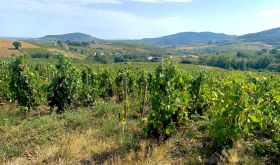
The association of Belgian winegrowers already has more than 200 members and it regularly participates in the major European wine-trade fairs in Paris and Düsseldorf. Many of the members previously grew other fruit, particularly apples. Vineyards can be found in much of the country except for the far south-east, which is just too wet. The greatest concentration of vineyards is between Brussels and Maastricht over the Dutch border (a pretty town that, I was assured, is more Belgian than Dutch in local habits, as was evidenced by the number of people drinking in outdoor cafés on the late March afternoon we spent there – see Nick’s restaurant reviews).
The total area of Belgian vineyards is under 1,000 ha (<2,500 acres), so less than a quarter of the extent of viticulture in Britain but more than most other far northern European countries in Scandinavia, the Baltics and the Netherlands, though the well-established Luxembourg wine industry has a little more. Poland has about the same total area under vine – but far more individual growers, suggesting that the average Belgian wine producer is more commercially viable than their Polish counterpart.
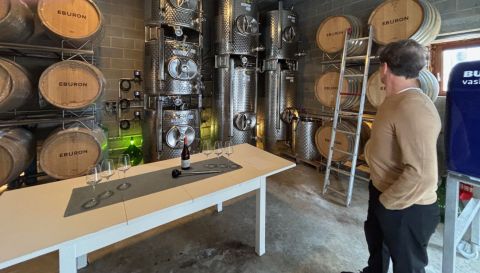
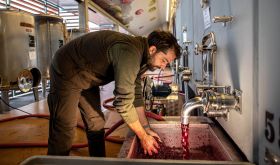
My Belgian wine tasting took place at a very nascent Belgian winery. Eburon Estate has only 1.5 ha (3.7 acres) of vines at the moment, and a tiny winery with just a dozen barrels and six small fermentation tanks, but it could not be faulted for ambition, nor the quality of its wines, even if for now it’s only a part-time occupation for its owners.
Paul Molleman and Marco Tiggelman work together as full-time employees of California’s Wine Institute in The Hague. Just before my tasting, Tiggelman had flown back from promoting California wine in Africa as part of US agriculture’s campaign there. He has a long history of generic wine promotion, working first for the famous Hazel Murphy, who did so much to introduce Australian wine to the UK in the 1990s, and then promoting wines from such corners of eastern Europe as Moldova and North Macedonia.
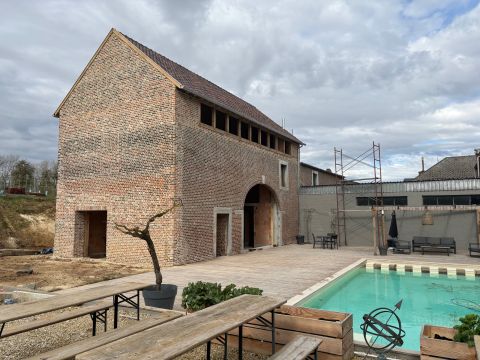
But he’d always wanted to make wine himself and began with a brand called Bucket, supplied by grapes from southern France and eastern Europe. A complicated story involving several divorces and an old flame saw him take over in 2023 a small, rather neglected vineyard that had been planted in 2015 on the edge of the village of Vreren just south of the oldest town in Belgium, Tongeren. (We had to take a circuitous route to the winery because the streets of Tongeren are given over to a popular antiques market every Sunday morning.) Molleman helped out by investing in the winery.
Since then, in his free time, Tiggelman and his partner Flore Engels have been feverishly restoring the vineyard to health, and converting the rather handsome Flemish barns on the property into a bed-and-breakfast and living quarters (see works above). They’ve even built a smart, modern cabin in the middle of the vineyard, complete with bathroom and hot tub, which they let out.

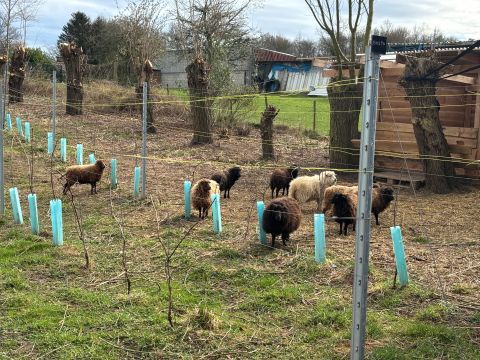
Other distinguishing marks include their 10 Ouessant miniature sheep (below) whose job is to fertilise the vineyard and keep the cover crops in check. Their Chardonnay, Pinot Noir, Auxerrois and recently planted Syrah vines benefit from a slight slope, but not one steep enough to protect them from Belgian viticulture’s most unusual and catastrophic 22 April 2024 frost, which reduced the country’s total harvest from well over three million litres in 2023 to just over one million in 2024. Eburon’s grape crop was reduced from 4,400 kg to 600 kg in the same period – not the greatest start for an embryonic business.
Low temperatures are no longer a problem for Belgian vignerons. Summer days can reach 30 °C (86 °F) and more nowadays. Wines of 13.5% alcohol are common. The biggest hazard is humidity: average annual rainfall in Belgium is 910 mm (3 ft) – more than ideal. ‘[Vine] disease control is a problem’, Tiggelman admitted, pointing out that Belgians, with their long love for French wine made from the European vine species Vitis vinifera, are much less enthusiastic about disease-resistant hybrid vine varieties than is the case in the Netherlands, Poland and Scandinavia.
On the other hand, Belgians are very fond of sparkling wine and, on the basis of my tasting, I’d say Belgian grapes, like their English counterparts, are well suited to producing fizz, thanks to their relatively high acidity. (Much of the underripe 2024 was made sparkling.) I enjoyed answers to champagne made not just by Eburon but by Schorpion, the well-established Genoels-Elderen and Entre-Deux-Monts.
Belgian Chardonnay first impressed me as long ago as 2007, when, in the smart Flemish restaurant Hof van Cleve, the sommelier served me and a fellow Master of Wine one from Clos d’Orpleeuw blind and we took it for a Puligny-Montrachet. Since then I’ve enjoyed examples from the newer enterprise La Falize, advised by the owner of the tiny, walled Clos d’Opleeuw Peter Colemont, and from Château de Bousval, whose refined Chardonnays are imported into the UK by Haynes Hanson & Clark.
My tasting of a dozen Belgian wines hand-picked by Rodriguez and Tiggelman included three Pinot Noirs, too. I particularly liked the purity and freshness of the Eburon 2023, which showed no obvious oakiness – quite a feat since, perforce, this debut vintage had been matured in brand-new barrels. The 2018 Vogelsanck from the well-established ‘château’-based Genoels-Elderen, on the other hand, seemed a little over-extracted, but this is probably not true of more youthful examples.
One of the Belgian wines I have recently enjoyed the most, however, was a fully mature 2017 Riesling from Aldeneyck which I’d been given to bring back to London. Served alongside a much younger Dutch Riesling from the equally well-established Apostelhoeve, grown just over the border, it went down particularly well with wine-loving friends who included a Belgian and someone who had worked several years in The Hague.
The number of Belgian wineries increased by 11% in 2024 apparently. Watch out, England.
Belgian but not beer
Sparkling wine
Schorpion, Goud Extra Brut NV
Eburon Estate, Blanc de Blancs Brut 2023
Entre-Deux-Monts, Collection Héritage Extra Brut 2019
Genoels-Elderen, Zilveren Parel Brut 2011
White
Alderneyck Chardonnay 2022
Clos d’Opleeuw, Cuvée Lossensis Chardonnay 2022
Genoels-Elderen Chardonnay 2020
La Falize Chardonnay 2020
Ch de Bousval, Gouttes d’O Chardonnay 2022
£30.85 Haynes Hanson & Clark
Ch de Bousval, Tout Cru Chardonnay 2022
£41.25 Haynes Hanson & Clark
Red
Aldeneyck Pinot Noir 2018
Back to basics
| Frost – an increasing hazard |
|
It is not just summers but winters, too, that are warming up. The result in vineyards is that vines are budding earlier and earlier, leaving them prey to the sort of disaster that befell Belgium’s 2024 vintage. Meanwhile, spring frosts seem to be becoming more and more frequent with sudden, unpredictable incursions of arctic or antarctic air. Frost is dangerous only when vines have started to produce buds. If temperatures fall below freezing, ice forms on the embryonic plant material which can turn brown and eventually drop off. Healthy green growth would have produced shoots, leaves and the flowers that would have eventually produced fruit, so frost damage can seriously shrink the size of the eventual crop. There can be secondary growth after spring frost but it is never as fruitful and ripening will in any case be delayed. 
Spring frost caused major damage to the 2021 vintage in much of Europe, including Bordeaux, as it had done in 1991.
|
| See the entries on frost, frost protection and frost damage in our exclusive online Oxford Companion to Wine. |