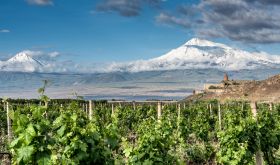
Nayan Gowda, 50, is a winemaking gun for hire. Although he took to winemaking only in his mid-thirties after working as a chef at The Ivy, he has already made wine in Australia, New Zealand, Germany, France, Hungary, Ukraine, South Africa, Norway, Chile, Kazakhstan and, most recently, Bolivia – two vintages during a global pandemic, surviving its particular vicissitudes plus some of the biggest challenges any wine producer could face.
Bolivia is home to some of the highest vineyards in the world but the most extraordinary aspect of his work in Bolivia is not altitude but the 200-year-old vines themselves. Just like when the Spaniards brought vines to Latin America in the sixteenth century, the vines Gowda works with grow not in neat rows on trellises nor as low bushes, but clamber, undisciplined, up trees – so much so, he says, that when you first visit the Cinti Valley in southern Bolivia where these vines grow, you don’t realise vines are there. Vine-growers everywhere are increasingly aware of the need to encourage biodiversity and are busy planting trees in vineyards; this valley is way ahead of the game.

The most essential bit of vineyard equipment here is a ladder. Unchecked, the vines, whose natural instinct is to climb if man does not intervene to marshal them into a more convenient shape, could easily grow six metres (20 ft) high or more. The main job during the pruning season apparently, when first the trees and then the vines must be pruned, is to cut down the highest growth so that the part of the vine that produces fruit is reachable by ladder.
Gowda was recruited to make wine here, via a Facebook group for travelling winemakers, by María Jose Granier, who belongs to a family of more conventional wine producers in Bolivia. She was alerted to the unique qualities of the arboreal vines of the Cinti Valley by Dutch Master of Wine Cees van Casteren, who, pre-pandemic, visited Bolivia frequently as part of a Dutch government development programme.
The Granier family make the sort of big, beefy reds that have so far been favoured by Bolivian wine drinkers but María Jose wanted to produce something very different. The idea of rescuing heritage vines and providing a livelihood for the local subsistence farmers strongly appealed to her and she was determined that her and Gowda’s wines, called Jardín Oculto (hidden garden), would be pitched at a premium price, the equivalent of $15 a bottle in Bolivia, ten times the price of the most basic wine there.
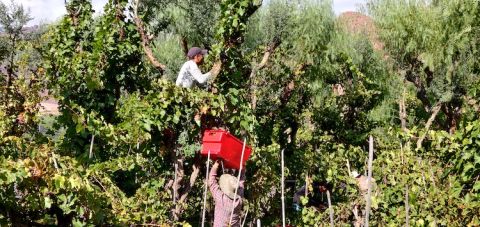
These tree-climbing vines are of three varieties, adding to the 54 different grape varieties Gowda had previously vinified. The Moscatel is the same as the Muscat of Alexandria grown in southern Spain, while the two red wine grapes are Negra Criolla (the same as Chile’s País and California’s Mission) and a local speciality called after the Bolivian town of Vischoqueña. Until the arrival of Granier and Gowda, these grapes were either distilled into the country’s favourite spirit singani or disappeared into blends with the international varieties that are planted in Bolivia’s more conventional vineyards, many of them round the town of Tarija.
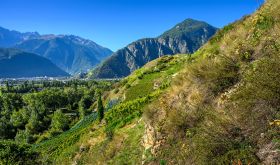
The Cinti Valley is at 2,300 m (7,550 ft), twice as high as the European mainland’s highest vineyard in the Alps, and three hours’ beautiful but dangerous drive, over two mountain ranges, from the Tarija winery that has loaned space to the Jardín Oculto project. Just as the grapes for Gowda’s first vintage, 2020, reached perfect ripeness, came storms so fierce that the whole country was shut down and harvest had to be delayed. So Gowda feels the 2020 grapes were a little riper than ideal but the three 2020 wines I tasted were genuinely thrilling.
Perhaps the most unusual one (as though there aren’t enough non-normative features to them) was a still white wine made from the local Vischoqueña grape. They meant to make a sparkling wine from it – though realised it would have to be a little less fizzy than sparkling wines drunk elsewhere because at altitudes such as the capital La Paz’s 3,640 m (11,940 ft), the wine would gush inconveniently unless they reduced the pressure in the bottle. They also realised they would have to leave the sediment in the bottle because in Bolivia there is none of the disgorging equipment that leaves champagne crystal clear.
But because of the pandemic, which has affected Bolivia, with its long, porous border with Brazil, particularly tragically, the border with Argentina was closed and their order of the sturdy bottles needed for sparkling wine never arrived, so Gowda had to turn his base wine for fizz into a still wine. He seems to have achieved this with aplomb, and the 2020 Blanc de Noirs has proved so popular with Bolivia’s better-heeled wine drinkers that he has had to make it again in 2021. ‘I just have to remember what I did. We’re learning every time we open a bottle’, he confessed. He describes himself as ‘addicted to learning’, which is what appealed to him about Bolivia.
The other two 2020s are a white from the Moscatel grapes that María Jose instructed him ‘shouldn’t taste like a Moscatel’ and is a pungent dry white with some burgundian features to it, and a very pale dry Negra Criolla red that is much more sophisticated than many of the new-wave light reds being produced today from the same variety under the synonym País on the other side of the Andes in Chile. I picked up a pepper note in this wine and apparently this particular vineyard (if vineyard is the right word for such a wilderness) is full of the pink-peppercorn trees known as molle here. One of the two additional vineyards they sourced fruit from in 2021 is called Los Membrillos because it is full of wild quince trees, with a predictable effect on the grape juice.
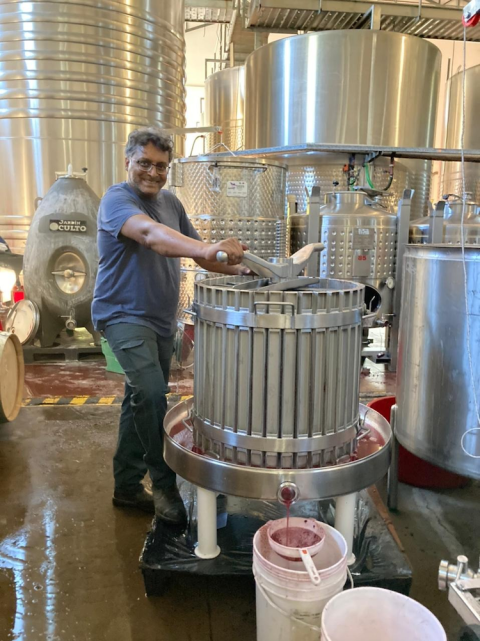
They made only 5,000 bottles in 2020 – with some difficulty because Gowda dislocated his shoulder – and have not increased production in 2021 because they have not yet been able to develop any export markets, even though apparently there has been considerable interest from Miami, where María Jose visits her mother. They are stymied by a chronic lack of equipment. All Gowda had access to while winemaking was a hydrometer, a thermometer, a pump, the small basket press pictured above, two hoses and a few small tanks; the wines can boast of being unfined and unfiltered for entirely practical reasons. The sort of analysis required for international trade is virtually impossible because there are no accredited labs in Bolivia and anyway any chemicals needed are extremely tightly controlled because they are assumed to be being used for cocaine production. Sampling the grapes, vital in deciding when to pick, is hampered by the wide variation in height off the ground. The sugar content of grapes growing up the same tree can vary by as much as an amount that would produce one or even 1.5 per cent of alcohol in the resulting wine.
There is no cool room in the winery but Gowda ensures that the truck carrying the grapes to the winery parks overnight in the mountains at 3,400 m (11,150 ft) so that grapes that were picked in temperatures of 25 °C arrive at the winery having been naturally cooled to 8 °C. This is just one of the challenges that have had to be met by lateral (perhaps an inappropriate word in this context) thinking.
Throughout his Bolivian adventures Gowda kept his social-media followers enthralled by his tales of sneaking into the winery in the pandemic to check on the progress of his ferments, equipment shortages, electricity outages and quarantines. His recent return from Bolivia entailed 10 days in the Four Points hotel at Gatwick Airport where he savoured a care package sent by one of his more avid online followers.
So what next? He really wanted to help out a friend with a vineyard in Bhutan which is at about the same elevation as Cinti Valley but winemaking is on hold there because of COVID. He has persuaded his doctor parents to return to India from Derbyshire. Perhaps he could offer a helping hand to the developing Indian wine industry?
Tasting notes on the wines, available only in Bolivia for now, are here. See also Jardín Oculto.