2025 will prove to be an excellent vintage for bordeaux but it’s another dastardly small one, unfortunately, with low yields. Here’s my annual weather and crop report in readiness for the tastings in April, when the world of fine wine descends on the region to sample the new wines.
The official production figures were released internally on the Bordeaux wine-trade’s website at the end of March. So, along with the data from six different weather stations around the region and other sources, I’ve put together a formidable series of graphs, maps and tables for what might be referred to as ‘a deep dive’ into the growing season and the resulting production.
2025 weather and growing season
2025 is the smallest crop since 1991 – as was, in fact, 2024. But while 2024 was a relatively wet year, 2025 was dry and hot throughout much of the growing season. It is the weather, after all, which largely determines the quality and size of the crop.
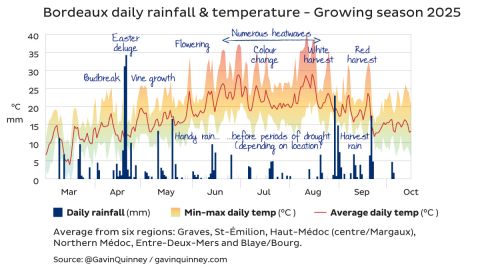
The graph above is one I’ve put together each year since the 2016 vintage, taking the averages from six weather stations around Bordeaux to get a more representative picture of the vintage. Note that there can be subregional variations, not least because it is a vast wine region. Following the dry, hot summer, we had an unusually early harvest, with the dry whites being picked in August and the reds being brought in from the start of September.
There are parallels with the really hot year of 2022 and, looking further back, to 2003. Below is an interesting graphic using the (Bordeaux Mérignac) rainfall and temperatures of each vintage from February to August, showing 2003, 2022 and 2025 in the hot and dry corner. It’s particularly relevant to precocious years like 2025, when the red grapes are harvested early, from the start of September. Many great vintages like 2016 saw later harvests, so when the fine September conditions are taken into account, that year would rightly move further to the left.

2025, 2022 and 2003 saw more days which went over 35 °C (95 °F) than any others this century. I remember those summers well, not forgetting that summer days which reach 30 °C (86 °C) are more than satisfactory.
The graph below shows a weekly timeline of the rain and the heat, while comparing the rainfall and average temperatures with the 15-year averages from the same weather stations. The heavy rain over Easter in late April was to prove useful given the lack of water and the heat that was to follow. It was warmer from May through August than the average, and the rain in August came only in the last days of the month. For many, just before the red harvest, the rain helped, keeping potential alcohol down and maintaining acidity. September saw rain intermittently during the harvest, and it was cooler than the average.
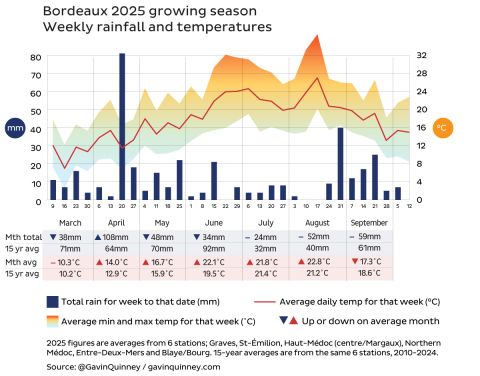
The same graph from the 2022 growing season shows the summer heat and lack of water was similar to 2025, though the timing of the rain was different, especially when compared with the significant rain in late August and September 2025.

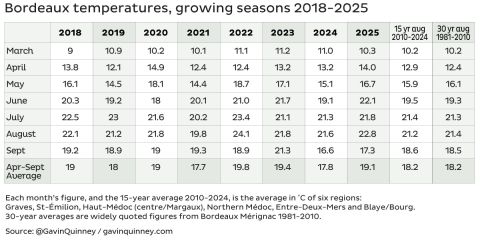
I’ve kept the data from the six weather stations for many years now, including the daily rainfall numbers. These are the averages of the six per month, with the 15-year average 2010–2024 of those same stations, and the 30-year Bordeaux Mérignac data. Every year can, of course, be quite different – such as 2024 v 2025. July and August are fairly consistent, though summers like 2022 can be too dry. As we saw above, the rain in August 2025 came at the end of the month, and that is often the way. A month’s high rainfall figure can be down to one or two days of stormy weather.
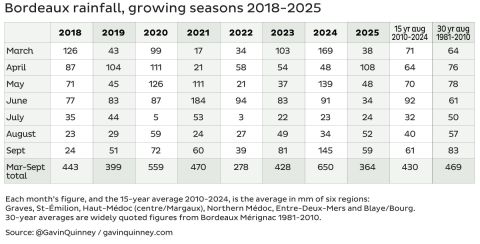
Below are the rainfall figures going back to the excellent vintages of 2009 and 2010, with the 30-year averages shown on the right. As well as those two years, 2016, 2018, 2019, 2020 and 2022 and now 2025 would be rated as the best vintages for red wines.
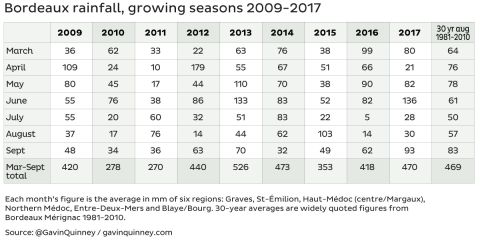
Some would add in 2015 as well, especially for the better wines of Margaux and St-Émilion. That would also make it easier if you like the handy sequence of very good bordeaux vintages ending in 0 or 5 (since 1990).
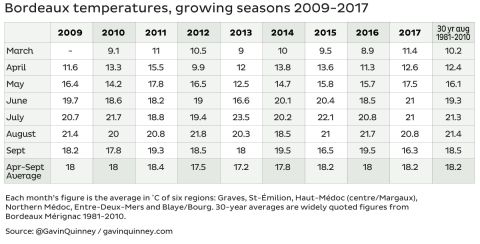
Here are the monthly average temperatures for each year. They don’t really tell the full story but can convey an impression – 2025 was warmer than average from April through to August, cooler in September.
Again, the same statistics going back to the top vintages of 2009 and 2010. You also get a feel for how a weaker vintage like 2013 never got off the ground with a chilly May and June.
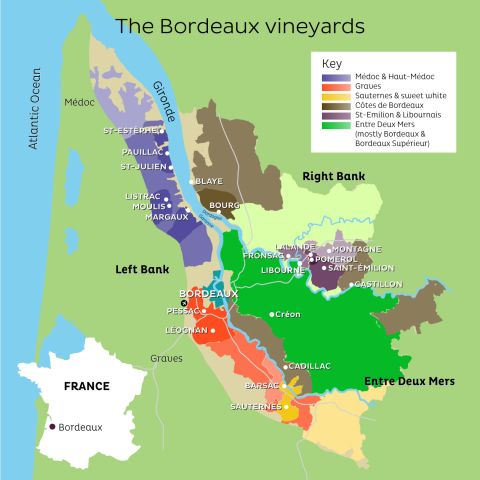
A quick reminder of where the Bordeaux vineyards are located. We live at Château Bauduc just outside Créon, south-east of the city of Bordeaux, in the Entre-Deux-Mers.
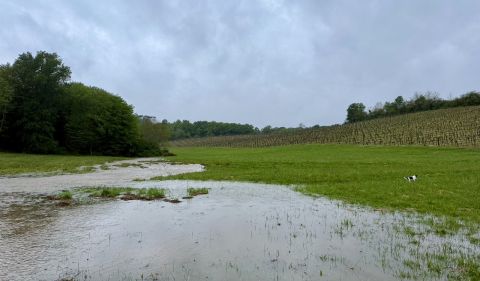
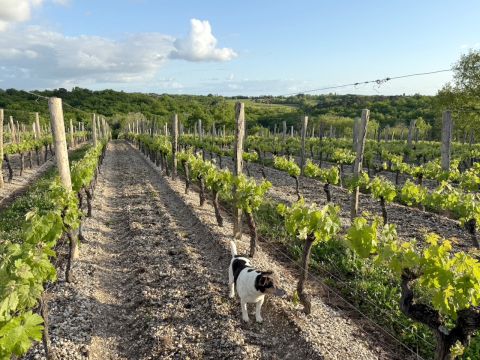
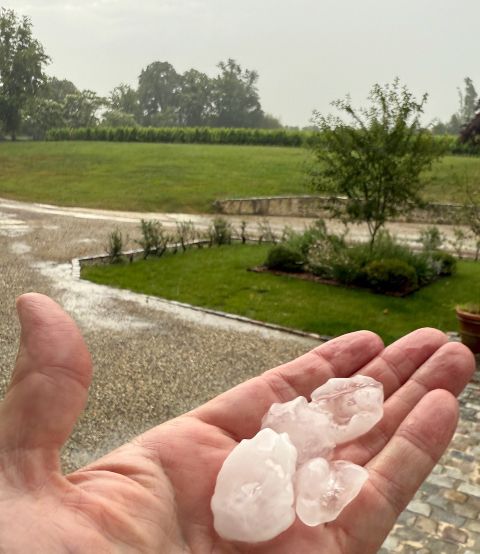
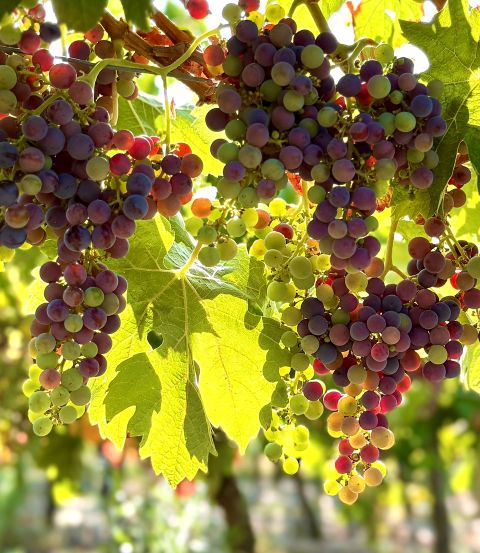
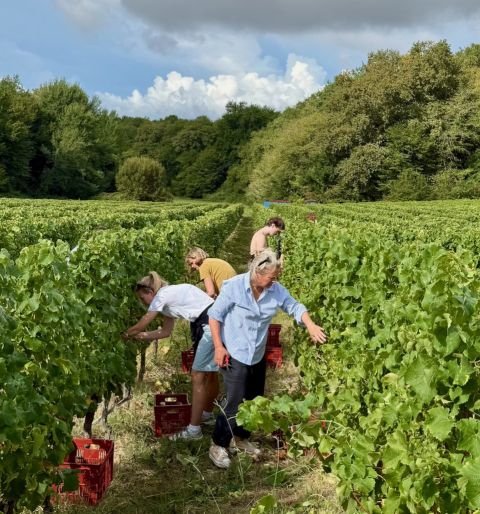
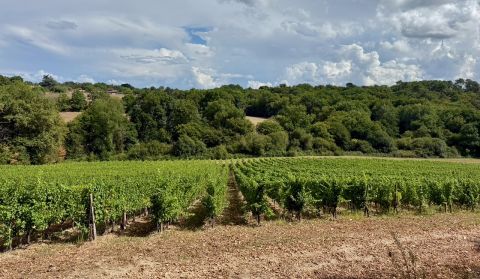
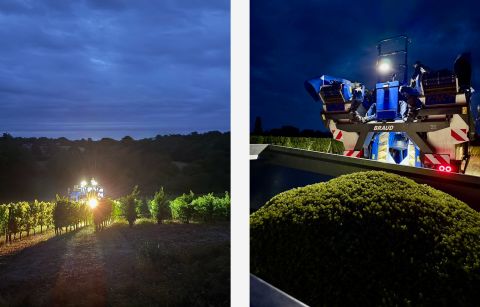
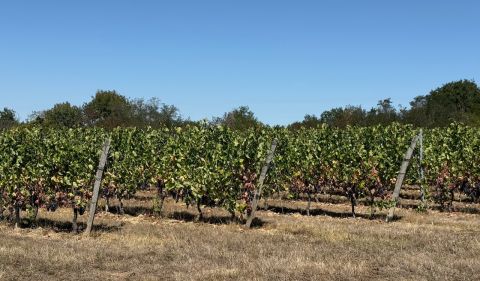
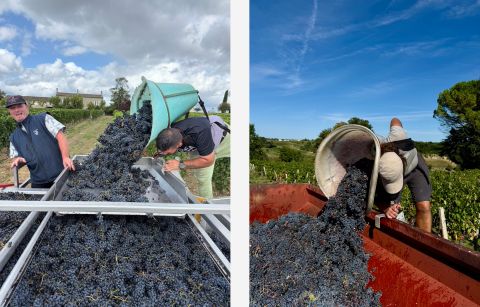
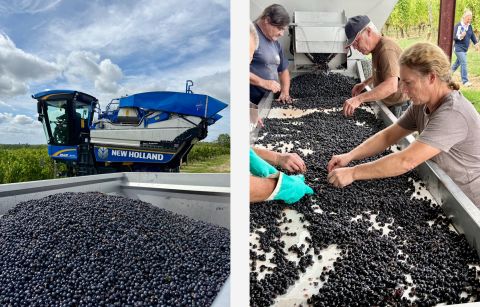
Photographic recap of the season
An interlude from all the tables and graphs.
Bordeaux wine production in 2025
In 2025, Bordeaux produced 82% red wine, 4% rosé, 9% dry white, 4% crémant blanc and 1% sweet white. The overall vineyard split is 86.7% red and 13.3% white.
After four years in a row of small Bordeaux crops, 2025 ended up with even less, and the smallest harvest since 1991.
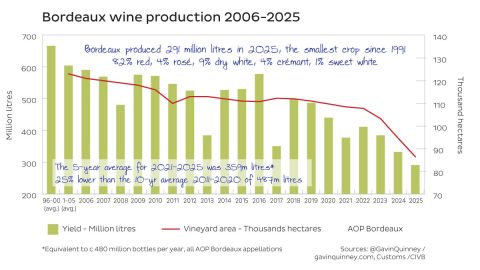
The 2025 figure of 290.6 million litres, with a low yield of 33.6 hl/ha, followed 2024 with 332 million litres and 35 hl/ha, 2023 with 384 million litres and 37 hl/ha, 2022 at 411 million litres (38 hl/ha) and 2021 with 377 million litres (35 hl/ha).
The five-year average from 2021 to 2025 of 359 million litres is 25% lower than the annual average of 487 million litres of the previous decade (2011–2020) and 38% lower than the average of 581 million litres of the decade from 2001 to 2010.
So it’s fair to say, given the current five-year average, that Bordeaux makes the equivalent of around 480 million bottles per year. That’s still a lot of wine, but considerably fewer bottles than the 650 million average of 2011–2020, and the 775 million bottles per year of 2001–2010.
A closer look at yields
These are the yields per hectare from the whole of Bordeaux, broken down into the main groups. 2025 produced low yields across the board for reds, and whites and rosé were lower than usual.
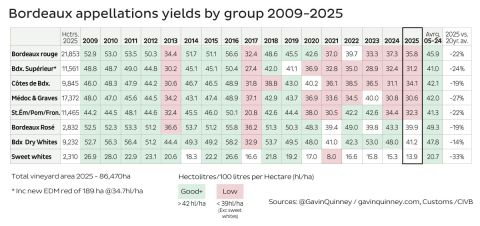
I’ve taken the yields in 2025 compared with the average of the last 20 years (2005–2024). As you can see, the production per hectare for red wines is down 19–27% in 2025 against that 20-year average.
2013 (poor weather) and 2017 (late April frost) saw low yields, and 2025 is the fifth consecutive year – for the generic wines – of small crops. 2021 was lower due to spring frosts in some areas and widespread mildew, 2022 due to drought and heat stress, 2023 and 2024 courtesy of the threat of mildew in the main, and now 2025 primarily down to drought and heat.
For many vineyards, there were fewer bunches in 2025 as a knock-on effect from the difficult flowering conditions for the 2024 vintage. (I noticed this on our Sauvignon Blanc before a grape had even formed.) Then, with the drought and heat, the grapes remained small and the yields never recovered from that. Fewer bunches, smaller grapes, great concentration but less juice.
The yields in the most prestigious appellations are of particular interest for the en primeur campaign that will follow the spring tastings in Bordeaux for the trade.
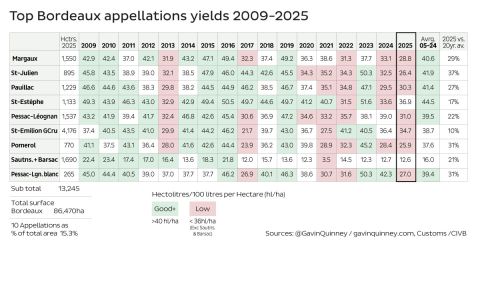
Compared with the 20-year averages from 2005–2024 shown on the right, the yields per hectare for 2025 are considerably down. 37% lower for St-Julien, 31% for Pomerol – both with just 26 hl/ha – then 29% less in Margaux and 27% in Pauillac (29 hl/ha and 30 hl/ha). St-Émilion and St-Estèphe got off comparatively lightly at 10% and 17% down on the averages, respectively.
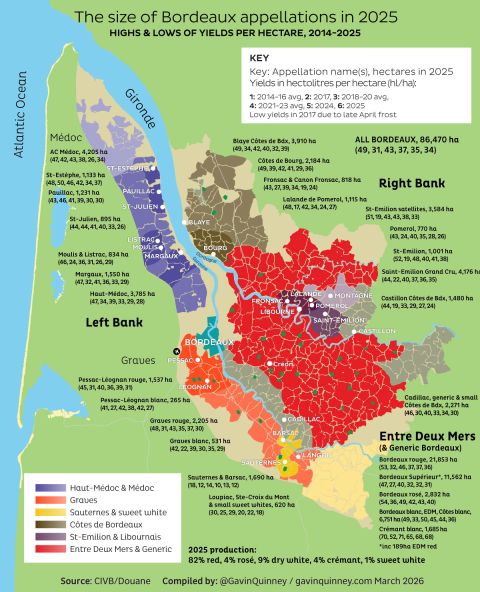
For those of a nerdy disposition, or for anyone with a special interest in certain appellations, a rather detailed map showing the size of each subregion and the yields per hectare in recent years. As you can see from the key, the yields are broken down into more manageable chunks. The Entre-Deux-Mers is usually shown on maps in green, but it’s where a great deal of basic red bordeaux comes from, so it’s here in red with dots of green to represent the dry white wines.
Dramatic fall in production and vineyard area
There’s less wine produced, less vineyard land and lower yields in Bordeaux. That much is obvious; this graph shows the general picture in five-year spreads. I asked Claude the other day ‘How much wine does Bordeaux produce?’ (That’s the AI ‘assistant’, not my neighbour.) ‘Around 850 million bottles of wine per year’ came back the immediate reply. That might have been true 25 years ago, but not these days.
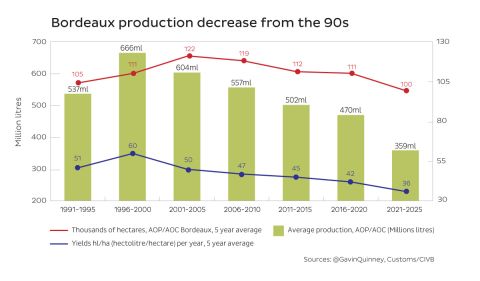
The graph below illustrates just how big a change there has been in the last decade, especially just the last few years. It’s extraordinary to think that for the excellent 2016 harvest, Bordeaux produced twice as much wine as it did in 2025.
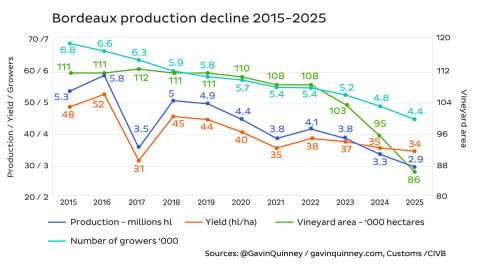
Meanwhile, the reduction in the vineyard area (the green line) has accelerated at quite a pace. Around 20,000 ha (c 50,000 acres) or 20% of the Bordeaux vineyard have either been ripped up (with or without a grant) or left abandoned in the last three years.
To put it another way, 20,000 ha is around four times the total vineyard area in England and Wales – including those not yet in production (around 4,250 ha were harvested in England in 2025).
More worrying for those of us still at it are the diminishing yields per hectare, mainly due to climatic conditions. For the vast majority of growers, yields of thirty-something hectolitres per hectare are just not tenable. Once in a while maybe, but not consistently.
The light blue line shows how many growers have stopped. From 6,600 in 2016 to 4,400 today – a third – and 1,000 of those have quit in the last three years, since the 2022 harvest.
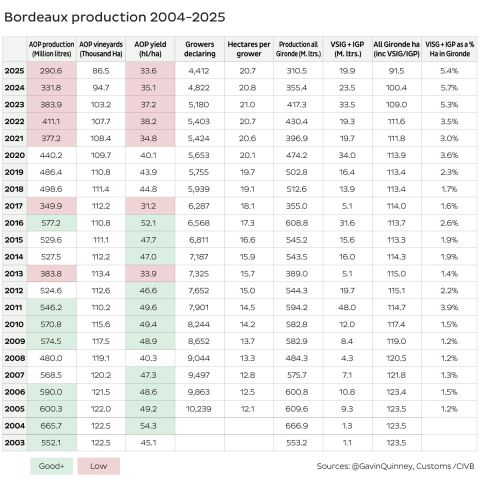
My somewhat detailed table above shows again how the average yields have dropped considerably in recent years. The total area of Bordeaux vineyards is falling, too – that’s all the subregions and generic bordeaux wines that are AOP (Appellation d’Origine Protégée). There’s also a smallish amount (about 5% each year of the total Gironde vineyard) of Vin de France and IGP Atlantique (previously Vin de Pays) combined, neither of which say Bordeaux on the label.
The number of hectares per grower used to go up, as a reasonably consistent surface area of vineyards was operated by fewer growers over time – consolidation, in effect. But now that the vineyard area is diminishing, and growers are quitting in droves, the average of 20 ha (49 acres) per grower (those declaring a harvest) has remained fairly constant.
More on the volume of wine
Here is an illustrative breakdown of where all the wine comes from, based on the volume made.
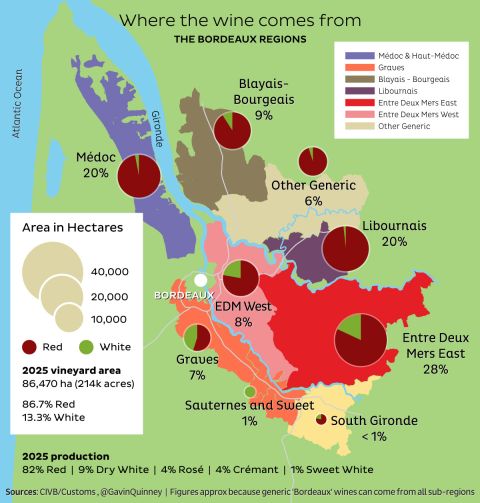
The Entre-Deux-Mers appellation (both west and east on the map) is better known for its white wine, but here’s an estimate of the enormous amount of mainly red produced here that’s labelled as generic red AOP Bordeaux. 10,000 ha of Bordeaux rouge have disappeared in the last three years, so that’s increased the percentage of wine from some other areas.
There is simply too much red wine being produced in Bordeaux.
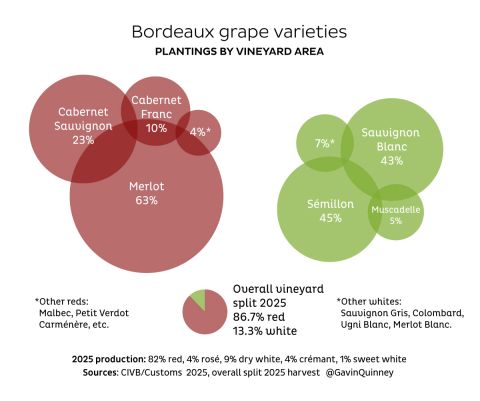
I haven’t seen a precise, up-to-date breakdown of the split of grape varieties for a while, so the graphic above is a best guess. But my estimates will be pretty close.
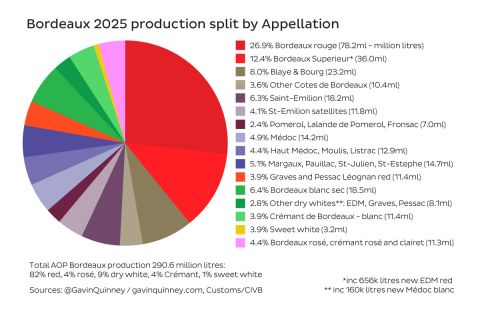
About 40% of the wine produced is generic red Bordeaux or Bordeaux Supérieur, plus another 10% or so of Blaye, Bourg and other Côtes de Bordeaux. Then there’s a bit more than 10% for St-Émilion and its satellites (Montagne, Lussac and so on) plus 15% from the Médoc appellations, on the left bank, in all. Graves and Pessac-Léognan red, also on the left bank, accounts for less than 5% of the total, and they produce a much smaller amount of dry white (1% – a similar amount to all the sweet white wine produced).
White wine accounts for just 10% of production overall. One area of growth is white Crémant de Bordeaux. In 2021, 550 ha were declared as white crémant, which produced 4.5 million bottles. In 2025, nearly 1,700 ha (c 4,200 acres) of white crémant were picked, making the equivalent of over 15 million bottles.

For comparison, above is the same chart for 2019. At the time, we thought it was a very good year, but with pretty average yields of 44 hl/ha. And yet 2019 produced 200 million more litres than 2025.
I’m afraid we’ve still got some way to go. A lot less red wine is required.
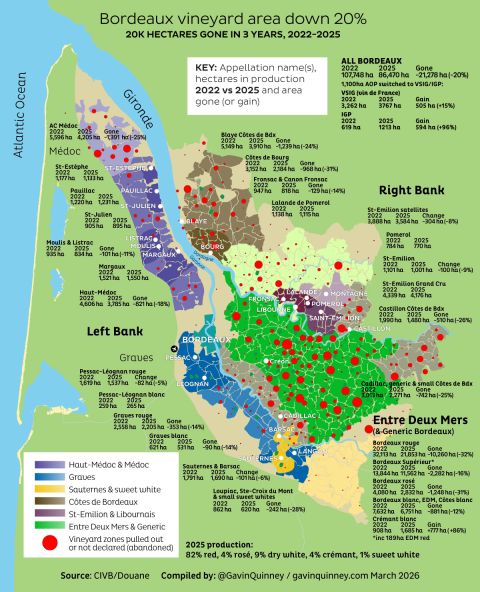
Well done for making it this far! With this final graphic, I’ve mapped out the rough location of the 20,000 ha that have disappeared in the last three years. Half have gone from ‘Bordeaux rouge’ – most of it from the Entre-Deux-Mers, around us, and not far from us.
The other areas where the vineyards have either been ripped out (or not declared for the 2025 harvest) can be seen by following the red dots: as well as generic Bordeaux Supérieur, there are the various Côtes de Bordeaux and up and over to the Médoc appellation, with many more in between.
To be fair, the authorities have been pushing for this, knowing that production has to fall in line with the diminishing market at home and abroad. Grants for pulling out vines have been in place at various stages in the last few years, while many growers have simply pulled up or abandoned vines regardless as they’ve been unable to sell the wine.
Onwards and upwards.