
There is something memorable about spending a night in a hotel that has recently opened, whether for the first time or simply for the season.
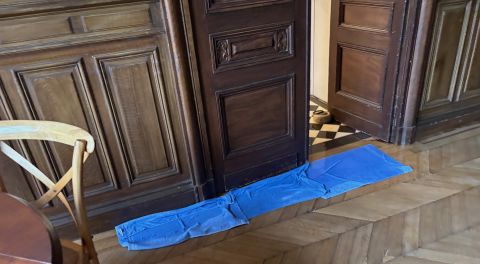
Shortly after we had been shown to our spacious bedroom in the Chartreuse du Château Le Thil which had just reopened, the electricity went out in our lavatory (it was fixed while we were out at dinner). Over breakfast the following morning, the waitress mistakenly gave our friend a bowl of salt instead of the sugar that he had requested for his coffee – and of course was mortified by the mistake. She also found herself on her hands and knees laying cloths along the base of the wall between the breakfast room and the kitchen quarters in an attempt to soak up water from an overflowing bathroom upstairs.
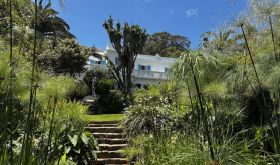
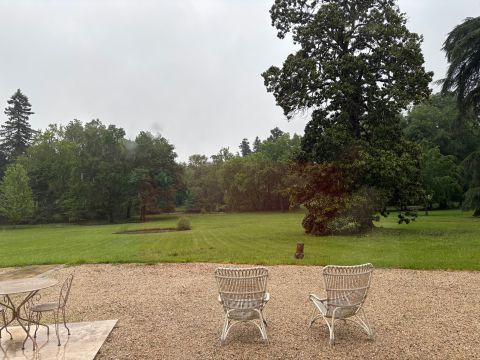
We had arrived the evening before under grey skies but the charms of this hotel in the woods south of Bordeaux had been clear. Once the summer residence of a 19th-century mayor of Bordeaux, it’s set in what the French would call un vrai parc, surrounded by beautifully mature trees with an extensive lawn at the front and a flowery meadow at the back.
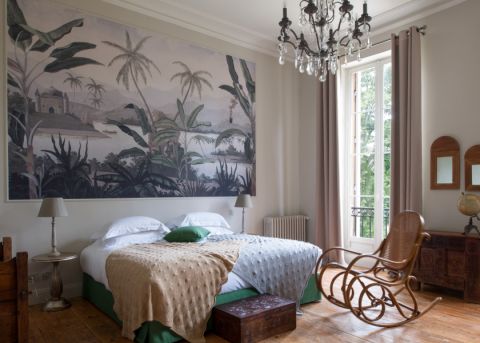
The building itself is only two stories high but is extremely elegant in the classical Bordeaux architectural style known as a chartreuse. The conversion from a private house into a hotel has been sensitively executed with each bedroom wildly but tastefully different. But the bones of the building have been left very obvious.
Our friend Julian Barnes, the salt recipient, great novelist and Francophile, had asked with some justification when we arrived on this pilgrimage to celebrate his 80th birthday, ‘why aren’t there buildings like this in England?’ I scrolled through my phone trying to find an answer. Was it because of the Enclosure Acts between 1750 and 1860 which accumulated wealth in the hands of the few? So many of England’s biggest buildings subsequently became boarding schools, psychiatric hospitals or government institutions.
Anyway, we were most definitely in Bordeaux, not England, and at a hotel that I would wholeheartedly recommend for any well-heeled couple or small group planning a visit. The nine rooms plus two suites can be taken over completely by a large party who could really take advantage of its handsome reception rooms.
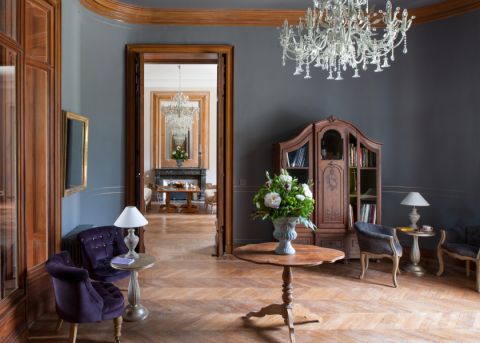
Château Le Thil is in Martillac, effectively a southern suburb of Bordeaux city, so little more than a 20-minute drive from Mérignac airport and the city centre. It has been restored and is now managed by Alice, daughter of the Cathiards of Château Smith Haut Lafitte, pioneers in wine tourism who opened the nearby Les Sources de Caudalie on the Smith property in 1999, and her husband Jérôme Tourbier. Sister Mathilde and Mathilde’s husband Bertrand Thomas founded the hugely successful Caudalie skincare brand, whose products filled our bathroom and are put to good use throughout the parent hotel-restaurant.
Les Sources de Caudalie is little more than a mile away from Château Le Thil and has a grand two-star restaurant, La Grand’Vigne, but we sought something more relaxed so ate in its sister establishment at Les Sources, La Table du Lavoir, which proved a great success.
There were several reasons for this – the food was excellent, the wine service attentive and it proved excellent value – but there was one more factor that underlined the restaurant’s success. Too frequently, second, less expensive restaurants in hotels are just that. They are places that have to be open because they are inside a hotel that has to be open for breakfast, lunch and dinner 365 days a year.

What is different about La Table du Lavoir is that the hotel’s owners have given this restaurant its own identity. It’s on the site of the old 19th-century laundry where the winegrowers’ wives came to do the washing. Hence its name – and there is still a large sink in the centre of the dining room. The reconstructed walls are glass, the ceiling (shown above) an almost wattle-and-daub reconstruction. The views are gorgeous, towards the château in one direction and towards the setting sun in another. Our small group felt extremely comfortable.

The menu excited us all, the dishes listed under five headings: starters; the kitchen garden basket; the fishermen’s creel; the butcher’s block; and cheeses and desserts, each selection seemingly united by an element of creativity and colour. There were four takers for the first dish, described as a spring pea cream, local strawberries and fresh cheese, which was cool, crunchy and absolutely delicious (and prompted me to attempt to recreate this dish on our return to London). This was a really first-class first course, pictured above without the bright green pea cream that was satisfying without being at all overwhelming.

This I followed with a hake tournedos (above), a thick, circular piece of the fish served with a rich meat jus that went well with the bottles of Pomerol and St-Émilion kindly donated by Edouard Moueix to the leader of our party and instigator of the expedition, Stephen Browett of Farr Vintners. With a bottle of Château Smith Haut Laffite’s excellent dry white donated for our first course by Florence Cathiard – the 2023 made when King Charles visited – and a shared rhubarb-and-fromage blanc vacherin to finish, I paid a bill for the food only of €424.60 for the six of us, including 10% service.
It is perhaps not an exaggeration to say that the winds of change are finally beginning to waft through even the thickest walls of the châteaux of Bordeaux as they face challenging times in selling their wines. They may not all have opened hotels and restaurants, as pioneered by Florence and the late Daniel Cathiard at Smith Haut Lafitte, but each has an extraordinary history to tell. And they are slowly beginning to tell it.
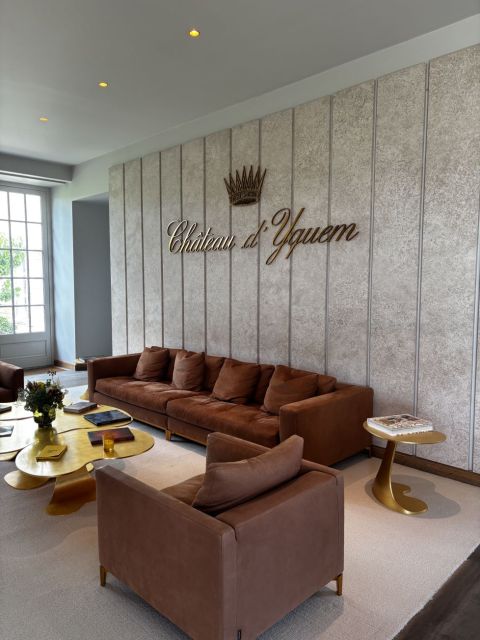
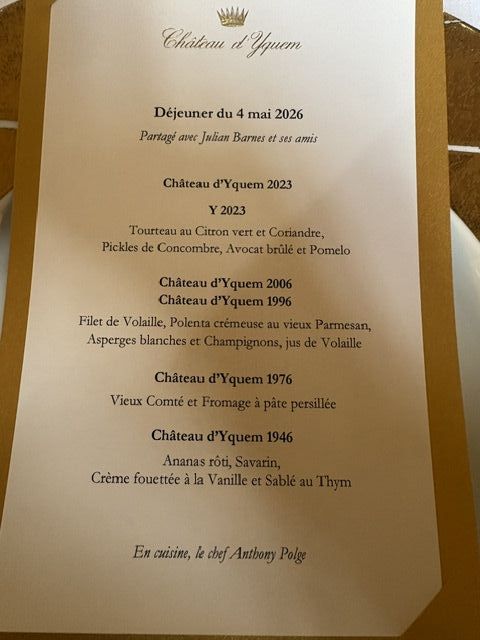
Our final destination was the birthplace of Barnes’s favourite wine, Château d’Yquem, for an exceptionally fine private lunch, a pilgrimage planned by Browett to celebrate Barnes’s birthday. (The last of the five vintages of Yquem – and one of Ygrec – we were served with lunch was a 1946.)
The château itself is uninhabited but the estate is now very much welcoming visitors in the new reception centre. This is work in progress but there is already a shop (sorry, boutique) where anyone can stop by and pick up a bottle of Yquem for lunch or dinner. (Interestingly, their still wine, Ygrec, continues to be made in such small quantities that none is for sale.)
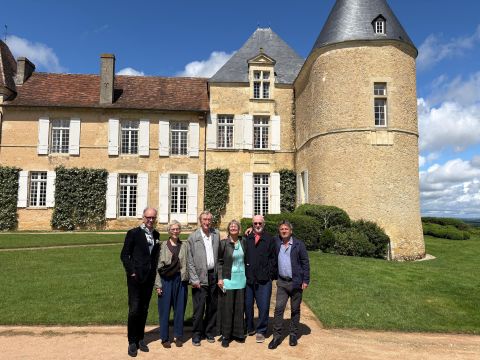
It’s also possible to book tutored tours – with top-quality visuals – for small groups priced from €100 to €350 per person depending on the number of vintages to be tasted. Our tour, led by the impressive Lebanese-born cellarmaster Toni El Khawand, was unforgettable. For a short while the clouds finally parted to allow us a leisurely tour of vineyards, cellar and garden in warm sunshine.
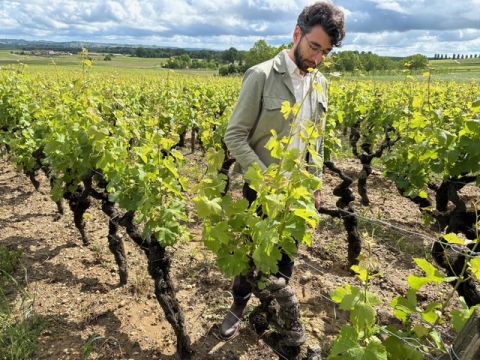
Also in the Pessac-Léognan appellation along with Smith Haut Lafitte is the famous first growth Château Haut-Brion, owned by the very friendly and generous Prince Robert of Luxembourg whom I had last encountered at the Primum Familiae Vini event in the Douro last June. (Our hosts there, the Symington family, have already moved successfully from port into table wine and then into the adjacent world of hospitality.)
I could not help but notice then that Prince Robert is an avid listener but after our recent visit to Bordeaux I wanted to ask him about his ventures into hospitality and his response was fascinating. ‘We already operate a visitor centre and wine shop at Château Haut-Brion while we complete the final works here. This will include a visitor circuit, a gallery, a cinema room, four extra tasting rooms, and cellars, of course. Also the château has been entirely rebuilt and insulated. I am also putting together a hospitality team to handle events, lunches and dinners at the château and we will be opening it up to visitors with times available from the autumn onwards. We are running about six months late, sadly. But I firmly believe the time is right to show off our history and there are 2,000 years of it – which is something no other wine region can equal.’
Lunch and dinner in the dining rooms of Bordeaux first-growth châteaux may remain by invitation only. But increasingly the front doors of these buildings will be open far more regularly and what’s inside will surely be far more welcoming than in the past. The Sauternes region dominated by Château d’Yquem prides itself on being at the forefront in this respect and already has flourishing starry restaurants at Château Lafaurie-Peyraguey (also a Lalique-themed hotel) and Château Guiraud.
Chartreuse du Château Le Thil 35 Chemin Le Thil, 33850 Léognan, France; tel: +33 (0)5 57 83 83 83
La Table du Lavoir Les Sources de Caudalie, Chemin de Smith Haut Lafitte, Martillac, France; tel: +33 (0)5 57 83 83 83
Château Haut-Brion 135 Av. Jean Jaurès, 33608 Pessac, France; tel: +33 (0)5 56 00 29 30 (by appointment only)
Before you go, check out our extensive coverage of Bordeaux’s small but promising 2025 vintage. And come back next Sunday to read Nick’s restaurant reviews.