Guest contributor

Michael Schmelzer of Monte Bernardi in Panzano reports on the last two vintages in Chianti Classico – and gives his verdict on the latest naming proposals there.
Very early on, Mother Nature tested our resolve to farm biodynamically by giving us a tough vintage – the 2005. It was challenging for us as well as for most Italian wine regions. Towards the end of the season it rained frequently, and as we approached harvest, I woke each time a storm rolled in, worrying what it might bring – disease or perhaps destruction from hail?
Fortunately, despite the challenges of 2005, the wines turned out to be delicious and the vintage brought with it a valuable lesson. I learned that organic farming done well results in better-balanced canopies and healthier vines, which in themselves are more resistant to disease and pests. In the end, we did have disease (mould), like everyone else, but in our case it started later and was less severe, which meant we lost less crop and were able to pick later – a big advantage in a year like 2005.
The wines we produced in 2005 convinced me that farming biodynamically was the right course, and helped instil a healthy attitude: the weather is not in our control; we can only strive to make the best wine possible, according to the vintage.
THE 2011 VINTAGE
The 2011 vintage was Monte Bernardi's twentieth vintage as a producer of estate-bottled wines. It was also the first anxiety-inducing vintage since our eye-opening 2005 experience. The 2011 vintage followed a year with drastically low production: in 2010 we had 30% less fruit in the young vineyards, and 50% less fruit in the older vineyards. So in 2011, when the vines burst their buds several weeks early, the thought that a frost could yet again reduce our yields was nerve-racking. Abundant winter rain followed by warm temperatures tricked the vines into thinking spring had arrived, and thus enticed them to an early start. With the delicate young leaves fully exposed, the fear was that the weather would return to near-freezing temperatures, damaging the tender new growth, and potentially destroying the first shoots. Had this happened, the auxiliary buds would have grown new shoots, which are always less fruitful than the primary ones. Fortunately the frost-risk temperatures did not return and the danger passed. I was once again able to sleep peacefully.
The season continued on its early course all the way through harvest, with some extreme heat in the hotter months of July and August. It was so hot in fact that the oak trees growing on the Chianti hillsides showed burning on their leaves, giving the impression that autumn had arrived early.
Like much of Europe, we started picking some of our vineyards as early as the last week of August, and continued picking until we finished on 19 September – three weeks earlier than what would be considered typical for our area (Panzano), and certainly earlier than ever recorded over Monte Bernardi's 20 years. In 2011 the last five weeks of bunch ripening occurred during much higher mean temperatures than in a normal season. As a result, the wines have riper aromas and less freshness, and express fewer of the aromatics and elegance which we think are unique to Panzano. Instead, to the taster, it may seem as if our vineyards were plucked out of our beautiful hillside and momentarily dropped into a warmer region for a one-off vacation. I hope it will be a rare voyage.
THE 2012 VINTAGE
To the outsider, the 2012 vintage was just as hot as, maybe even hotter than, the 2011. July and most of August were certainly very hot and dry, but the absence of rainfall over the winter and during the growing season may have actually saved the vintage and, in the end, allowed us to produce wonderfully aromatic, fresh wines with the lowest alcohol levels since 2004. The utter lack of winter and spring rain created a stress which delayed veraison by several weeks. We had bunches in which just a few berries changed colour; further ripening did not occur until several weeks later. When the much-needed rain finally came at the end of August, the vines were able to complete veraison and ripen during a cooler September through to early October, with harvest concluding on 16 October. In the end what seemed to many to be a season that concluded with unseasonable heat had a wonderful outcome.
IN THE VINEYARD
Over the last few years I've come to the conclusion that one of the biggest contributions to our wines' elegantly tannic quality and their relatively low alcohol levels is a result of sticking to an old practice that has been virtually abandoned, even in organic vineyards.
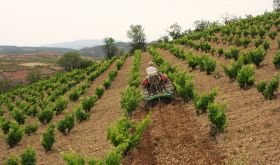
When the shoots of the vine surpass the top wire and start hanging into the rows, they risk being pulled down and broken by our passing tractor. This is when most producers would come through and use a rotating saw to hedge-trim the shoots to a nice uniform height above the top wire. I have always resisted this practice because it causes the lateral shoots to grow, increasing shading and humidity, and as a result augmenting the risk of disease and pest pressure.
When the shoots start hanging into the rows we, instead, manually wrap them along the top wire, evenly distributing them from right to left of the trunk. I realised that in addition to maintaining a better-balanced canopy, this practice brought another important advantage. In 'tipping' the shoot tip, you remove the shoot's hormonal driver at a time when the vine is about to change its focus from producing vegetation to ripening the grape bunch. The vine now has to expend more energy to produce new vegetation before it can change its focus to ripening the tannins in the grape. The resulting delay will mean sugar levels will continue to increase, as the bunch requires more time on the vine to ripen.
Later in the season, when we see the shoot tips are gone and tannin ripening is well underway, we may then trim excess vegetation above the top wire; this, however, is something we do mainly for aesthetics.
Warm growing areas with more fertile soils will inevitably have to tip their shoots, as the vegetation growth is too great to wrap along the top wire. Unfortunately, the end result will likely be greener tannins and/or higher alcohols.
GRAN SELEZIONE (or Grande Confusione)
The Consorzio of Chianti Classico ratified the introduction of a new, third tier in the Chianti Classico hierarchy – Gran Selezione. This tier, a Grande Riserva of sorts, would be placed above the Riserva category, and would be restricted to wines coming from 100% estate-grown fruit, something you would think is what a Riserva ought to be: a selection of an estate's best fruit. Clearly, if embraced, the Selezione will likely render the Riserva category null and void.
Rather than improving the image of the region as a whole, this move seems to be a tool to aid individual producers who perhaps felt they were hitting a price ceiling with the Riserva category, or wanted to find a new home for wines in the weakening Super Tuscan category?
If Italian producers want their customers to know a wine is made from fruit which is 100% estate-grown, -produced and -bottled, the guidelines already exist to label it as 'Integralmente prodotto e imbottigliato' – a designation which means just that – estate-grown, -produced and -bottled.
We believe a better way for the Consorzio to strengthen the denomination would have been to work on prominently distinguishing the differences between the Chianti Classico subzones, as David Berry Green of Berry Brothers and Rudd has brought to attention following the latest anteprima tasting [and our very own Walter Speller did before that – JR]. Of course, certain subregions may be reluctant, worrying that their region would be estimated inferior to another. This may happen, but it would be better for the whole. In all likelihood, it would stimulate interest in learning and appreciating the differences among particular subregions, as in Burgundy or in the communes of Barolo and Barbaresco. There would be more debate, and more meaningful research into what makes each region particular, and perhaps individual producers would be inspired to move toward a wine style which supports the strengths of their individual subregion. Shouldn't this, in the end, be our goal?
We see our work at Monte Bernardi as doing just this. It took a while for it to become evident in our wines; in the beginning we had acquired a number of new large oak casks which, in the first few vintages of their use, had a significant impact on the wines. However, our goal, from day one, was to emphasise the elegance and freshness we saw as unique to Panzano. At the time, it seemed as if we were working against the current but it certainly has paid off in the long run.