
Jérôme Binda has a nearly empty jar of Marmite in his larder. Have you ever met a Frenchman or Frenchwoman who likes this pungent, salty yeast-extract spread? But that’s not the only unusual thing I discovered when I spent time with him on the island of Tinos last month.
Trained as a graphic designer, French-born Binda worked with his mother as an art dealer, specialising in Old Master drawings. His grandfather, he told me, worked at the Louvre and later, during the Second World War, at the Met in New York. When at the Louvre, he was part of the team responsible for sending into rural hiding many of the museum’s greatest treasures, including the Mona Lisa, just before the war.
In 1987, soon after leaving art school, Binda holidayed on Sifnos, an island in the Cyclades south-west of Tinos, lapping up the sunshine and surviving mostly on foraged sea urchins. He knew he would come back to the Cyclades but it wasn’t until 2011 that he moved to Tinos with his wife Sabrina, now a ceramicist, and children, when his youngest was only three years old.
His initial idea was farming for essential oils. However, while he was exploring the island, he found and was captivated by a particular piece of land and, just after that, came across some of the island’s very old vines. Meeting local people in the nearby villages, he ‘fell in love with the perspective of trying to become a part of it, trying to become a winemaker and a peasant, a “paysan-vigneron”.’
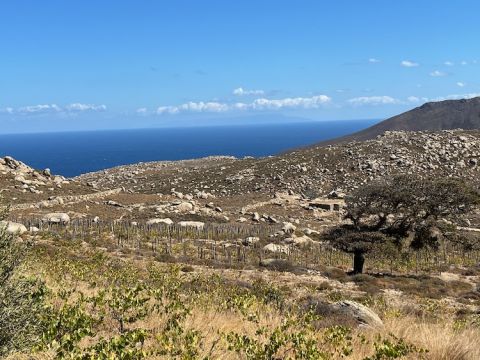
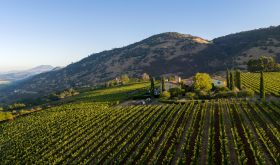
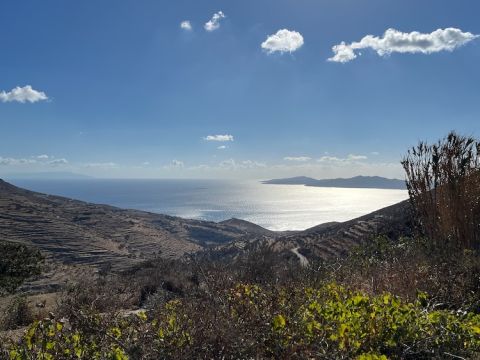
He bought the land (above) in 2010 and, having sought advice from growers such as the late Haridimos Hatzidakis from Santorini and father and son Thomas and Jason Ligas in northern Greece, he planted vines in 2012. Binda’s tale of how he bought the land suggested it might be more accurate to say that the land found him. (For background on Tinos and its wines, see my 2019 article The Tinos Renaissance.)
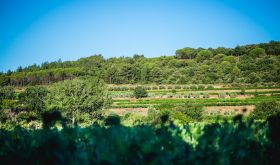
He has planted bush vines of Assyrtiko (using cuttings from Hatzidakis) and Rhône varieties Syrah (from Matthieu Barret in Cornas) and Serine (from Jean-Michel Stephan in Côte Rôtie) on the sandy granitic soils of his own land. The vines are individually staked, as shown below, because of the wind. He also harvests grapes from very old ungrafted vineyards, some up to 200 years old, that he looks after for their mainly elderly owners, who are unwilling to sell something they value and are proud of even if they cannot maintain the vines themselves and their children have no interest in doing so.

He and his small team, comprising his son Gabriel, who has worked with his father for seven years, long-term intern Jan, who fell in love with Binda’s wines when he was a sommelier in Belgium, and other occasional hard-working devotees, do all the vineyard work in return for the meagre amount of fruit that the local varieties produce. The main ones are Aspropotamisi (often called simply Potamisi; aspro means ‘white’), Mavropotamisi (mavro means ‘black’), Rozaki, Koumariano and Koundoura (which may be a synonym for Mandilaria). All vineyards survive the local marauding goats only if they are securely fenced. (Scattered around the island are the remains of EU-funded initiatives to promote agriculture such as broken-down fences from one-time goat pens – what Binda laments as an attempt to turn polyculture into silos of unsustainable specialisation and what some canny but unprincipled farmers saw as a way of earning a quick buck.)

The Tinian tradition is for the vines to sprawl along the ground, often on terraces and spreading several metres from the head of the short trunk, to protect them from the strong salty winds that Tinos is known for, and which are especially strong in July and August. In 2024, thanks to a year-long drought, there was virtually no harvest unless you could irrigate. Binda prefers not to, except for the young vines, and even if he wanted to water the vines in times of drought, the five wells on his land are all dry this year. The pressures of tourism and filled swimming pools compound the water shortage in such times.
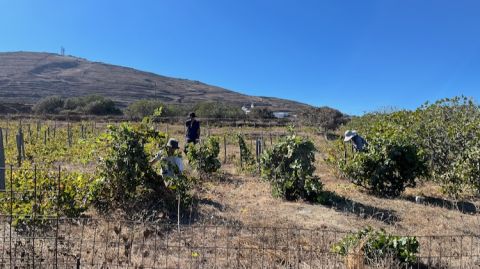
On the day I visited the young vineyard, and the house overlooking those vines and the sea that he restored for his family and his mother, who was a frequent visitor in the last years of her life, Gabriel and his team drove a tank full of water along the partially unmade roads from the winery. The precious liquid was used to water the roses and citrus trees around the house that looked as if they had a chance of surviving. There is water in some parts of the island, particularly in the north, but if you don’t have any, you have to buy it and have it trucked in. The main domestic water supply in some parts of the island is desalinated. Even the shower water in my hotel tasted salty. Thalia and Nikiforos Sotiriadis, whose recently planted terraced, organically farmed vineyard I also visited during my short ‘holiday’ on the island, explained that they had to pay €10 per cubic metre for trucked-in water.
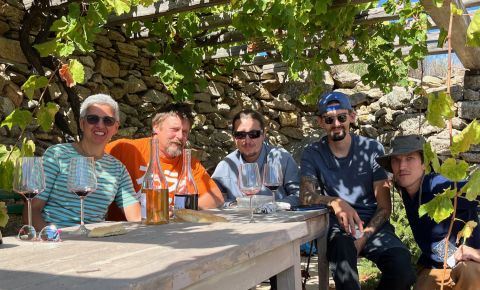
Using fruit from his own vines and from the treasured ancient vineyards, Binda made his first commercial vintage in 2016. On average he produces 10,000–12,000 bottles a year and sells to almost twenty markets around the world.
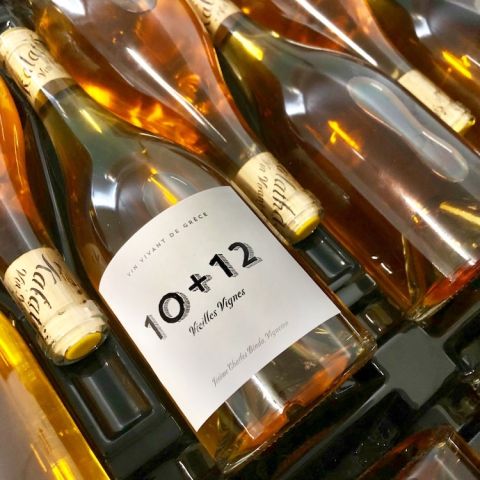
All the Domaine de Kalathas wines are certified organic, have had no additions or corrections whatsoever, including no added sulphites, and are unfined and unfiltered, which is why he tells anyone who transports, buys, sells or stores his wines that they must be maintained at 10–14 °C (50–57 °F). To highlight the living, changing character of his wines, he writes ‘Vin vivant de Grèce’ (living wine of Greece) on every label. For the same reason, the wines are at their best when drunk at room temperature. The first time I tasted the 2020 vintage of the 10+12 Vieilles Vignes, it was chilled, and I underestimated its beauty and complexity. But tasting the 2020 with Binda at room temperature in London in May this year was a revelation.
Named after the composition of the first vintage (tanks 10 and 12), the 10+12 Vieilles Vignes is made from foot-trodden Aspropotamisi, spontaneously fermented with a small percentage of whole bunches. It typically goes through malolactic conversion but there is so little malic acid in the grapes that this doesn’t really affect the taste.
The 2021 vintage that I tasted this week in London, like the 2020 and the 2022, is a golden-apricot colour, very slightly cloudy, and smells deeply of apricots, light spice and bitter orange. But there is also something stony, with a touch of hay, giving a kind of dusty, mineral impression that is hard to pin down in words. Even though Aspropotamisi is not a high-acid variety, the wine is immensely fresh, even (especially) at room temperature. The moderate tannins contribute as much to the freshness as does the acidity.
There’s also a savoury quality to the fruit, which Binda says is deeply appreciated in Japan, where they refer to his wines as ‘umami wines’. I’m often sceptical about the claims of ‘natural’ wines but here is one that is fault-free and intensely alive in the way it changes in the glass and seems to adapt itself to the food you drink it with – from seafood to chicken pie to grilled sardines to fatty meat.
In 2021 (the vintage is not shown on the label but can be deduced from the first two digits of the lot number on the back label), 15% of the wine spent three weeks on the skins in clay amphorae, but the exact winemaking varies from year to year and most of the fermentation and ageing is carried out in stainless-steel tanks. He never uses barrels of any shape or size.
Most of Binda’s wines spend a long time on their lees and are bottled late. The 2022 vintage, which I tasted on Tinos in early October but has not yet been released, had just been bottled after two years in the tank. At the winery, Binda explained that they had had to bottle just about all the wines that were ageing on the lees because their landlord had decided to turn the main part of what was the winery into an Airbnb, and their working and storage space was severely reduced.
This is a remarkable wine made by a remarkable man – and not just because he likes Marmite. His understanding of the natural world and the people who live in it, and his desire to see agriculture deindustrialised, is inspiring. He seems to accept his limitations in the face of Nature and to see every opportunity, every obstacle, as a chance to learn. If any batches of his wine don’t turn out as he hoped, he turns them into something else, eg high-quality vinegar!
This may all sound very worthy but Binda also exudes a zest for life, has a cheeky smile, emotional and practical acuity, and an obvious love for his family. His overriding aim is to ‘bring sweetness out of the rugged landscape of Tinos’. I’d highly recommend all three of the vintages I have tasted. While there are some vintage differences, they share this structured sweetness and complexity of a living, food-friendly wine.
The 2021 is available in the UK via importer and retailer Tutto Wines, along with several other Domaine de Kalathas wines including the 2017 vintage of 10+12, which I haven’t tasted. Maltby & Greek, who also import Jérôme Binda’s wines into the UK, have apparently just sold out of the excellent 10+12 2020 but have other Kalathas wines in stock. Shrine to the Vine have just one bottle of the 2020 10+12 and more of the 2021 vintage.
In the US, 10+12 and other Domaine de Kalathas wines are imported by DNS wines. Email Dionysi Grevenitis or call him on 718-864-8166 for more information about availability in your area.
According to Wine-Searcher, the 10+12 (various vintages) is also available in Greece, Spain, Sweden, France, Denmark, Canada and Australia.
For more notes on Greek wines, members can access our tasting notes database, where our love and respect for the country's wine is clear in the 3,600-plus reviews available.