When asked to host an online wine tasting as part of the forthcoming FT Weekend Digital Festival, I didn’t hesitate when choosing a theme.
Last September I’d chosen new-wave California wines and I wanted to continue to showcase exciting wines that are off the beaten track. For next weekend’s Spring Edition of the Festival I have chosen a less expensive theme: Eastern Europe.
There has been the most dramatic revolution in the vineyards and cellars of this vast area and the results are only just making an impression on wine buyers, professional and amateur, in export markets. Russian president Gorbachev’s campaign of the late 1980s to impose sobriety on the Soviet Union had a massive effect on wine production. Not just in such Soviet wine-producing republics as Moldova, Ukraine, Georgia and Armenia, but in countries that had until then shipped vast quantities of wine to the USSR: particularly Bulgaria, Romania, Hungary – and Cyprus.
The state monopolies overseeing production and shipments to the Soviet cities fell apart. Collective wine farms lost their principal customer. Vineyards all over Eastern Europe were abandoned, often without any obvious owner. As with so much that emerged from behind the Iron Curtain, the wine scene in the 1990s was chaotic. But as a new century dawned, EU membership beckoned alluringly, and there was considerable and often well-considered investment in these newly independent countries that had been producing wine – usually much, much better wine than was shipped to the USSR – for millennia. The exciting, and often keenly priced, results of those investments are now making their way west.
Of course each country is different, with very distinctive terroir and traditions, and this very article is a conceit in trying to cover so much varied ground. But if I can persuade a wine drinker in Chicago or Coventry not to turn their nose up at a wine from Eastern Europe, then it will have done its job.
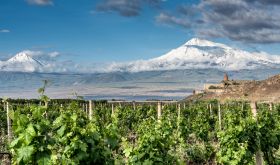
The first wine I chose for my online tasting was from the border of Europe and Asia, a haunting red blend of two local grapes from Armenia, a country that is currently sparring with neighbour Georgia as to which houses the birthplace of winemaking. I included the Armenia Wine Company’s Yerevan Winemaker's Blend Areni Noir/Karmrahyut 2016 in my recommended wines under £10 last October. This led me to its importer, Shropshire family wine merchant Tanners, which has a more adventurous array of affordable Eastern European wines than many so we gave them the job of supplying wines for the Festival tasting.
Tanners’ private sales director Robert Boutflower confesses to suffering from palpitations while following the progress of the latest shipment of this wine from the furthest edge of the European wine map. In early January he emailed the news that ‘The Armenians are on the way … but have been since November’. Two weeks later: ‘Yerevan is “en-route …”’. Early February: ‘the Armenian Yerevan is currently “changing vessel” in Turkey. They say it will be two weeks from the Black Sea’. 17 February: ‘it has now cleared Turkey and is due into Liverpool on 5 March’. 25 February: ‘after two more delays and a further stop for the Yerevan, the earliest we can get it is now is 15 March – too late’. (All orders for my tasting had to be in by 9 March to allow time for delivery by next weekend.)
I’m sad not to be able to share the very special qualities of Armenia’s signature grape Areni Noir with tasters, but below I recommend a more expensive but hugely inspiring example, aged in traditional karas clay pots. Alberto Antonini, the Tuscan consultant winemaker to Armenian producer Zorah, describes Areni as like a cross between a Tuscan Sangiovese and a Burgundian Pinot Noir.
To fill the place of the errant Armenian I have chosen a Pinot Noir, as it happens, from Hungary’s red-wine hotspot Villány: a pure, fragrant 2018 from producers Csányi. Hungarian wine culture suffered less from the Gorbachev effect than the other countries cited above because a much higher proportion of the country’s vineyards remained in private hands and so were better cared for.
Bulgarian vineyards suffered terribly. British wine drinkers of a certain age will remember Bulgarian Cabernet Sauvignon as one of the great bargains of the early 1980s but Gorbachev’s anti-alcohol campaign left Bulgarian vineyards and distinctly industrial Communist-era cellars in disarray. Bulgaria’s is one of the Eastern European wine industries that has been most transformed by outside investment. Another notable characteristic of current Bulgarian winemakers is how many of them are female, about 50%, as compared with just 14% in perhaps the most right-on wine region of all, California, according to a Santa Clara University research project last year.
I have already written in some detail about the vibrant wine scene in Romania and neighbouring Moldova, and their rich legacy of indigenous grape varieties, one of which, a mature Fetească Regală, provides one of our dry white wines in the tasting.
The other white in the FT tasting was designed to represent another sort of revolution in Eastern European wine: breeding new vine varieties that are particularly suitable for the local conditions. The vine nurseries of the Czech Republic and, especially, Slovakia have been particularly active in this respect. I originally chose an increasingly popular perfumed crossing of Gewürztraminer and Roter Veltliner from Martin Pomfy of Slovakia. But because of the additional post-Brexit paperwork burden, the shipment had to be switched to rail from road and it too was due to arrive too late for my tasting. So at the last minute I substituted the white 2018 version of the Armenian Yerevan wine, made from two local grape varieties like the original red.
Slovenia and Croatia are also sources of brilliant white wines, although the locals and tourists lap them up so enthusiastically that we see too few of them abroad.
Georgia, also missing in my tasting, has the world’s most powerful wine culture and, after several false starts, I hope to get there one of these days and write about it in the detail it warrants. Apologies that I have tasted so few Georgian wines recently.
My other red wine next weekend is a complete contrast to the delicate Pinot Noir: a potent, spicy wine made from North Macedonia’s signature grape Vranec by the dominant wine producer Stobi. This is a snip for a wine that will clearly continue to develop for many more years.
I am deliberately excluding the riches of the Eastern Mediterranean (Greece, Turkey, Lebanon, Cyprus and Israel) here but am already braced for complaints from Poland (which now, thanks to climate change, has a thriving wine industry), Montenegro, Albania, Bosnia and Herzegovina, Serbia, Kosovo, Ukraine and Russia that I have not mentioned the transformation of their wine industries – but I continue to be fascinated by them.
And only last week I received my first invitation to taste the wines of Azerbaijan.
Eloquent evidence from Eastern Europe
Whites
Paparuda Fetească Regală 2017 Romania
£7.50 Tanners Wine Merchants
Barta, Egy Kis Furmint 2019 Tokaj, Hungary
£14.95 Corney & Barrow
Martin Pomfy Devín 2020 Slovakia
£15.50 Tanners Wine Merchants (arriving soon)
Chateau Vartely, Individo 2017 Moldova
£16 Moldovan Wine
Urban Petrič, Natural White 2018 Slovenia
£16.50 Wanderlust Wine
Kolonics, Juhfark 2018 Nagy-Somló, Hungary
£17 Wanderlust Wine
Gašper Rebula 2016 Western Slovenia
£127 per case of 6 The Fine Wine Company
Reds
Stobi, Vranec 2019 Tikves, North Macedonia
£8.95 Tanners Wine Merchants
Rumelia, Merul Mavrud 2016 Bulgaria
£9.95 The Old Cellar
Armenia Wine Company, Yerevan Winemaker’s Blend Areni Noir/Karmyahrut 2019 Armenia
£9.95 Tanners Wine Merchants (arriving soon)
Via Verde, Expressions Cabernet Franc/Melnik 2015 Bulgaria
£12.60 The Old Cellar
Fáutor, Negre 2017 Moldova
£23 Moldovan Wine
Zorah, Karasì Areni Noir 2018 Armenia
£26.29–£34.50 various independents including Symposium Wine Emporium, Hedonism, The Wine Reserve
See tasting notes in Promising Eastern Europeans.