The ripe, accessible 2015 vintage should have suited Bordeaux’s less exalted properties down the ground, just as 2009 did so ably.
The so-called, indeed surely rather quaintly called, crus bourgeois are those Médoc estates below classed growth (cru classé) level deemed each year, on the basis of blind tastings, to have produced a red bordeaux of superior quality from that vintage. Ever since this new, quality-focused initiative was introduced in 2009 it has always seemed rather admirable to me.
By contrast, the crus classés were given their exalted rank way back in 1855 and little has changed since then – apart from massive changes of boundaries, ownership and direction for the great majority of properties. This doesn’t seem nearly as admirably meritocratic as the current crus bourgeois system – although the organisers are planning to change the latter to three divisions of properties, to be re-examined every few years, as spelt out in 2014 crus bourgeois and a new plan. I think I prefer the current system.
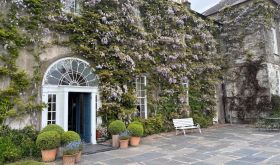
Some of these also-ran properties, the great majority of them qualifying for either the Haut-Médoc or Médoc appellation (the one pictured above is Ch Paveil de Luze, owned by the late Frédéric de Luze, who did so much to reform the cru bourgeois system), can represent the best value Bordeaux has to offer. If they can afford it, their proprietors grow vines and make wine in almost exactly the same way as the classed growths. Because they tend to have less propitious locations and terroir, they can sometimes fail to ripen grapes fully in cooler and/or wetter years, but in a warm, dry year such as 2009, 2010, 2015 or 2016, the differences between terroirs should be less marked.
Admittedly the northern Médoc (where properties qualify for the simple Médoc appellation, as opposed to the Haut-Médoc southern half) took the brunt of Storm Henry and so had a thorough soaking in mid September 2015, but so long as yields were not too high, and the vines were allowed to dry out before picking, this should not have been too serious.
The week before last, the identities of the 271 properties whose 2015s were deemed to have qualified as crus bourgeois were revealed and immediately afterwards 190 of them were shown at a well-run tasting in London.
I heard several complaints from professional tasters at this showing that some of the wines were less impressive than expected. But I fear this was to be expected. Life is extremely tough in the lower reaches of Bordeaux’s carefully stratified pecking order. Production costs for crus bourgeois are not that much lower than at the crus classés, but whereas a Bordeaux négociant will typically pay €40–45 a bottle for a middling classed growth (and far, far more for the most famous names), the price paid for most crus bourgeois is well under €10.
On a recent trip to France, Tom Munro, a Brit importing some of Bordeaux’s quirkier wines into Australia, was horrified to find red bordeaux bottled by one of the bigger companies eager for distribution retailing for less than €1 a bottle on a French supermarket shelf (see The other Bordeaux – part 1).
His recent tour of off piste Bordeaux properties took in Ch Bel Air Marquis d’Aligre in Margaux, whose idiosyncratic owner still has about 100,000 bottles from 20 vintages in stock – truly an unusual (no-) sales policy for Bordeaux where most producers like to sell their wines when they are only six months old and a long way from even being bottled.
It must be dispiriting for those producers trying to up their game with every vintage to see that a retailer as respected and fastidious as The Wine Society in the UK is able to source a fully mature Haut-Médoc, Ch Fontesteau 1998, cheaply enough to be able to offer it to their members at just £14.95 once it arrives in late November.
Bordeaux is just one wine region that seems to be suffering devastating weather events ever more frequently – notably hail and, this spring, fatal frost at the end of April that cost vignerons up to 75% of their 2017 crop, especially in some of the less well-favoured areas. (Few of the classed growths suffered particularly badly at the hands of Jack Frost this year, thanks to their proximity to the Gironde estuary.)
It must be tempting therefore when pruning in winter and early spring not to be too severe with the secateurs. For this reason, I suspect a few of the crus bourgeois vineyards may have been a little overloaded with grapes when the time came to pick the 2015 harvest – anyway a particularly generous crop. It costs a great deal of money to send a crew through a vineyard later in the season to snick off bunches deemed to be surplus – not least in a country with France’s employment laws.
And, if your selling price is only a few euros a bottle, you may also be tempted to cut a few corners on your oak purchases. Tasting nearly 100 of these 2015 crus bourgeois from the Haut-Médoc, St-Estèphe and Moulis (my colleague Master of Wine Richard Hemming tasted the other appellations), I found a few very non-classic oak notes.
The wines I tasted were very varied, but some were outstandingly good, and some of those exceptionally good value. The tasting booklet provided recommended UK retail prices. These were all over the place, from £10.50 (Ch Chantemerle 2015) to £34.50 (Ch Lestage Simon 2015). But, as so often in wine, there seemed to be little correlation between suggested price and quality. One of my favourite wines, Ch de Gironville, was listed as selling at only £9 a bottle, but this seems to apply only in tax-free France.
Styles were equally varied. Some of the wines seemed still to be pursuing maximum ripeness and oak (the gods of the 1990s) while others were very obviously following the refreshing ‘stoniness’ of the current Zeitgeist.
Many of these wines could be broached already, although the most ambitious will repay ageing for five years or so, occasionally more. Once again, as far as likely longevity goes there is considerable variation.
As for grape varieties, early-ripening fleshy Merlot very definitely rules at this quality level – presumably as insurance against unco-operative weather – although all of these wines are blends of the well-known dark-skinned Bordeaux grape varieties including, increasingly, the late-ripening Petit Verdot.
Crus bourgeois come with a sticker that can be read with a smartphone to reveal the background to all wines. Rather sweetly the Cru Bourgeois organisation assures us that their special sticker also protects the wines against counterfeiting. I fear the chances of these wines attracting the attention of a counterfeiter are rather limited at the moment.
SOME FINE ALTERNATIVE RED BORDEAUX
I gave the following 2015s a score of 17 out of 20 at the recent showing, but 25 other wines, of the 94 I tasted, earned a score of 16.5. Please note that the 2015s are just starting to trickle on to the market and retailers such as The Wine Society may not offer their purchases for quite some time. The mature vintages of the unusual Margaux, to be profiled next week, are still available. Global stockists on wine-searcher.com. Tasting notes at 2015 crus bourgeois – some bargains.
Ch Barreyres 2015 Haut-Médoc
A Sainsbury’s favourite at £12 but they have only just moved on to the 2014.
Ch Bel Air Marquis d’Aligre 2009 and 2010 Margaux
£549 a dozen, Christopher Keiller
Ch Belle-Vue 2015 Haut-Médoc
£144 a dozen in bond, Millésima UK
Ch Le Boscq 2015 St-Estèphe
£252 a dozen in bond, Millésima UK
Ch de Gironville 2015 Haut-Médoc
€9.50 in France
Ch du Taillan 2015 Haut-Médoc
CA$27.95 SAQ, Quebec