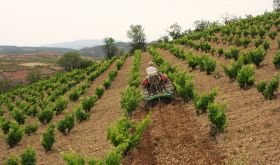
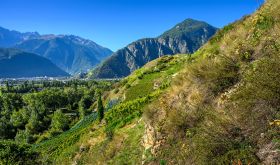
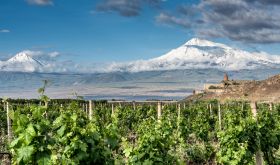
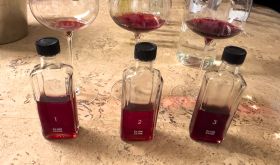
Benjamin writes This time it is the Rouffach-spooning Grand Cru Vorbourg. Véronique Muré of Domaine Muré has been making Pinot Noir here for years under the Clos St-Landelin lieu-dit. This exceptional vineyard was requested for Pinot Noir grand cru status at the same time as Kirchberg de Barr and Hengst, but received recognition only in recent weeks. The two-year wait is negligible as the grand cru has been well renowned since the eighth century. The red clay soils, rich in iron, are greatly appreciated by Pinot Noir. A certain level of ‘minerality’ can be detected in Pinot Noir from Vorbourg in the form of graphite and the tannins are usually as smooth as silk.
30 May 2022 Dutch wine professional Benjamin Roelfs highlights the transformation of Pinot Noir in Alsace and suggests we hold on for Syrah d’Alsace. He is also responsible for the images here, and for many of the recent updates of our Old Vines Register.
Pinot Noir, currently the only variety allowed for red wine in the Alsace appellation, is getting better and better. What used to be a rather thin and notably light wine, is now growing into serious Pinot Noir.
A history lesson
What most people might not realise is that Pinot Noir has a long history in Alsace that pre-dates the founding of the French Republic. It was when the Swedes intervened in the Thirty Years’ War (around 1631), that the first Pinot Noir vines were planted in Alsace. This happened because soldiers took Pinot Noir vines with them en route from Burgundy to Baden-Württemberg. The first vines were planted around the village of Marlenheim, which is one of the first villages on Europe’s oldest vine trail.
The 16th century, known as a Golden Age for Alsace, had been when wine-growing reached its peak. It helped that the government ensured that the tax regime was favourable for the wine industry. Growers were subsidised to continue to produce wine.
Despite the Thirty Years’ War and phylloxera, Alsace, and especially its hillside vineyards, earned a reputation for excellent white wines. And now, in the post-COVID era, will Alsace also gain a reputation for red wine?
Styles
Red-wine styles are currently divided into two by the CIVA (Conseil Interprofessionnel des Vins d’Alsace):
- Pinot Noir d’Alsace Rouge Léger – léger literally means ‘light’, and refers to the style of Pinot Noir that benefits from a lower serving temperature. This style is easy-going and generally has no evidence of (new) oak. It is a rather fruity style with very few secondary aromas. This light style of Pinot Noir can be very enjoyable when made well.
- Pinot Noir d’Alsace Rouge – is a more full-bodied style that is growing in reputation. Wineries are allowed to use oak, old or new, but in practice they use only French oak. It is not uncommon to see élevé en fût de chêne or barrique on the labels of wines in this category.
The best winemakers capture both styles in the wine: intense red fruit as well as generous mouthfeel and structure.
Appellations
There are several appellations in which Pinot Noir may feature.
AOC Alsace
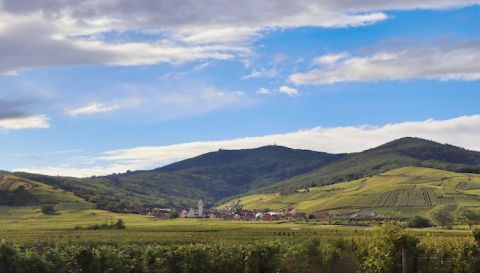
This is the obvious one, the broadest appellation of Alsace. The wines may be labelled Pinot Noir d’Alsace, Rouge d’Alsace or simply Pinot Noir. The wine must contain 100% Pinot Noir. The grapes may come from anywhere in the region, allowing a lower price for the eventual wine. The light (léger) style is often found labelled as AOC Alsace.
AOC Alsace communale
The appellation system also includes the village level. Certain villages specialise in Pinot Noir and in 2011 regulations came into place to allow these villages to label their wines as such. Côte de Rouffach, St-Hippolyte, Ottrott and Rodern are allowed to label their wines at village level and will often simply name them ‘Rouge d’Otrott’, ‘Rouge de St-Hippolyte’, etc. These villages have a long history of growing Pinot Noir and can produce excellent wines.
Often the fuller-bodied Pinot Noir wines come from these appellations communales. They could be compared to village-level burgundy, and can show similar quality, if not an exactly similar style. Alsace Pinot Noir can of course be compared to other Pinot Noir wines, but it truly shows its own character when made by the right winemaker.
AOC Alsace lieu-dit
Made up of around 400 individual vineyards, the AOC Alsace lieu-dit is considered to be of higher quality than AOC Alsace and the communales. A significant number of these lieux-dits have been planted with Pinot Noir and a few famous names are making wine from them. These include Marcel Deiss (Burlenberg, Gruenspiel), Pierre Frick (Strangenberg, Rot Murlé), Albert Mann (Clos des Failles) and René Muré (Vorbourg, Clos St-Landelin).
Lieu-dit is the quality classification that sits just below Alsace Grand Cru and offers Alsace winemakers a chance to see more recognition for Pinot Noir.
AOC Alsace Grand Cru
As yet Pinot Noir has not been generally allowed to be labelled as grand cru when grown on one of the 51 grands crus of Alsace. But the INAO has been considering whether Pinot Noir should be a part of the Grand Cru classification, for which the region has been lobbying for more than ten years. The first signs of success for this campaign came on 9 May 2022 with the announcement that Pinot Noir in Kirchberg de Barr and Hengst grands crus could be labelled AOC Alsace Grand Cru!
AOC Alsace Premier Cru (pending)
In December 2016, the INAO began to consider a premier-cru plan. They visited Alsace to review the Pinot Noir dossier. While this is not yet in place, there are a few whispers about which vineyards will be classified as premiers crus in the future. Most prominent of these whispers have been that some lieux-dits will be promoted to premier cru. This appellation will be, just like in most other French regions, just below grand cru. It is as yet unconfirmed, but let’s hope the INAO will designate these exceptional vineyards premiers crus.
Rosé and Crémant d’Alsace
For the upcoming season, Pinot Noir Rosé from Alsace is one to consider. Typically, it is a light-hearted rosé with enough complexity and acidity to match many dishes.
Naturally, Blanc de Noirs is made out of Pinot Noir in Alsace. But you can also find Pinot Noir in a white or rosé blended Crémant d’Alsace.
Why Alsace Pinot Noir is gaining traction
Climate
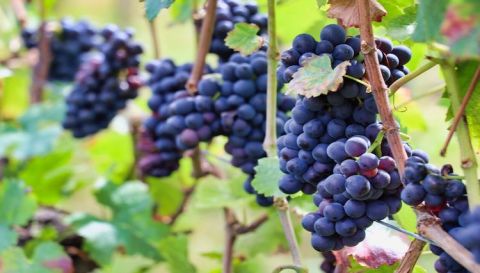
Pinot Noir is a grape variety that is particularly challenging to grow. So why is it nowadays thriving in Alsace? The principal answer to this question is climate. Alsace’s continental climate is beneficial for Alsace’s sole official red variety. However, it is an early-budding variety and in the past Alsace has suffered from spring frosts which can gravely influence quantity and quality. Our escalating temperatures have been beneficial for Alsace as the risk of frost is reducing by the year. Spring is getting warmer, hence Pinot Noir is increasing in quality. It must be noted, however, that even though temperatures are rising, the climate is becoming increasingly extreme. Spring temperatures might generally be higher, but so is the risk of snow in April.
Soil
Most evidence suggests that Pinot Noir likes a clay soil. The ancient soils of Alsace, going back hundreds of millions of years, often have at least a portion of clay in them. Most common for Pinot Noir are marl and limestone soils, which allow Pinot Noir to achieve ultimate ripeness as well as develop a certain minerality. Marl encourages proper ripeness of the grapes as it usually contains 50% clay. And clay helps to delay ripening and hence increase acidity in the eventual wine. Limestone also increases the acid levels in the wine as well as retaining water particularly well. Clay, besides the influence on the ripeness of Pinot Noir, also gives more structure to Pinot Noir d’Alsace.
The new generation of grapes
One of the pioneers in bringing new grape varieties to Alsace is René Muré. They were the first to bottle Syrah from Alsace, from the hot 2018 vintage, which aided the ripeness of the Rhône Valley’s signature grape in this northern Riesling Valhalla. Jancis’s tasting note on this wine includes the phrase ‘A real eye-opener. This may well last longer than my guess but it's already a pleasure.’ I truly think that none of us expected to see Syrah from Alsace work, but apparently it does. More viticulturists are following Muré’s lead. Meyer-Fonné is planning to bottle their first Syrah this year, either by summer or the 2022 harvest season. They planted the Syrah vines on the Wineck-Schlossberg Grand Cru. This was the result of 10 years of continuous drought on this grand cru, which is predominantly planted with Riesling.
Veronique Muré told me that they planted the first Syrah vines 12 years ago (!) with the effects of global warming in mind. They were seeking out varieties that ripen more slowly or that reach maturity later in the season. They did not choose Cabernet Sauvignon because it performs much better in less-continental climates, nor Gamay as it grows much better in granitic soils. They knew that Syrah works well in Pic St-Loup and the Terrasses du Languedoc, and hence decided to go for Syrah.
Domaine Weinbach is going even further, planning to plant Grenache Noir as well as Syrah. Both will be planted on the Schlossberg Grand Cru, which makes some exceptional Riesling in the hands of the Faller family. Twenty-year-old Riesling vines must make way for this project so this is an enormous leap of faith as almost one hectare (2.5 acres) will be planted.
Wineries such as Jean-Marc Bernhard, Hauller and Justin Boxler are considering planting Syrah. There is no doubt that there will be much more red wine in Alsace soon!
What to look out for
As previously mentioned, the style can make or break your experience with Alsace Pinot Noir. In my opinion, wines between €20 and €40 are generally the best value, and this is also the case for Pinot Noir d’Alsace. Some wineries do make more premium/high-end Pinot Noir but they can be quite difficult to sell.
As is well known about Pinot Noir, it can truly express its terroir when winemaking is done right. Which is why I also believe it should be allowed under the grand cru classification regulations. Bottles with a vineyard name on them should be a safe bet for quality. They cannot be labelled as Grand Cru, but sometimes a winemaker makes a subtle reference to the grand cru the grapes come from. Finding names as Bollenberg, Herrenreben, Luft, Schlossreben, Stein and such would certainly indicate that a winemaker had put some effort into making Pinot Noir sing.
Wines labelled Vieilles Vignes may not come from vines with the age of those you may find in the Old Vines Register, but they are certainly not insignificant. These Pinot Noir vines were often planted in the 1960s or 1970s, giving extra depth, character and intensity to Pinot Noir d’Alsace.
Some recommendations of some of the lesser-known Alsace Pinots
Jean-Marc Bernhard, Hinterburg Pinot Noir 2017
Justin Boxler, Vignes Sélectionnées Pinot Noir Barriques 2019
Meyer-Fonné, Altenbourg Pinot Noir 2019
Meyer-Fonné, Gallus Pinot Noir 2018
Dussourt, Réserve Particulière Pinot Noir 2015
Kirrenbourg, Roche Granitique Pinot Noir 2017
Kirrenbourg, Terroir B Pinot Noir 2017
Pinot Noir truly has a future in this German-looking French region. Alsace will become well known in the future as a congenial home for Pinot Noir, and not only for the refreshing, light-hearted and fridge-cool léger style.
To answer the question, ‘Is the future of Alsace red?’, if you ask me – certainly!