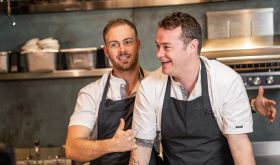

There have been many significant changes, most of them major improvements, in the restaurant industry since I began my life as a restaurateur in 1981.
The number and variety of cooking styles is perhaps the most obvious. The skills on show from the largest possible range of different nationalities and ethnicities is another – in London anyway. (In 1980s London, the restaurants were predominantly staffed and enjoyed by whites only). And the wine lists on offer today would put those of yore to shame for their range, the availability of wine by the glass, and for the knowledge and confidence of the waiting staff. Glassware has also improved immeasurably.
But in my opinion there have been four changes whose significance has dwarfed all the others. Here I discuss them. But I would like to hear from you if you disagree, or if you agree, or if you can think of something equally significant which I have missed.
Everything is now in plain sight
I was sitting at a table with 10 close friends and JR at Quality Wines one lunchtime in October. Next to me was an old friend, a very good cook, but without any connection to the world of restaurants.
As we were talking a delivery man walked in and called out to Richie, the Australian who runs the butchery at the back of the room. The man was unmissable. Dressed in a long white jacket, he had an enormous leg of Mangalitsa pork over one shoulder. This he dropped off with Richie, and made three more, similar trips from his white van parked outside.
While I joked that ‘at last the going-home presents had been delivered’, my neighbour said something far more profound. ‘That’s what I really love about restaurants – the way that today you can see everything that goes on. I find the whole process absolutely fascinating.’
This has to be the most significant improvement in restaurants: the fact that in so many places there is now an open kitchen in front of you. And there is so often a bar where you can see the mixologist at work, often with the same store of ingredients as the kitchen.
The original open kitchen was designed, initially for the domestic cook, as long ago as 1934 by Frank Lloyd Wright for his Malcolm Willey House in Minneapolis. It gave a clear view from the kitchen to the living and dining area, allowing Mrs Willey, assumed then to be the cook, to watch the rest of the house while she was cooking in the kitchen. But these simple design proposals were not widely copied until the 1990s. Then the growing popularity of TV cooking shows brought this design into everyday restaurant life. It is not universally popular with chefs. Some of them want it but with a little privacy attached. The chef in Sydney, Australia, who insisted on shades that could come down from the ceiling so that he could tell his kitchen staff off in private whenever necessary springs to mind.
But this design quirk apart, I believe that this is the most fundamental change and improvement – to such an extent that being able to show off an open kitchen is an essential ingredient in any new restaurant opening. As well as the educational aspects, and the ogling potential, it is now the case that chefs have to be well mannered at all times. And the prevalence of the open kitchen has had the effect of elevating the profession of a chef. In my day, chefs were treated like children – to be seen but not heard, confined as they had been for a couple of centuries to basement kitchens.
Today, chefs are out and in plain sight. I believe that this is an extremely good thing.
Women in the kitchen
It used to be said that you will never find a top female chef because they are simply not strong enough to lift a heavy stockpot full of hot liquid, bones and vegetables. La Mère Brazier was a famous exception, with three-star restaurants in both Paris and Lyon, but photographs of her suggest she would be well able to lift the heaviest of stockpots.
This weightlifting test was mistaken for two reasons. The first was that in most kitchens there were plenty of men to do the heavy lifting if simply asked. The second was the equally mistaken supposition that cooking depended on heavy stockpots. Once the citadel of classic French cooking crumbled, everything was possible.
The modern leader of this female gang has been seen as Alice Waters ever since she opened Chez Panisse in Berkeley, California, in 1971 with Victoria Wise as its first head chef. But she was not alone. There was Joyce Goldstein at Square One in San Francisco initially, and then the hugely talented Barbara Tropp, who introduced so many to the pleasures of Chinese cooking.
Australia began to produce highly innovative female chefs, too. There was Maggie Beer, Christine Manfield and Stephanie Alexander, an enormously talented trio. This soon became an international trend with the likes of Anne-Sophie Pic and Hélène Darroze (both of whom now have restaurants in London as well as France). There was Myrtle Allen who began her career at Ballymaloe in Ireland in the 1970s, followed by her daughter-in-law Darina, while Sally Clarke, Ruth Rogers and the late Rose Gray carried the flame in London. Whether it was the women who came first or the lighter, brighter, healthier style of cooking which they will always be associated with is a moot point.
But the dynamic had definitely changed. From appreciating half the world’s population as customers, the restaurant industry now accepted them as fully fledged cooks and chefs and as culinarily inspirational as men. Not before time.
Traceability
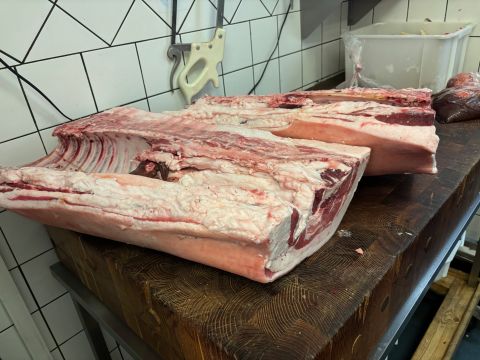
Restaurants are now much more likely to specify exactly where their ingredients come from, with farms, farmers, fisherman and even boats now featuring on menus, a sign of long-term relationships. The farm whose name is on the Mangalitsa van shown at the top of this article repays the compliment by specifying on its own website that it supplies Shaun Searley, the chef of the Quality Chop House.
Days of the week
These have not changed, of course. But what has is their importance to every restaurant’s trading pattern and profitability as these figures, kindly supplied by Will Beckett, founder of the Hawksmoor group with outposts in London, Manchester, Liverpool, Edinburgh, Dublin, Chicago and New York, reveal.
| Lunch | Dinner | |
| Monday | 2 | 8 |
| Tuesday | 2 | 9 |
| Wednesday | 3 | 10 |
| Thursday | 3 | 11 |
| Friday | 3 | 12 |
| Saturday | 6 | 14 |
| Sunday | 10 | 6 |
| Total | 29 | 71* |
* Individual percentages sum to 70 due to rounding.
As a restaurateur, I was closed for business on Saturday lunch and all day Sunday. I simply could not afford that today. The rise in demand for business on Saturday and Sunday lunch is too strong to ignore.
The gap between the contributions from the lunch and evening trade has grown enormously. This can be attributed to two very different factors. The first is the widespread enthusiasm for people spending their hard-earned income on going out to good restaurants in the evening. The second is the importance of having an excellent bar as an integral part of the restaurant to take advantage of the fact that drinking at lunchtime has become heavily curtailed over the past decade but it is still something that many will indulge in during the evening.
The trading week has always started slowly but the pattern has shifted since ‘working from home’ and COVID. Monday is traditionally quiet. Business strengthens over Tuesday, Wednesday and Thursday, dips slightly over Friday lunch and then picks up again for the weekend. As Richard Coraine, chief development officer of Union Square Hospitality Group in New York, succinctly explained, ‘Thursday and Saturday are neck and neck, with Thursday driven by business clientele, Friday seeing work-from-home, Saturday driven by social’.
The business to be had at Sunday lunchtime, particularly in the UK where the tradition of the Sunday roast remains strong, is still significant. But I wonder whether if I were a restaurateur today, would I still be able to have a Saturday lunch as my favourite time of the week to go and eat in a restaurant?
Every Sunday, Nick writes about restaurants. To stay abreast of his reviews, sign up for our weekly newsletter.