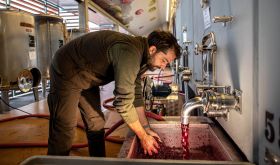
Pascal Marchand must be one of the most envied men in Burgundy. He not only has parents-in-law of his own age, as a winemaker he is able to get his hands on grapes from 14 different grand cru vineyards and produces scores of different burgundies each year – without having to satisfy the financial demands of a host of relatives (the usual set-up on the Côte d'Or). And he is not even a Burgundian. Furthermore, he has been able to learn from the experience of vinifying the Burgundy grapes Pinot Noir and Chardonnay all over the world, notably in the southern hemisphere.
Flying winemakers tend to be young and relatively inexperienced. There are not that many serious wine producers who have already earned their spurs in one classic wine region and who subsequently make their own wine on another continent. Marchand had a solid 15-vintage career at Domaine Comte Armand in Pommard and then a stint at Boisset's flagship Domaine de Vougeraie while adding not just one but two more continents to his roster.
He now makes about 60 different burgundies every vintage for his négociant business Marchand-Tawse but also a range of Marchand & Burch wines in Western Australia, and until recently made wine in the coolest reaches of southern Chile. And, just to really stretch his experience of different climates, he also has a small wine project in Belgium.
This geographical flexibility may derive from his roots in Québec and a brief stint in the merchant navy. He claims that his early travels in Europe inspired an appreciation of the special contribution vines make to landscape. By 1983 he was experiencing his first vintage in Burgundy and over the next few years was part of a seminal group of young Burgundians such as Dominique Lafon, Christophe Roumier, Patrice Rion and Étienne de Montille who were in the process of taking over family domaines and tasting, travelling and discussing wine together. The other big influence on him was the legendary late winemaker Henri Jayer, whom he credits with sharing an enormous amount of advice. So successfully did he develop the reputation of Domaine Comte Armand, making robust, long-lasting wines that were then very much in vogue, that he was an obvious choice for Vougeraie. And given his nationality, an even more obvious one for the initial supervision of a major Burgundian project in eastern Canada, also directed by Boisset, Clos Jordanne.
Burgundy was always going to be too small a canvas for a burly chap who, on his own website, describes himself as 'half a woodsman, half an old sea dog'. He had developed such expertise with Pinot Noir that he was sought out by the well-heeled owner of the Bío Bío labels Veranda et al in southern Chile – and it was but a short hop over the Pacific (and admittedly the entire land mass of Australia) to the south-western coast of Western Australia, where Marchand & Burch is co-owned with Jeff Burch of the commercially successful producer Howard Park.
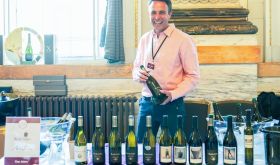
When Marchand was in London recently to show off a range of burgundies and their Australian counterparts, I asked him to highlight the differences between the two wine cultures. He does not watch his words and was emphatic. 'The Aussies manage vines quite differently from how we do in Burgundy. If we need to thin the vine shoots in summer, we just go into the vineyard and do it. In Australia they cost everything in advance, and they're always trying to minimise costs. Mind you, I'm very happy with the vineyard labour where we are (on a fine, old Chardonnay vineyard in Porongurup and a rather more challenging Pinot Noir one in Mount Barker). The Afghans and Vietnamese there do a great job. In France it's getting more and more difficult to find people to work in vineyards.' Picking by hand rather than machine is regarded as a luxury, of which he is proud for his vines, in Australia.
Another problem is finding the right clones, particularly of Pinot Noir, to plant in Australia. He describes Australia's Pinot evolution as way behind that of California, for instance, partly thanks to the delays entailed by Australia's rigorous quarantine requirements. 'Clone 777 has only just arrived', he sighed, mentioning one of the more desirable of the Dijon clones of this finicky grape variety.
He also notes a much less diverse yeast population in Western Australia than in Burgundy, a function presumably of its much shorter wine-growing history. One particularly obvious legacy of his Australian experience is the screwcap. This is the ubiquitous wine stopper Down Under and is applied to the entire range of Marchand & Burch Australian wines, but he has even imported it into Burgundy. He gave me a taste of two Gevrey-Chambertin 2010s, exactly the same wine under screwcap and under cork. They were clearly different already, even though they had spent only two years under these different stoppers. The screwcapped version was much more precise and youthful, the cork-finished one somehow smudgier and more evolved. He clearly preferred the latter, but I bet he is lobbied hard by the screwcap enthusiasts in Australia.
Although he no longer has a permanent role in Chile, one of his sons is currently working for a wine producer there and, like his father, is forcefully struck by the low wages of vineyard workers there, and feels that the Chileans, blessed with an unusually benign climate, would do well to depend less on agrochemicals. One of the greatest legacies of Marchand's generation in Burgundy has been their determination to revitalise the vineyard soils after a post-war generation of industrial additions by adopting organic and, often, biodynamic practices.
But now Marchand has really fallen on his feet. After working for others, he has a partnership, with Ontario banker and burgundy lover Moray Tawse, who already owned Tawse Winery in Niagara before proposing to back Marchand in Pinot heartland, Burgundy. 'I wanted the experience of being on my own', is how Marchand describes it, 'but a partnership was inevitable. I took consultancies to get funds because I didn't want to be forced to go into the first partnership I was offered. In 2010 Moray Tawse approached me. I'd known him for a long time and I was waiting for him to ask me. I didn't want to ask him, but he's the perfect partner.'
Since setting up Marchand with a dream négociant business Marchand-Tawse, Moray Tawse also managed in 2012 to buy the famous Domaine Maume in Gevrey Chambertin, including (now) vines in no fewer than four grands crus, against considerable competition; 'perfect' seems no exaggeration. Knowing how difficult it is for non Burgundians to get their hands on Burgundy vineyards, I asked Marchand how Tawse managed it. 'Money!', he grinned, 'but it was also my relations with the Maume family and the middleman we used for negotiations'. In the last year or two they have somehow acquired even more desirable vineyards. Any young Burgundian would dream of this. But perhaps Marchand has put in the hours by now to be considered an honorary Burgundian.
See my tasting notes on a wide range of current Pascal Marchand offerings.
SOME FINE WINES BY PASCAL MARCHAND
MARCHAND & BURCH, Western Australia
Chardonnay 2013 Porongurup
Chardonnay 2012 Porongurup
Shiraz 2008 Margaret River
MARCHAND TAWSE, Nuits-St-Georges
Beaune Premier Cru Les Tuvilains 2012
Morey-St-Denis Premier Cru Clos des Ormes 2012
Gevrey-Chambertin Premier Cru Les Cazetiers 2012
Bonnes Mares Grand Cru 2012
Chambertin Grand Cru 2012
Puligny-Montrachet Premier Cru Les Champs Gains 2012
Corton-Charlemagne Grand Cru 2012
Gevrey-Chambertin Les Roncevies 2010
Morey-St-Denis Premier Cru Clos des Ormes 2010
Gevrey-Chambertin Premier Cru Les Cazetiers 2010
Clos de la Roche Grand Cru 2010
Chassagne-Montrachet Premier Cru Abbaye de Morgeot 2010
DOMAINE MAUME, Gevrey-Chambertin
Gevrey-Chambertin En Pallud 2012
Gevrey-Chambertin Premier Cru Lavaut St-Jacques