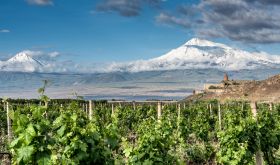
9 May 2014 - Garry Crittenden sends this label and this message:
'By way of explanation your original story referred to the Los Hermanos Tributo [Savagnin conventional ferment] as if this would be the package. Yours was a barrel sample well prior to bottling. In fact when we bottled this Cri de Coeur Savagnin we did so under a whole new package. This, and the wine you tasted, refers to the 2011 vintage which has just been released here. There was no 2012 vintage and the 2013 is still in barrel sous voile'.
8 May 2014 - Today's Throwback Thursday article was first published on 25 April 2009 . Five years on I recently asked our Australian columnist, wine writer Max Allen, how Australian wine producers have been coping with discovering that what were thought to be Albariño vines were in fact Savagnin Blanc, otherwise known as Traminer, Here is his response:
'Mixed responses – some have pulled out their vines or grafted in frustration; most have simply changed names on the label – with no one as far as I know using the ‘Blanc’ (way too easily confused with Sauvignon Blanc), and a few getting caught up in the spelling (Savignin, Savignan – you name it, I’ve seen it); and a handful have, à la Crittenden, embraced the surprise appearance of Savagnin in their vineyards, done their homework, and are exploring techniques such as flor-maturation.
'What I think is most interesting is that when we all (makers and commentators) thought it was Albariño, the wines were better. It’s as if, when they discovered it wasn’t Albariño, makers lost their confidence in the fruit and made safe but non-committal, bland wines. Either that or we were all suffering from mass delusion ...'
30 Apr 2009 – For important new information about the Australian 'Albariño' issue, see Albariño and Godello in members' forum.
Spain is becoming almost as fashionable in wine as it already is in the restaurant world. There may not be a single Spanish wine name with the potency of the words El Bulli, but among Spanish white wines, Albariño comes pretty close.
Albariño is Spain's most famous white wine grape, a speciality of Galicia in the cool, Atlantic-washed north west of the country. Its poised, super-refreshing wines are so distinctive, and command such a premium in the restaurants of Madrid and Barcelona, that trend-conscious vine growers from Oregon to Australia have been planting and selling their own versions of Albariño.
Except that in Australia, the viticultural arm of the official government research centre CSIRO (Commonwealth Scientific and Industrial Research Organisation), has just announced that the cuttings they have been selling as Albariño are not actually Albariño at all, but are a quite different vine variety, the Jura speciality Savagnin. (See Australian 'Albarino' isn't.)
This came to light when France's top ampelographer – vine identifier – Jean-Michel Boursiquot of the University of Montpellier, toured Australian vineyards a year or two ago and suggested that the vine they were calling Albariño was in fact Savagnin. Although the classical way of identifying vine varieties is keen visual observation and familiarity with precise leaf shapes, nowadays this has been superseded, just as old-fashioned detectives have been, by comparison of DNA analyses. The Australian authorities therefore set to and imported samples of genuine Spanish Albariño and French Savagnin to compare with what they were selling as Albariño. And now they are sternly telling anyone who acquired 'Albariño' from CSIRO sources to cease and desist from selling it under the fashionable Spanish name. So labels such as the one shown would be illegal for the 2009 vintage.
Australia's producers of Albariño are being told that from now on wines made from this variety must be labelled Savagnin Blanc, or Traminer. For DNA analysis in Italy had previously confirmed that Savagnin is identical to Traminer, the pale skinned, non-aromatic version of the better-known Gewurztraminer, which has pink skins and is headily scented.
The problem for Australian growers and producers of 'Albariño' however is that the name Savagnin, unlike that of Albariño, has no market traction at all, so far. It is most famous for the vin jaune of the Jura, a sherry-like wine that is worshipped locally but is little-known in the greater world of wine. And in Australia the name Traminer would be misleading as it is associated with old-fashioned medium-sweet blends based on its much smellier relative Gewurztraminer.
Damien Tscharke of the Barossa Valley was the first and is the biggest producer of Albariño, with plans for nearly 50,000 bottles of his Girl Talk brand of Albariño from the harvest just in. 'I have been very excited to pioneer this variety in Australia and consistently amazed at its results in the Barossa's tough, dry Mediterranean climate, he reports. 'Whilst impressed at its performance, this is the first year that I have thought we have produced an Albariño that reflects those amazing wines from Spain that inspired me to invest in the variety, with lifted floral aromatics, tones of ripe peach, green pear, kiwi fruit and spice'. He is still reluctant to accept CSIRO's ruling, for he sees many a difference between his 'Albariño' vines and those grown in the Barossa Valley that have always been called Traminer.
Grower Garry Crittenden of Victoria is equally shellshocked. 'One can not underestimate the contribution of the name of course, and the thought of calling it Savignin [sic] fills me with dread, as it does my colleagues.'
There are now dozens of growers of this controversial variety in Australia, most of them having been supplied with cuttings from CSIRO, which claims that they acquired the cuttings in good faith in the late 1980s from a mislabelled Spanish official collection. I would have thought that in the US, lawyers would be rubbing their hands in anticipation of a nice, juicy class action for some financial compensation.
Such problems are problems specific to our era when so many wines are labelled varietally, after the grape variety from which they are principally made. But they are likely to increase as the range of grape varieties found commercially on labels increases dramatically from the meagre diet of the 1980s and 1990s, which consisted of little other than Chardonnay, Cabernet Sauvignon, Merlot, Syrah/Shiraz and Sauvignon Blanc.
'Alternative' or 'heritage' varieties are becoming more and more common, but many of them are still new enough to go under several aliases. (It is hardly surprising that varieties have traditionally had different names in different regions; it takes time for one name to emerge as the most recognised and therefore marketable one. Even a variety as well known as Chardonnay has a synonym or two. In Austrian Styria it has long been known as Morillon.)
This is particularly true of those varieties grown in both Spain and Portugal. Alvarinho, for example, is what Albariño is called when grown over the river Miño/Minho in northern Portugal. The most famous Spanish red wine grape of all, Tempranillo, still goes by such names as Tinto Fino, Tinto del País, Tinto de Toro, Cencibel and Ull de Llebre in Spain itself, and in Portugal is known as both Tinta Roriz and Aragónez – very different names. Because this particular variety is so well known and has such a clear identity, many consumers realise that this is the same variety under a range of names. But it gets more complicated with less familiar varieties.
One increasingly fashionable grape springs most obviously to mind. Mencía is the dominant grape variety of the beautifully sprightly red wines of the Bierzo region in north-west Spain, which, thanks to the likes of Descendientes de J Palacios, are slowly becoming more celebrated in international markets. It takes a very sophisticated wine drinker, however, to realise that this distinctive variety is one and the same as that called Jaen in Portugal. Below are some of my current favourite examples.
Other Iberian white wine varieties travelling under more than one alias that should be of interest to non-Iberian growers include the firm white Godello/Gouveio, the Portuguese varieties Arinto and Encruzado and the Portuguese variety known variously as Roupeiro, Códega and Síria.
Look out for tasting notes on about 200 good and great Portuguese wines next week.
MENCÍA AND JAEN – ONE AND THE SAME
Spanish then Portuguese examples of the same grape, listed in increasing order of price.
Alma de Tinto Mencia 2007 Monterrei
£7.25 www.spanishwinesonline.com
The Pilgrimage Mencia 2007 Bierzo
Tesco
Raul Perez, Ultreia Saint Jacques 2007 Bierzo
Indigo Wine (£8.85 as part of a mixed dozen from Indigo; £9.99 from Handford Wines, SW London; £11.49 from The Sampler, N London)
J Rebolledo Mencia 2007 Valdeorras
Raymond Reynolds (£11 from Vin Neuf of Stratford upon Avon, Duncan Murray Wines of Market Harborough, S H Jones of Banbury)
Raúl Pérez, Castro de Valtuille 2005 Bierzo
£33 Indigo Wine
Dominio de Tares, Bembibre 2005 Bierzo
Raymond Reynolds (£27-30 from Barrica of Preston, The Vineyard of Ramsbottom, Steep Hill Wines of Lincoln)
Quinta da Pellada Jaen 1999 Dão
Egans Too, Liscannor, Ireland
Quinta dos Roques, Quinta das Maias Jaen 2006 Dão
Raymond Reynolds (£18 from May)
See Purple Pages for hundreds of tasting notes on Spanish and Portuguese wines and www.wine-searcher.com for international stockists.