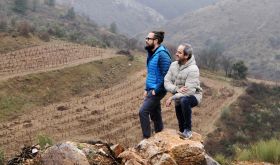

There is something about standing on top of the remnants of a volcano surrounded by water, something that feels somehow primordial, powerful, awe-inspiring.
In many cases this has to do with the barrenness, as on Santorini or Tenerife, where the (lack of) soil makes it quite clear that you’re standing on a large pyroclastic mound born out of an incredibly violent act. Add to that the constant wind and sun – beautiful on a vacation escape from a colder clime, but wearing on a daily basis, especially if you’re a plant – and the tease of water as far as you can see in 360°, none of it potable for person or plant – and it’s hard to understand why anyone or anything would root there.
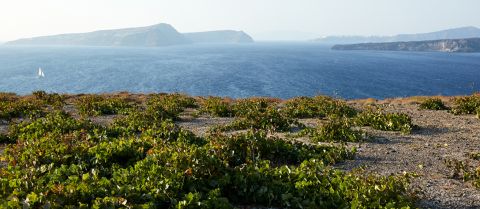
But, as John Szabo MS points out in his introduction to the Volcanic Wine Awards, the tasting he established after writing an entire volume focused solely on volcanic wine, it’s that lack of soil and water in volcanic areas that make for such powerfully unique wines. After tasting through a variety of volcanic island wines for the Volcanic Wine Awards, the tasters agreed that if you surround that volcanic area with salt water, it seems doubly true.
Santorini
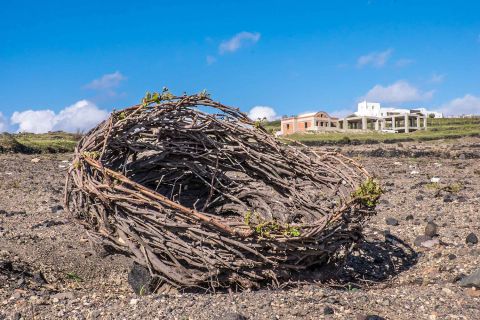
Take, for instance, Santorini, the remnants of a massive volcanic explosion in 1610 BCE and which last erupted in 1950. While there are many delicious Assyrtikos from mainland Greece, none tastes like a Santorini wine. That’s not to say all Santorini whites taste the same – in fact, the wines we tasted ranged from razor-sharp, lemony-lean and near-clear to dandelion-yellow, dense and meaty, plus some sweet mahogany-hued elixirs and an exceptional red. What they all had in common is savour, salinity and stunning acidity. These aren’t fruity, fun party wines or bottles that reflect the imported luxury lifestyle of caldera-side infinity pools from which to watch the sun set; they are wines that capture the unforgiving wind that whips across the island so relentlessly that the locals wrap their vines in baskets close to the ground to protect the fruit (as pictured below), and train them so that the leaves protect the berries from the sun. They capture the lack of water in their concentration and sea-spray minerality, and the sense of the blindingly white soil (high in calcium, almost devoid of magnesium, with a pH averaging 8.2) in bone-dry flavours and a grippy texture reflecting wines’ pHs that are regularly around 2.8. Increasingly, too, they reflect the intensity of their producers, who keep on despite ever-smaller vintages, ever-costlier fruit (See Julia’s Santorini – investing in the future) – because there’s nothing like Santorini.
Canary Islands
Another example: Spain’s famously underwhelming Palomino turns into a powerhouse when it’s grown in the Canaries, where they call it Listán Blanco. All the Listán Blanco we tasted for the competition came from the Valle de la Orotava on Tenerife, one of the youngest of the Canary Islands (last eruption 1909), and because of its youth, also one of the tallest, with Mt Teide reaching 3,715 m (12,188 ft) in elevation. (As Ferran Centelles explains in his extensive guide to Canary Island wine, it hasn’t had time to weather like the archipelago’s easterly islands have, and consequently in some places it looks like a moonscape of black dust.) The elevations, combined with distance from the continent of Africa and the ocean currents, make for a cooler climate and longer grape-growing season, which makes for some pretty intense white wines. But also, as Ferran explains, relating a conversation he had with Jonatan García Lima at Suertes del Marquéz, the low pH in the volcanic soils also make it challenging for the vine to take up magnesium, phosphorus and potassium. The resulting nutrient-weak musts can stress the yeasts during fermentation, giving rise to the smoky, flinty, ashy notes commonly found in Canary Island wines. It’s worth reading the whole article to get the full explanation, but you can also just taste the wines to get a clear sense of Tenerife’s clear volcanic character.
Azores
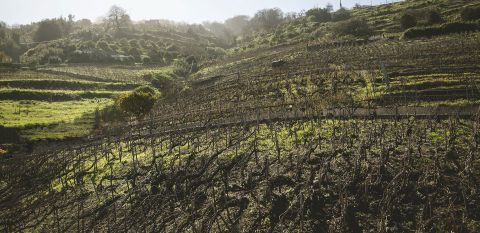
Pico in Portugal’s Azores might be even more extreme, rising out of the sea around 1,750 km (1,087 miles) miles out into the Atlantic. This island, the second-largest of the volcanic archipelago that makes up the Azores, boasts Portugal’s tallest mountain – which is actually a volcano reaching 2,351 m (7,713 ft). It’s also the youngest of the islands, its black basalt landscape making for one of the wildest vineyard landscapes in the world: not only are the vines rooted into the cracked basalt, but chunks of it have been stacked into about 800 km (c 500 miles) of walls to form a protective maze around the vines. Check out Julia’s story, The resurgence of Pico’s magnificent wines, for pictures and explanations.
Madeira
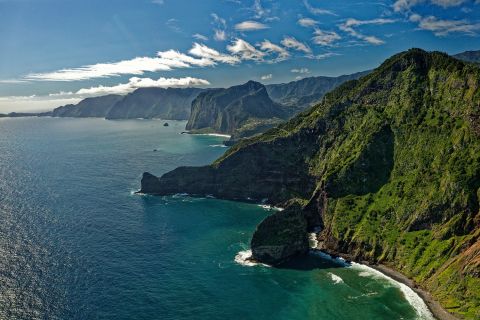
Just 1 hour 20 minutes south-east of Pico by plane is Madeira, another basaltic island in an archipelago of islands, though this one is lush and subtropical, its well-weathered high peaks (last eruption 4500 BCE) often shrouded in damp fog. The island rises abruptly out of the sea, reaching 1,862 m (6,109 ft) at its peak; to cultivate vines on its steep sides, terraces have been hacked out of the basalt slopes, the stones used for retaining walls. Most of the vineyards are planted around the edges of the island at 200–450 m (c 660–1,480 ft), where the vines’ roots can work their way through a complex mix of basalt, tufas, clay formed from decomposed tufa and gravels containing ancient corals and shells. The wines, in both dry and sweet styles, are entirely unique, as you’ll see from the two tasted and reported on here. (You can also read more about Madeira in The Oxford Companion to Wine.)
Sicily and Pantelleria
Much of southern Italy was created through volcanic activity; Sicily and Pantelleria, together with Campi Flegrei del Mar di Sicilia, a sunken cluster of volcanos, make up the Sicily Volcanic Province. Etna is the region’s most famous, as well as its most dramatic, a 3,357-m (11,014-ft) peak that’s been extremely active in its life, starting around 6190 BCE ±200 years, with the last eruption lasting from 2022 to 2026.
Its size and its eruptive history makes for a multiplicity of terroirs on its flanks, which Etna growers have been busy defining by contrada, a small parcel akin to a Burgundy cru. As our Italy expert Walter Speller points out in Can Etna’s Nerello Mascalese age?, not only are winemaker styles wildly different but also, ‘within one and the same contrada there can be enormous differences in elevation, from 600 m to well above 1,100 m (1,968–3,610 ft), which has its own stylistic consequences.’ Generalisations are impossible to make here, save to say that the white wines – made mainly from Carricante – tend to be subtle, citrusy and brightly acidic; the reds tend to live up to their moniker of ‘the Nebbiolo of the south’, with pale colours, driving acidity and grippy tannins – though the flavours tend to have a smoky, rocky sense that conjure up their volcanic origins.
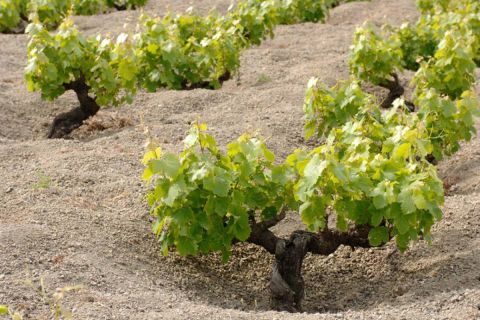
On Pantelleria, a small, low Italian island off the coast of Tunisia (highest elevation 836 m/2,743 ft; last eruption 1891), bush vines are grown in hollows in the volcanic soil to protect them from the wind and surrounded with lava-stone walls. The soils are well weathered (the volcano dates to around 7050 BCE), sandy, with a pH of 6.5–7 according to Donnafugata, leading to wines with low pH (although not as low as Santorini’s). Zibbibo, a type of Muscat, is the grape of the island, which they make the most of by air-drying to make luscious sweet wines such as Donnafugata’s Ben Ryé.
In our tastings for the Volcanic Wine Awards, all the wines were presented blind, grouped by country, to a panel of wine experts headed by Szabo, our own Sam Cole-Johnson or me. Here are the volcanic island wines the panels deemed medal-worthy or worth an honourable mention.
Gold
Animaetnea, Animalucente Bianco Contrada Santo Spirito 2024 Etna
Animaetnea, Animardente Rosso Contrada Santo Spirito 2021 Etna
Arautava Listán Blanco 2024 Valle de la Orotava
Arautava, Finca La Habanera Listán Blanco 2021 Valle de la Orotava
Argyros, Cuvée Monsignori 2022 Santorini
Argyros, Late Release Vin Santo 2002 Santorini
Azores Wine Company, Vinha dos Utras Criação Velha 1os Jeirões 2022 Pico
Benanti, Pietra Marina Superiore 2020 Etna
Blandy’s, Verdelho 10 Años Meio Seco/Medium Dry NV Madeira
Caravaglio, Malvasia Secco 2024 IGT Salina
Donnafugata, Sul Vulcano Bianco 2022 Etna
Donnafugata, Sul Vulcano Rosso 2022 Etna
Donnafugata Ben Ryé Passito 2023 Pantelleria
Gaia, Thalassitis 2024 Santorini
Giovanni Rosso, Pietra Marina 2024 Etna
Madeira Wine Company, Bual 10 Year Old Meio Doce/Medium Sweet NV Madeira
Mikra Thira, Nykteri 2024 Santorini
Mirella Buscemi, Tataraci 2020 Sicilia
Pietradolce, Barbagalli 2020 Etna
Passopisciaro, Passobianco 2024 IGT Terre Siciliane
Passopisciaro, Passorosso Nerello Mascalese 2024 Etna
Passopisciaro, Contrada G 2023 IGT Terre Siciliane
Passopisciaro, Contrada PC 2023 IGT Terre Siciliane
Pietradolce, Feudo di Mezzo 2021 Etna
Planeta, Contrada Feudo di Mezzo 2023 Etna
Planeta, Eruzione 1614 Carricante 2022 Sicilia
Planeta, Eruzione 1614 Edizioneduemilaventitre Carricante 2018 Sicilia
Santo, Grande Reserve 2022 Santorini
Santo, Vinsanto 2020 Santorini
Sigalas Mavrotragano 2022 Santorini
Suertes del Marqués, Vidonia Listán Blanco 2024 Valle de la Orotava
Suertes del Marqués, Vidonia VP Listán Blanco 2024 Valle de la Orotava
Tenute Ballasanti 2023 Etna
Torre Mora, Chiuse Vidalba 2022 Etna
Torre Mora, Scalunera 2024 Etna
Vassaltis, Gramina Cuvée des Vignerons Assyrtiko 2023 Santorini
Silver
Argyros, Cuvée Palatia 2023 Santorini
Argyros, Cuvée Gerontampelo 2020 Santorini
Caravaglio, Occhio di Terra Malvasia 2022 IGT Salina
Gaia, Wild Ferment Assyrtiko 2024 Santorini
Generazione Alessandro, Croceferro 2022 Etna
Giovanni Rosso, Contrade Nuove 2024 Etna
Giovanni Rosso, Contrade Nuove 2023 Etna
Herdade do Rocim, Oceânico Arinto dos Açores 2024 Pico
Ilha do Pico, Terras de Lava 2024 IG Açores
Insula Verdelho 2022 Pico
Artemis Karamolegos, Ftelos Assyrtiko 2022 Santorini
Mikra Thira Assyrtiko 2024 Santorini
Mirella Buscemi, Il Bianco 2023 Sicilia
Tenute Orestiadi, La Gelsomina Blanc de Noir Metodo Classico Brut NV Etna
Passopisciaro, Contrada C 2023 IGT Terre Siciliane
Pietradolce, Archineri 2024 Etna
Sigalas, Kavalieros Assyrtiko 2023 Santorini
Santo, Kameni 2022 PGI Cyclades
Tenute Ballasanti 2023 Etna
Tenute Orestiadi, La Gelsomina 2022 Etna
Titerok-Akaet, Akaet Valle del Malpaso 2023 Lanzarote
Vassaltis, Alcyone Cuvée Mythologique Assyrtiko 2023 Santorini
Bronze
Envínate, Migan 2021 Spain
Generazione Alessandro, Trainara 2023 Etna
Mikra Thira, Terrasea 2022 Santorini
Palmento Carranco, Villa dei Baroni 2021 Etna
Santo Assyrtiko 2024 Santorini
Santo, Nykteri 2023 Santorini
Torre Mora, Cauru 2024 Etna
Torre Mora, Scalunera 2023 Etna
Honorable mention
Generazione Alessandro, Sciaramanica Vigna Vecchia 2021 Etna
Tenute Orestiadi, La Gelsomina Moscato Passito 2023 IGT Terre Siciliane
Tenute Orestiadi, La Gelsomina Rosé Metodo Classico Brut NV Etna
Source for eruption dates: Smithsonian Institution National Museum of History Global Vulcanism Project.
You can find reviews of all the wines tasted, as well as the scores assigned by the JancisRobinson.com editor who tasted the wines (noted in the review). Many of these wines will also be shown at the International Volcanic Wines Conference in NYC on 10 June 2026. Come back next week for another instalment of volcanic wines.