You may have noticed in Last chance to stop the bridge my comments about the British-born Stuart Pigott, now based in Berlin and a pre-eminent wine writer in Germany, and his foray into practical grape-growing and winemaking. I have managed to elicit this direct report from him on his recent adventures.
I've written a kind of blog (I call them wine telegrams and they're written in telegram language) about my vineyard in German, but simply haven't gotten around to writing something about all this in English. What you've written is basically correct. Let me fill in some details.
I started studying as a Gasthörer, guest student, at the Geisenheim wine school early October last year, that is at the beginning of the winter 2008-09 semester. I stayed for two semesters and focused on soil science and plant nutrition, agricultural meteorology and winegrowing, the areas I felt weakest on. However, I also took a bunch of other lectures including winemaking. This was a great experience and I learnt a great deal. I haven't dropped my previous perspective on wine, though I have certainly changed my mind on some key points*; instead this was primarily a process of augmentation, of mind-expansion. Perhaps the most important thing I took away was a strong feeling for how dynamic the wine world (and the world of wine science) is, and how everything is in flux due to climate change. I also got to know some of the world's leading wine scientists (most importantly Hans R Schultz) and some really interesting young winegrowers who we'll be hearing a lot about in the future.
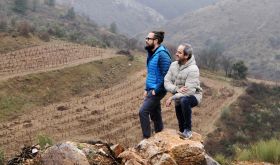
The idea behind cultivating a vineyard this year is to put into practice what I ![pigottprunes]() learnt in Geisenheim. I'm working a 0.1 hectare plot (10 rows each of just over 40 vines) in the site Tauberzeller Hasennest, which is in the Franken section of the Tauber Valley. It is 68% steep, at just over 1,000 feet elevation and has a stony limestone soil, on which I have done a lot of sliding about. I began pruning the 25-year-old Müller-Thurgau vines at -2° C on 31 Jan (as shown here) and I did the last pre harvest work at 32° C on Tuesday of last week (as shown above). I've put in 100 hours of work so far, had 10 hours help from a fellow student and the odd hours here and there from Christian and Simone Stahl of Winzerhof Stahl in Auernhofen in Franken (who are making extremely intense and expressive wines for what, from the conventional view, is the middle of nowhere), mainly in the form of spraying when I couldn't be there.
learnt in Geisenheim. I'm working a 0.1 hectare plot (10 rows each of just over 40 vines) in the site Tauberzeller Hasennest, which is in the Franken section of the Tauber Valley. It is 68% steep, at just over 1,000 feet elevation and has a stony limestone soil, on which I have done a lot of sliding about. I began pruning the 25-year-old Müller-Thurgau vines at -2° C on 31 Jan (as shown here) and I did the last pre harvest work at 32° C on Tuesday of last week (as shown above). I've put in 100 hours of work so far, had 10 hours help from a fellow student and the odd hours here and there from Christian and Simone Stahl of Winzerhof Stahl in Auernhofen in Franken (who are making extremely intense and expressive wines for what, from the conventional view, is the middle of nowhere), mainly in the form of spraying when I couldn't be there.
It's Christian Stahl’s vineyard and I decided to follow his non-organic spraying regime. Given the enormous peronospera (downy mildew) problem this year, I'm glad that I made this decision, since it saved us from significant losses. I have done a number of things differently from Christian's rows next to mine, beginning with manual weed regulation instead of herbicides, continuing with winding the vine shoots around the top wire rather than trimming them, concluding with cautious leaf-plucking and green harvesting (primarily to prevent bunches from touching one another to create infection points for Botrytis). The difference is apparent at the first observant glance, which is good because it is the result of backbreaking work. In spite of the vines’ excessive vigour (which was the main challenge), I expect a total crop of 50 hl/ha. But if I have to do some prre-harvesting to prevent Botrytis, then this could easily drop significantly lower for the main harvest.
On the basis of Christian's wines from this site, I expect 13% or slightly more natural alcohol and a Riesling-like acidity (typical harvest figures are 95° Oechsle and 3.1 pH in the must). I will ferment the wine bone dry if it will let me do that and will leave it on full lees for about six months, followed by some additional months on fine lees. The wine will be bottled under Stelvin, all proceeds will go to the HIV/AIDS Project HOPE in Cape Town via my charitable initiative Wein hilft, or ‘wine helps’.
I could go on, but this gives a good idea of what I've been up to.
*I then asked Stuart for some examples of how his mind had been changed by all this practical experience and learning and this is his response:
Prof Monika Christmann convinced me that if the grapes are clean and don't need sorting for other reasons (ie other than rot), mechanical harvesting can give every bit as good a result as manual harvesting. On the other hand, the mechanical harvester has a disadvantage, because it is heavy and compresses the soil. Prof Otmar Löhnertz showed me how this results in reductive conditions in the soil leading to all kinds of problems, including the release of laughing gas into the air. As a greenhouse gas, laughing gas is 300 times worse than carbon dioxide. Vine growing is a tiny source of this gas in the atmosphere though compared with rice growing, since in rice growing the fields are flooded...
Prof Hans R Schultz showed me how temperature not light is the decisive factor for tannin synthesis in the grape, though more sunlight on the grapes will result in them being warmer. Then he went on to show how yield is a decisive factor for the grape tannin content for some varieties, spectacularly for Pinot Noir, whereas for certain other varieties with a naturally high tannin content like Cabernet Sauvignon, yield reduction does not really increase the amount of tannin in the grapes. Of course, quantity isn't everything though, and yield reduction in Cabernet Sauvignon may result in different tannins...
These are not only two good examples of things I had to rethink, but also examples of how Geisenheim tries to teach you to see connections, look for indirect effects of what you do.
I then asked him to comment on these pictures.
One of those of me pruning gives a good idea of how steep it is and was taken on 31 Jan when it was -2° C, but the other days were worse, because then there was a snow storm! The summer prictures are from 18 Aug, the last day of fine tuning when it was 32° C. Often I asked myself, ‘why are you doing this when most of your energy goes into not falling over?’ and I suppose the final answer is, ‘because it's there'.


 learnt in Geisenheim. I'm working a 0.1 hectare plot (10 rows each of just over 40 vines) in the site Tauberzeller Hasennest, which is in the Franken section of the Tauber Valley. It is 68% steep, at just over 1,000 feet elevation and has a stony limestone soil, on which I have done a lot of sliding about. I began pruning the 25-year-old Müller-Thurgau vines at -2° C on 31 Jan (as shown here) and I did the last pre harvest work at 32° C on Tuesday of last week (as shown above). I've put in 100 hours of work so far, had 10 hours help from a fellow student and the odd hours here and there from Christian and Simone Stahl of