San Donato in Bellaria: a permaculture wine project in Chianni, Tuscany
‘Permaculture principles focus on thoughtful designs for small-scale intensive systems which are labor efficient and which use biological resources instead of fossil fuels. Designs stress ecological connections and closed energy and material loops. The core of permaculture is design and the working relationships and connections between all things.’ Bill Mollison, founder of Permaculture
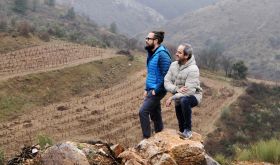
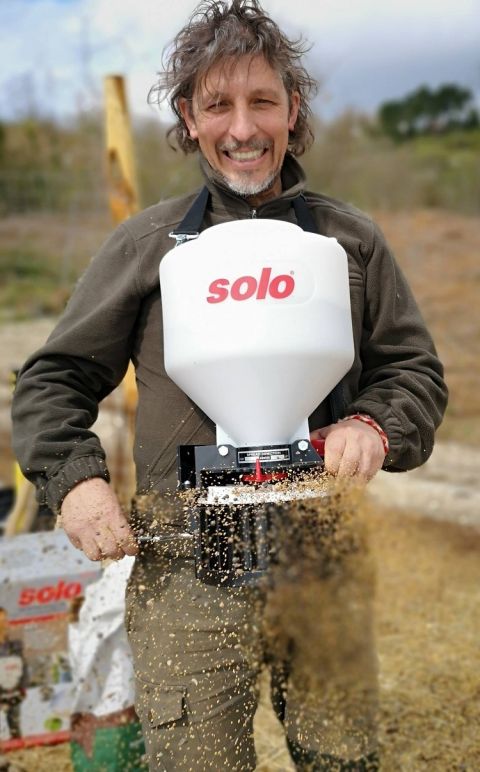
San Donato in Bellaria is a young wine project, a permaculture farm and vineyard based in Chianni, in Valdera, Tuscany. My partner and I founded it in 2018 after completing our education in Permaculture with a PDC (Permaculture Design Course) and a long search for the right place to settle down. We both have a wine related background, my partner (Stefano, pictured above with Nicoletta) has his own personal project, a small biodynamic winery in Tuscany, and I have been exploring for years the European natural wine scene, traveling extensively across the continent to meet wine artisans from Georgia to Lanzarote, in quality of a wine blogger and wine lover.
The place
We believe that true sustainability can only be achieved in areas where natural equilibrium is preserved, something impossible in a context of monoculture. The reason for which we avoided looking for a piece of land in other, more highly regarded appellations in Italy where the vine dominates the landscape and is close to being a monoculture. Instead, we turned our quests to areas out of the beaten tracks and finally found what we were looking for in the municipality of Chianni, in Valdera, Tuscany. With its territory of 47% of woods and remaining 53% of cultivated land split among grain, sunflowers, orchards and vines Chianni was representing our idea of a healthy, balanced environment suitable to settle a permaculture project.
Finding our ‘hidden valley’
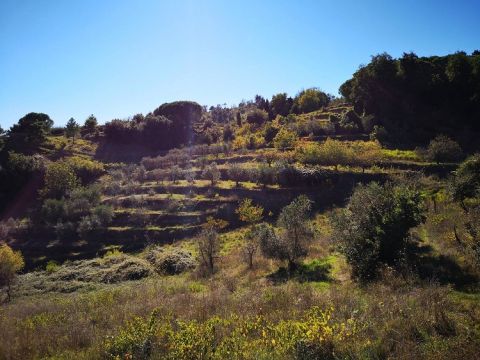
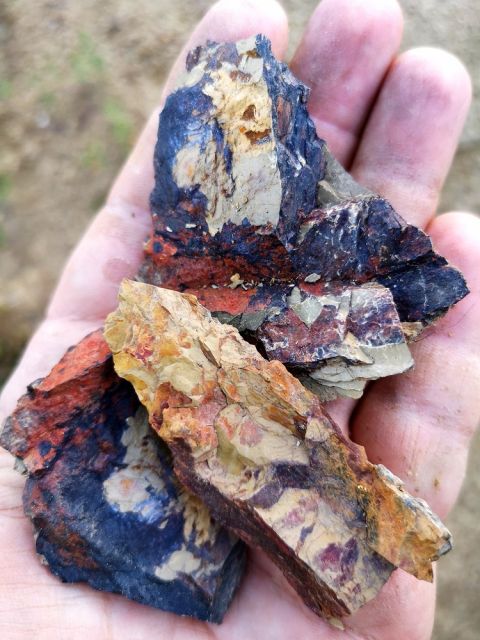
You don’t really know if it is you who find a place or it is the place that finds you. When we first saw the San Donato in Bellaria property, situated at 450 m of altitude on a pure schist terroir (polychromatic schists) surrounded by forests and entirely situated on terraces of dry stone walls, we felt as if the place was calling us. Inviting us to settle down and stay. That’s what we did.
The dry-stone walled terraces of Bellaria
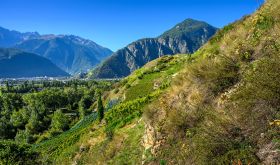
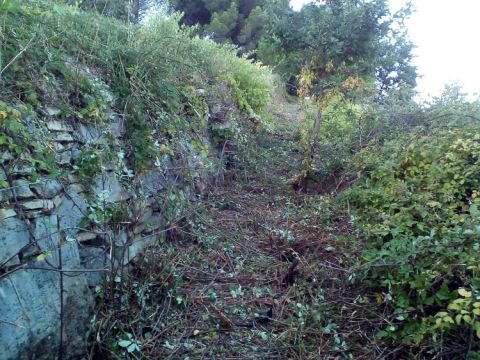
The dry-stone walled terraces of Bellaria were perhaps the element that mostly attracted us in choosing it for our project. The art of dry-stone walling, declared UNESCO heritage, is a particularly fascinating example of a harmonious interaction between humans and landscape. Hand-made, using exclusively local stones as material with nothing else except dry soil added as binding agent, this ancestral construction technique is a true example of sustainability. Apart from being undoubtedly beautiful, dry-stone walls have many environmental advantages: they make agriculture possible in steep terrains, promoting the preservation of soil fertility by limiting erosion. Furthermore, being porous they permit air and water flow: dry stone walls are not inert and sterile as cement or other materials, they are boosting with life, homing a multitude of insects, plants and bacteria.
A permaculture vineyard
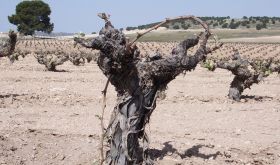
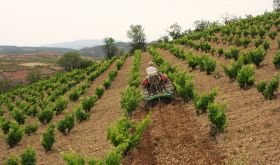
Back in ancient times after the Great Flow Noah planted a vineyard as a symbol of the New Alley and the New Beginning, we did the same ancestral ritual for establishing a kind of alley and a connection with the place. The first step was to clean up the terraces of Bellaria from shrubbery and bushes which were conquering them again after decades of neglect and abandonment. We planted the first two terraces in the autumn of 2018 applying the principles of permaculture and agroforestry to the vineyard design. We choose deliberately not to plough the land prior to planting as our aim was to keep the natural microbiology of the soil as intact as possible. The soil analysis we made prior to the vine planting were very promising: 4% of organic matter at 40 cm depth testified for an extremely healthy soil, settled in a naturally balanced environment of biodiversity and remained uncultivated in the past 20 years. Feeling lucky custodians of this piece of land of rare harmony, we decided we shall disturb its equilibrium as less as possible, meaning that a tractor will never be used on these terraces, also in order to reduce to minimum the carbon footprint of our production. We planted the vines by hand, choosing a selection of old clones of Sangiovese grapes. The vines were planted at high density with a diamond shaped design and left untrained as bush vines (gobelet). We considered this system the closest to our idea of naturalness and sustainability, a lack of wires and poles was giving to us, and to our vines, a sense of freedom and harmony. The lack of wires has also the important function of permitting free circulation of grazing animals, providing natural weed control and fertilization.

In order to keep biodiversity as high as possible we have sown melliferous species with the so-called ‘seed bombs’ technique and planted rosemary, lavender, sage, oregon – aromatic plants protecting in synergy the vines from potentially harmful insects. Furthermore, following the permaculture and agroforestry approach we planted fruit trees in between the vines, choosing ancient varieties of apples, pears, plums and almonds, particularly suited to the area and selecting the ones with reduced growth so that they will not compete with the vines. As Permaculture teaches, the higher the diversity of a system, the higher its resilience, the symbiotic relationship among vines, orchards, aromatic, melliferous and medicinal plants is meant to enhance the resilience of the vineyard as a living system. Also it provides higher and more diversified yields per hectare increasing resistance to seasonal and climatic adversities.
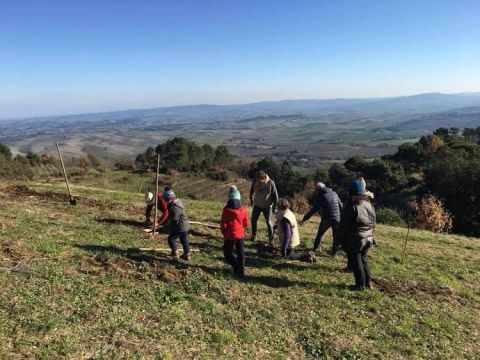
In the spring of 2020 we planted two more terraces of vineyards, this time with a massal selection of an old vineyard in Lamole, a territory we are particularly in love with, due to the natural elegance of the wines of this high altitude area of Chianti Classico and the shared rare heritage of dry stone walled terraces. As part of our permaculture project we also created a small bio lake, now inhabited by fish, insects, frogs and edible plants such as water chestnuts, further increasing biodiversity and resilience. We also created a productive food forest incorporating more then 50 different species among edible orchards, edible bushes (cassis, hawthorn, gooseberries, raspberries, blackberries, blueberries and sea buckthorn), leguminous plants and medicinal herbs. We also made our mandala shaped vegetable garden meant to ensure the food supply of the family, a fundamental step towards true sustainability. There are very few things in life that give such a deep sense of fulfilment and satisfaction as growing with your hands your own food. In terms of energy we use photovoltaic panels to provide electricity, a biomass burner for the winter heating and for irrigation needs we use the rain water collected in the bio lake as well as the water of the two wells present in the property.
Managing a permaculture vineyard with a minimum input
So far in our vineyard we have never used any kind of chemical additives, including copper and sulphur (permitted in small doses in biodynamics and organic viticulture). The particularly favorable microclimate of Bellaria (on a top of a hill, surrounded by a forest in a well ventilated area with a very good diurnal temperature range and low level of air humidity) resulting in low disease pressure has encouraged us to take the challenge of deliberately choosing not to use any chemical and potentially toxic substance in the vineyard (copper, although harmless for humans in controlled doses, is highly nefarious for the microorganisms living in the soil and on the plants and with the time it accumulates in the soil reducing its vitality). We have chosen instead as a strategy to contrast the insurgence of fungal diseases by enhancing the natural resilience of the vines through the use of EM (Effective Microorganisms) and periodical spraying with compost tea, all done exclusively by hand. We also use zeolite, effective in absorbing humidity from the leaves of the vines and reducing the risk of fungal disease insurgence. So far, these alternative non-orthodox methods of fungal disease management have worked well in the context of the particularly favorable microclimate of Bellaria and the healthy biodiverse environment surrounding the vineyard. We hope to be able to proceed on this path which for us is an important step towards a long term viticultural sustainability.

Future plans
Our project is deliberately intended to be very small: the property is 3.5 hectares divided among cultivatable dry-stone walled terraces and forest. Our intention is to reach 1 ha of vineyards, planted following the permaculture and agroforestry principles as multi-cultured plots. We don’t want to go beyond this dimension, in order to be able to maintain the level of handwork and care this place deserves. We plan to insert an animal element as part of the weed management strategy: in 2021 a geese herd is going to join our family, these new ‘workers’ will be happy to cooperate with us 24 hours seven days a week, for free, eating grass and providing the necessary fertilization. As part of the agroforestry approach, a family of black pigs is going to be inserted in the forest of the property mainly composed by wild chestnut trees, oaks, and typical Mediterranean ‘garrigue’. 14 beehives have been already settled in Bellaria since this spring.
In conclusion
What we do love particularly in the permaculture approach is that it is built on the idea of being accessible to anyone, to normal people living in rural or urban contests, willing to change their lives and lead them in a different way. As Bill Mollison, the founder of Permaculture explains ‘permaculture offers a radical approach to food production and urban renewal, water, energy and pollution. It integrates ecology, landscape, organic gardening, architecture and agroforestry in creating a rich and sustainable way of living. It uses appropriate technology giving high yields for low energy inputs, achieving a resource of great diversity and stability, the design principles are equally applicable for both urban and rural dwellers.’ For us it is this combination of rationality and sensibility, based on thoughtful, protracted observation of the patterns in Nature that makes the permaculture approach unique and perhaps the most valuable way towards sustainability.