Ana Rivas writes Nothing from my past indicated that I would pursue a career related to wine world. It was more a kind of a love affair with wine. Working as lab manager in Canary Islands I fell in love for the first time with volcanic wines. Working as Data Analyst in Germany I got mad about the 'Mosella' wines. Since my job at that time required that I travelled often I could enlarge my wine slips list, a long list. It is now that I have found the one whom to share the pleasure of tasting wine from the same glass, that I have permitted myself to enter this world fully, at whatever consequences. I did finish my Sommelier diploma degree in Barcelona and currently waiting for the results of my WSET certification level 3 exam.
El Neno Da Ponte
Roberto Regal was born in Pincelo, a tiny little village looking at the Miño River in the Chantada sub-region of the Ribeira Sacra. When he was 7 years old, his big dream was becoming a famous soccer player. The only problem was that he was the only kid in Pincelo and therefore, there were no others ‘nenos’ to play soccer with.
One day, his grandmother Esther had some tasks to do in the vineyard closer to the bridge, the ‘ponte’. She did not wished that the boy stayed alone in the house and asked him to join her. You can play with your ball, she suggested. Roberto refused the proposal because there were no other kids there to play with. There is one kid there!, she insisted. If you do not believe me, shout and you will hear him.
Roberto screamed. He believed that his own echoed voice was indeed another boy in the distance. Esther insisted, come with me and you will play with ‘el neno da ponte’.
He happily accompanied Ester to the bridge. The frustration was immense when he confirmed that there was not other boy there to play soccer with. Roberto realized in that moment that things are not always as we wish them to be.
That boy grew up. He abandoned the Ribeira Sacra and become a professional soccer player.
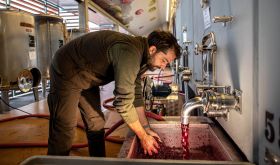
Only a few years ago, he become oenologist and decided to return to Pincelo, to his origins. He initiated a winemaking activity, the same that his grandmother Esther still practices on the solitary slopes of Chantada. His first wine could only be named ‘El Neno Da Ponte’.
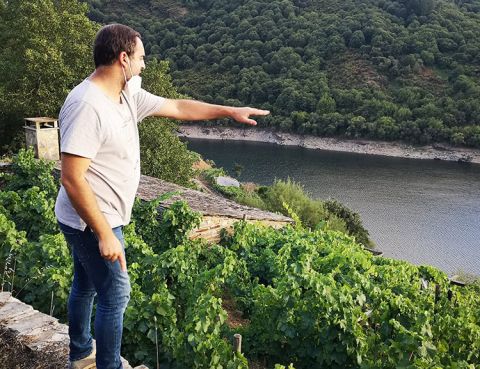
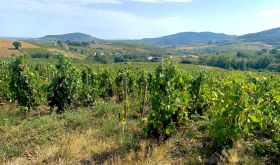
The Ribeira Sacra wines were already well known in Roma during the Roman Empire times. The steep slopes over the Miño and the Sil River make so difficult the labour work that it is described as ‘Heroic Viticulture’. The trade of this wine was already in place with the Phoenicians and Carthaginians, but the Romans propelled the viticulture by increasing the demand during their exploratory journeys searching for gold.
The monks during the Middle Age planted the vineyards in terraces, here called ‘socalcos’ and the brand ‘Ribeira Sacra wines’ grew in popularity worldwide. At the end of the 19th century, the region was almost abandoned. Firstly, the phylloxera spread, then the civil war and finally the difficult economic situation after the war, together with the toughness of the work, caused a massive steady migration of the inhabitants of the Ribeira, looking after a better future in the big cities. The vines were abandoned as well, causing the disappearance of almost all that important viticultural legacy.
Not everyone left. Esther Teijeiro, the grandmother of Roberto, stayed and continued making wine. This 82 years old strong woman, would like to see people coming back to the Ribeira, in the same way as they left some decades ago, particularly young people.
Although the fact of producing wine in such an isolated and hard-working condition was sufficiently challenging, this small and heroic woman was the first person who commercialized an organic wine in Galicia, obtaining the recognition for that in 2003. Esther had an enlightenment moment observing the naked soil of her vineyards. This land is sick because the herbs do not grow, she realized.
Not being understood at the beginning and even criticized by her other fellow winemakers, she was fully convinced that ecological wines were already produced by her ancestors not so long time ago. Esther pioneered after her 60s the return to what it was always there.
It was necessary to protect her vineyards with screens from the neighboring chemically treated vines. She was tempted to quit several times during the first year looking at the critically reduced yields, since the soil had to adapt to the new situation. After three years, she successfully saw a green cover growing in between the vine rows and the yields increased.
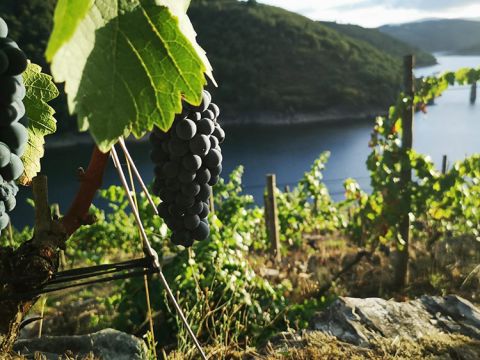
She thinks that is very important to produce ‘healthy’ grapes, not knowing at that moment that she was practicing any organic or sustainable viticulture.
Her grandson, Roberto, has picked up the baton handed over by Esther. Together with other young winemakers from the region, he has co-created Enonatur, a project for the regeneration of the abandoned vineyards of the Ribeira Sacra. Any person can rent a vineyard in Chantada to produce her own wine from the collected grapes. An unavoidable requirement is that the grapes growing must be organic and sustainable, in line with the values on the project.
The reinvention of a grandmother and a grandson, the recuperation of the traditional ways of making wine, the renewal of the soil by allowing the resurgence of biodiversity, the resuscitation of a viticultural region that was almost completely abandoned. This is a story about regeneration.
All photos are the author's own.