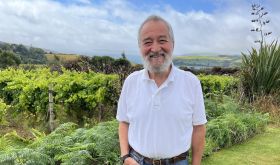
Sierra Newell writes Sierra Newell is a writer, marketer, and traveling wine professional. After moving abroad from California, her love of words and wine has led her to work in Austria, England, and Australia. She is currently based in Germany, about to begin her third wine harvest
Vine interventions
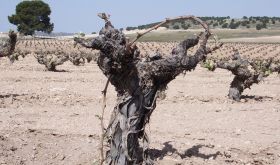
It was a full moon when we descended upon the 60-year-old vineyard in Oggau, Austria. A heat wave had spread into Burgenland, and the dense, sticky air created a dreamy haze over the vineyards that extended beyond the horizon. The sunrise’s orange glow kissed my bare shoulders as I wrestled through vines twisted in a mangled knot. Snip. Leaves fell away, revealing my aim: a perfect, inky indigo grape cluster. As I pulled branches back, I felt earwigs fall from their hiding places above and tumble across my skin. I reached farther, the muscles in my back groaning. One final snip and the Blaufränkisch bunch landed into my outstretched hand.
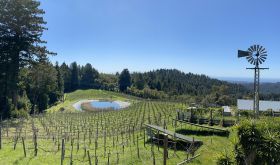
Burgenland is a peaceful but expansive winegrowing region in Austria, nestled west of Lake Neusiedl and warmed by the Pannonian Plain. It’s affectionately known as Blaufränkischland, home to the underrated but distinctive grape variety that thrives in Burgenland’s limestone and slate soils. Here, biodynamics and sustainable winegrowing aren’t niche; they’re the standard. When you stand in their ancient vineyards, leaves rustling in the undulating breeze, it’s easy to see why.
Last August, I became intimately familiar with this special stretch of Austria when I joined Eduard and Stephanie Tscheppe-Eselböck’s team at Gut Oggau, their biodynamic winery that’s a cult favorite among natural wine lovers. Like the fifteen other strangers I worked alongside for six weeks, I had years of experience in the wine industry under my belt and wanted to deepen my knowledge through assimilation. But unlike my coworkers, I’d never tasted or even heard of Blaufränkisch. My motivations differed: I had just finished my first year in recovery from atypical anorexia.
Weeks prior, I was in California, working a cushy marketing job while quietly dealing with my diagnosis, with some progress, albeit slow. I’d managed to reinstate homeostasis and heal some side effects: the numbness in my hands, the loss of vision when I stood up too quickly, the shredded skin from biting the inside of my cheeks to check their fat content. But I still felt untethered from my body, like I was floating, watching my life unfold from above. So I quit my job, sold most of my belongings, and escaped to Austria to devote my days to Blaufränkisch. After ten years of punishing my physical form, I hoped to rediscover her in a new context.
We began harvesting by hand at 3 AM, when the air was cool enough that we could pick, load the tractor, and drive the grapes back to the winery before they turned to vinegar. We dispersed across the vineyard rows, international interns peppered among seasoned Hungarian harvesters. Our headlamp beams bobbed as we shuffled along, combing through coarse leaves and clipping bunches of Blaufränkisch with our shears. I quickly learned how to harvest — cut the stem, remove shriveled, sunburnt clusters or botrytis-infected berries, and repeat. A seemingly simple task that, after several weeks, tests even the most patient person’s endurance. But despite the aches and pains, I basked in each sore muscle, sunburn, and scar because it meant my body was alive, and I finally had space to listen.
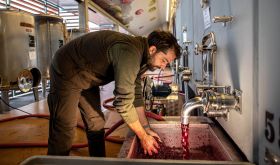
On many afternoons, after a long morning in the vineyard, a few interns would be selected to help with the processing in the winery. Most often, we’d hop up onto the loud, vibrating sorting machine to pick any stray leaves or faulty bunches out of the day’s yield. But sometimes, there’d be less chaotic but equally essential tasks; topping up barrels in the cellar with fresh juice, destemming grapes by hand, or pressing berries by foot. I lowered myself into a crate of grapes, the bright, acidic liquid stinging the scrapes on my legs earned from wrangling unruly vines. I lifted one knee at a time and pressed down, feeling the grapes pop and burst, squished between my toes.
Our bodies, in comparison to machinery, allow for a softer and more gentle extraction. My hands, calloused and dry, had spent eight hours clipping Blaufränkisch from the vine that morning. As someone always concerned about the size, weight, and appearance of my physical form, I’d never considered that it would be the most versatile tool in such an important ritual. I wanted to hug the past version of me that struggled to accept how powerful my body could be.
Twice a week, we ate dinner together as a team in Eduard and Stephanie’s courtyard. Fluttering, dirt-stained hands shuffled ceramic plates, each overflowing with decadent spreads still steaming from the pan. Accents floated between us as we eagerly awaited the first bottle to be opened. We’d drink Bertholdi, the Blaufränkisch cuvée made from their oldest vines, for the first time.
Eduard pulled the cork and poured the wine into our glasses. Deep and velvety red, it smelled of blackberries, rosemary, and olives. I took a sip, and cherry and pepper danced across my tongue. It was uplifting and alive. I’d never had anything like it before.
Blaufränkisch sparked a curiosity in me that superseded my desire for restriction. I was fascinated by the Burgenland terroir that shaped each glass, where the limestone soil and vines worked in concert, drenched in centuries of wisdom. I was captivated by Eduard and Stephanie’s fierce love for their craft and ability to work with, not against, the rhythms of nature. An entire galaxy of inspiration unfolded before me, infinitely more interesting than one defined by calories and consumption. Blaufränkisch showed me not only how to care for land and people but how to care for myself, too.
The voice that held my recovery back, whispering not to eat that, not to speak too loud, not to want too much, was still there, but I was learning not to mistake it as truth.
“Do you want some more?” My coworker asked, the wine bottle dangling above my glass. A flame, enduring and seductive, ignited in my chest.
I knew he meant the wine, but I wanted more of everything — joy, pleasure, life.
Credit for the photo of Sierra Newell picking Blaufränkisch at sunrise belongs to Manu Grafenauer.