Pietro Buttitta writes Pietro Buttitta is a grape grower and winemaker in California producing many Italian cultivar wines for his Prima Materia wine label, including a varietally-labeled Sangiovese. He considers himself a student of Italian wine who is deeply interested in wine history, and a former professional chef.
On Sangiovese …
Randall Grahm, my hero of grand visions and broken businesses, frequently invoked the old divide between wines of effort and wines of terroir. Wines of effort are willed into existence with straining muscle, additives, oak, and gleaming steel. Wines of terroir however spring forth fully crafted and elegantly assemble themselves, clearly voicing place, elegance, and nobility. Rustic and pure.
Wines of terroir have somewhereness (assuming you know what a somewhere tastes like) that is fragile or screaming like Priorat or Mt. Etna, but should be uncluttered by winemaking. Wines of effort necessarily come from grapes planted in the wrong places, and by definition are “constructed” by a winemaker. As a winemaker and grape grower, I do dream of birthing angelic wines of terroir, but I am damned to produce wines of vulgar effort.
Most of us can’t afford grand terroir, let alone find it and coax struggling vines for decades with miniscule yields as a sustainable business. While we should probably aspire to terroir, at the least because we are told we should, what if the tyranny of terroir is just cultural appropriation, or ideological servitude? What if terroir is just another myth inflicted onto the lower classes, fooled into endless searches for limestone and gravel? What if there is a third path?
Case in point: my love affair with Sangiovese, a grape I once hated. While Barbaresco spoke to me immediately of ferocity and elegance with towering crystalline clarity, and Taurasi seemed the Dionysian inverse, California Sangiovese became my white whale.
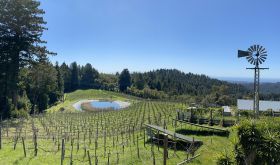
After many vintages from vines I personally panted, and from other locations, it is still a wine of effort. Clearly. Sadly. I planted five blocks to hedge against a climate that is too hot, too sunny, too Sangiovese by way of Manduria. This is the difference between a spiritual home and a production zone. The wine aspires to approximate a wine of terroir by using multiple pieces to build a wine of balance with a nervous texture, a sculpted hourglass midpalate, or what old California winemakers call a gaping hole crying for Cab or Merlot. That hole, my misguided friends, is where your dreams go. To maintain or even expand it along with minerality is the holy grail.
One Brunello clone was planted east-west on a gentle slope with a sun-drenched southern exposure where the thick skins evoke macerated black cherries on the sun side. The shaded north side holds restrained flavors of herb and spice with a touch of green. I then drove 1,000 miles for some Biondi-Santi vines. It is slow growing and clearly a different biotype with singular habits like huge leaves that barely filter enough sunlight to temper the dark fruit. But my God is it robust and haunting. Almost Sagrantino-level tannin, black fruits, thick skins, tobacco notes, herbs, with sanguine and bass-driven complexity that speak to age, wisdom, time itself.
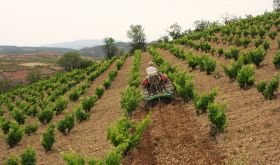
Italian viticulturists told me to plant some Romagnolo Sangiovese. Spicy, with blue fruit tones and cinnamon overlaying strawberry and cherry. Moderate tannin and acid here – further softened by high potassium from our acidic volcanic soils. We have a fruit bomb here, to deny it is impossible. Like Grenache it speaks of summer love and puppies. Overthin the vines and the tannin hardens and acid drops, underthinning makes it watery and insipid. The crop generally holds at 3-4 tons per acre naturally though – a bonus not achieved in the Old World that I attribute to alkaline soils and summer rain there. The north-south block with full sun rollover requires an extra cane or two for shading. It is important to minimize direct sunlight, and then pray for cold nights. Here I shamefully fight the California terroir.
The Prugnolo Gentile block’s growth looks anemic in comparison. The canes are less than half as long, internodes are gangly, irregular, almost sickly. Lots of fruit thinning happens since many canes are only 2-feet in length, and there is too little leaf area for adequate ripeness. But what this questionable selection adds to the wine is disproportionate alchemical transforming fire with floral aromatics, peculiar spiciness, agitation, confusion, and a sense of nervosity. It anthropologically unites Chianti with Brunello like some newly discovered sibling. Vinified alone it is scrawny, scratchy, frankly unpleasant.
I may use a little stem inclusion to contain the warm-climate fruit. Fresh stems maybe, some dried, then pitched back into the fermentation. Long macerations. Get some ripping hot, but keep that delicate Prugnolo super cool. Have a plan, but let intuition shape it. Craft the pieces in the vineyard then safeguard them in the winery. No tricks, use the lees, trust the vineyard. Repeat.
The resulting Sangiovese is indeed a highly constructed wine of effort. With these pieces I can slightly alter the whole by picking some blocks a little earlier for lower alcohol or higher acidity, more tannin ripeness here to offset picking a little too early there. But, it is doomed to be an assemblage mirroring my personal caricature of a fading Platonic form, specifically one particular Chianti Classico Riserva I tasted in 2016.
After 17 years I can’t claim to understand our terroir fully, or what works best there, though I have beliefs. And now we have vintages too, swinging wildly between heat and cold. Some things are obvious, like needing more Rhone and Portuguese grapes, but Cab is where the money is. Listan Negro? Bobal? Can we ever know what grows best? In Barolo do they remember that Pelaverga was once considered superior? What if Roter Veltliner is actually our perfect terroir match, quietly awaiting discovery?
Of course, I love Randall’s romanticism. It nourishes me. I need these myths and dreams to sleep at night and feel part of the general arc of vinous history, but the truth gnaws away inside. We all start somewhere, and the yoke of history and the weight of tradition are optional burdens in California, and we are blessed and cursed by living without history, so wines of effort we must make.
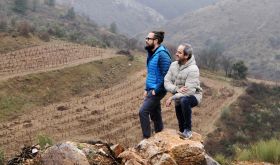
The main photo is of the author.