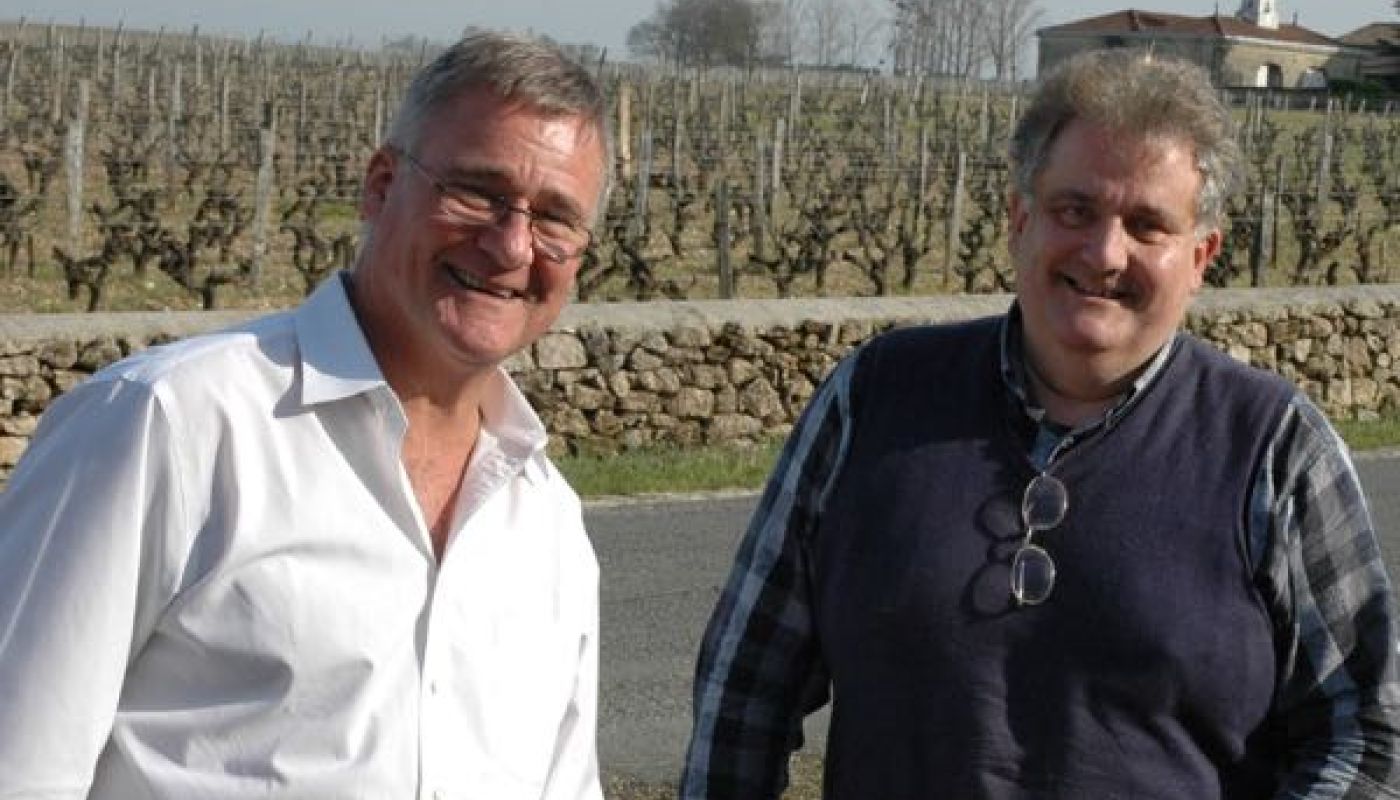
20 March 2018 Bordeaux commentator Bill Blatch carries on from Blatch on Bordeaux 2017 – the vines. See also, Blatch on Bordeaux 2017 – the stats. Bill (left) is seen here with Jean-Pierre Meslier of Ch Raymond-Lafon in Sauternes, a region whose producers needed great resilence in 2017, as described below.
Vinification
There were no general rules. Everyone had to adapt to each tank's special requirements. If there was a rule, it was gentleness of extraction, yet, for unfrosted grapes, few seem to have opted for lightness because the grapes were concentrated, their pHs were good, their tannins very extractible and the few pips they had (as in 2005) were generally ripe. If the harvest was perfectly sorted and the lots properly selected, a concentration of tannin equivalent to the 2014s could be easily achieved. In fact this is the comparison that was the most frequently drawn at this time. Later, after the vinifications, everyone noticed that the wines were in the end softer than that and had something of 2012 or 2001 about them.
2017 reds
Of course there is enormous variation from vineyard to vineyard, even among the non-frosted ones. The very complete ripening of the skins, originating in the May–June heat-stress period and continuing in the heat at the end of August meant that there are generally no green wines and, provided proper selection of the harvest has been made, the wines, both Merlot- and Cabernet-based, are solid and quite rich. In terms of absolute quality, there seems to be little difference this year between the top wines of the left and right banks. Both have made some equally impressive wines.
2017 dry whites
These are extremely balanced wines, moderate in their alcoholic power (although more powerful than the 2016s) and nicely acid from the cool nights of the second half of August and from the cool days of the first half of September. At this stage, before the rot risk arose, and especially because of the thickness of the skins, the acidities were nicely fresh and allowed the harvest to be performed in a much more relaxed manner than that of the reds.
2017 Sauternes
The terrible April frosts did not spare Sauternes; on the contrary. At 40–50 cm (16–20 in), the foliage was too far out and much of it had frozen, not just the leaves but the whole shoot right down to the stump. Barsac and the lower areas were the worst-hit: Myrat lost 85%; Climens made just 35 barrels, none of which will be Cyprès let alone grand vin; and Coutet's 8 hl/ha came only from the heart of the vineyard. Parts of Sauternes fared no better: the lower reaches of Preignac – as one would expect – but also up on the top suffered. Arche made a mere 300 hl and La Tour Blanche just 50 barrels. Yet, as always with frosts, some did OK: Sigalas and Rayne Vigneau made almost-normal yields. These survivors and the unaffected parts of the frosted ones benefited greatly from the hot, dry summer with the result that by mid August, they had beautifully golden, ripe bunches, but of course it was too early and too dry for botrytis.
The end-of-August rainfall and the succession of windless, drizzly days in September brought on a small development of noble rot, which accounted for a little first trie of excellent, fresh, beautifully perfumed musts of 20° Baumé or so, provided that any bad grey rot, aigre, was previously or simultaneously discarded. This aigre didn't attack everywhere, but where it did, it accounted for even more loss of production than the frost itself – and also for a general feeling in these final days of September that the vintage could now go no further.
But a Sauternais never gives up and with the change of month came a transition in the weather to increasingly warm and dry conditions which, when combined with the cooler nights, arrested the aigre, allowing the next generations of noble rot to be sealed into ever-increasing concentration and purity for an excellent big and very rapid trie from 9 to 13 October. The concentration was at times even too much and, with no less botrytised grapes left with which to tone it down, it had to stay that way, so some of these October picks had to be very sweet, especially for those few estates that continued on to 20 October.
Very generally the cuvées will be composed of 25 to 33% very fresh, end-of-September pick with the rest made up of the much more concentrated October picks (and nothing at all from the early October ones). In this sense, the vintage was similar to that other ‘beginning and end and no middle' vintage 1998, but with much more of the density and racy balance of, say, 2010. There is not going to be much of it to go round but what there is will be really excellent, perhaps yet again the best part of the Bordeaux vintage, very concentrated but also beautifully lively and fine.
We spare a thought for those who had too few grapes left either from the April frost or from the September aigre to take advantage of these fabulous and unexpected October conditions. But again, as we all know, a Sauternais never gives up.
Conclusion
Latest estimates have confirmed, almost finally, a decrease in production from 2016 of 40% for the reds and 50% for the whites, representing a total loss of €1.6 billion. This is virtually pure loss for the growers as, even with insurance, they get compensation for only a small percentage of the basic generic price. The economic effect will start to be felt sorely later this year or in early 2019 when the absence of revenue kicks in. Meanwhile, the increased cost of tending a damaged vineyard has to be met by current vintages.
The subject of the effect of the 2017 frost on the next vintage 2018 has been widely publicised as everyone plans their pruning programme to choose the healthiest wood in order to repair the vines and ensure a reasonable harvest for this year. Many are saying that 2018 will see another short harvest. Historically, there is little substantiation for this. Examples are 1978 after 1977 and especially the incredibly prolific (if not of great quality) 1992 after 1991. Each time, the vine, which is after all more interested in reproducing itself than in putting fine wines on our dinner tables, seems to have decided to catch up on lost production. That said, the pruning is currently in its final stages very late and it is incredibly complicated: it takes skill, experience and a lot of time to work out which of the myriad shoots that have sprung out all over the vine are the best ones to retain for this year's fruit and to avoid scarring the stumps when eliminating the others.
Still to come, Blatch on Bordeaux 2017 – the stats, a compendium of statistics on weather and picking dates.