It’s harvest time in South Africa. Winemakers have been up to their elbows in grape skins for several months already, and as the intensity of high summer wanes, the late-ripening varieties have been coming into the cellar.
Clairette Blanche, as Clairette is known in South Africa, is one. Tasting a varietal bottling made on Cape soils, I find it difficult to put my finger on the style – earthy yet ethereal, like the memory of a favourite perfume.
One of the first I encountered was Craven Wines Clairette Blanche 2017, which is textured, entrancing, pithy. It’s wine to light up a dark room. The shifting nature of the wine plays into its mystery. Though, to be fair, there’s nothing mysterious about it. Historically Clairette Blanche has been as much of a workhorse as Chenin Blanc in the production of Cape brandy, as well as providing ballast for white blends.
But when it flies solo, it flies straight to the moon. There's a handful of the Cape’s winemakers making it thus, intrigued by fruit found in forgotten vineyards. From a block in Stellenbosch’s Polkadraai Hills, John Seccombe, winemaker-owner of Thorne & Daughters, makes a single bottling he actually calls Man In The Moon.
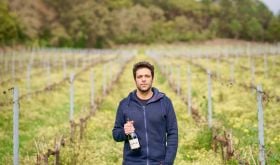
‘The vineyard is approximately 32 years old now, planted on granite and quartz soils', says Seccombe, pictured below. ‘Clairette has long been blended away, so it’s interesting to see it starting to feature now as a single varietal.’

All of the whites in the Thorne & Daughters’ range take inspiration from childhood stories and objects. Seccombe says that Clairette Blanche means ‘fair or clear white’ just like the moon can be, which made him think of that universal childhood tale which gives the wine its name. ‘I also really love one of the skits in The Mighty Boosh in which Noel Fielding plays the Man in the Moon', he admits.
Seccombe’s Thorne & Daughters, Man in the Moon Clairette Blanche 2017 is as luminous as its inspiration, a discourse between perfume, earth and fruit. In the making, the grapes are whole-bunch pressed in an old Vaslin press. ‘It’s a very old press from France with a large metal screw in the middle of the cage and with two plates that move towards each other to press the grapes', explains Seccombe. ‘It's a lot like an old basket press but much more efficient at getting juice out of white grapes. The juice then settles in a steel tank overnight, after which we rack the juice off its heavy solids and take it to old barrels where it undergoes a spontaneous fermentation. We also skin-ferment a portion of the Clairette Blanche and finish the fermentation in old barrels.’
From the same Stellenbosch vineyard comes another varietal expression of the grape. Radford Dale, Thirst Clairette Blanche 2017 is the other side of the moon, less ethereal, more terrestrial. Jacques de Klerk, director of winemaking and viticulture at Radford Dale, shows just how malleable the variety can be. De Klerk harvests at a relatively low potential alcohol level (approximately 12% to 12.5%) in a bid for freshness. ‘The grapes are hand-picked and sorted, then destemmed and crushed', says De Klerk, explaining his process. ‘A period of skin maceration follows, usually around four to five days. During this time we extract the tannin, which helps to give the Thirst its perceived saltiness. The higher acid and low alcohol combine with this to create a flinty, stony expression of the grape.’
There’s a counter revolution at play in the Cape. Large co-operatives have acted as unwitting guardians to pockets of old vines, from Chenin to Cinsault and, yes, Clairette. While sending out large volumes of Sauvignon Blanc and other popular cultivars, they tend to overlook smaller pockets of vines that may be all the better for it.
Such is the case with Daschbosch Wines, which is the boutique arm of co-op uniWines, the second-biggest primary producer in South Africa with some 3,000 ha (7,415 acres) of vineyard under cultivation. They were also one of the first members of the Old Vine Project, the programme set out to catalogue and conserve vineyards that are 35 years and older.
‘We accidentally came across this pocket of old bush vines planted on the farm, Avon, in the Breedekloof', says winemaker WS Visagie. ‘The Clairette Blanche bushvines were planted in 1977 and almost forgotten about until we managed to salvage them. We’ve tried to showcase a different side to Clairette, which used to be a ubiquitous and pretty innocuous blending ingredient. We wanted to show what could be done with the fruit of these once-untended, unirrigated old bush vines.’
The Daschbosch, Avon Clairette Blanche 2018 is named after the farm it’s grown on on the slopes of the Olifantsberg Mountains in the Breedekloof. Only 900 kg of fruit was harvested in 2018 from the bush vines, and the Avon is silkier, smoother than those mentioned above. This is due in part to its warmer growing region, but also as a result of extended lees contact for about six months with regular bâtonnage. The Avon offers aromas of hay, tea (in a South African context, rooibos) and citrus, while it lies rich yet pithy on the palate.
It wouldn’t be too much of a stretch to say this style would be closest to that of the Clairette made in the south of France, which tend to be rounder, richer examples of the varietal. What is it that distinguishes South African Clairette from its French counterpart?
Seccombe of Thorne & Daughters has a hunch. ‘I haven't had much experience with single-varietal bottlings from the south of France. What I have seen though were fairly rich, alcoholic wines, which doesn’t fit with the clonal material we have here. We don't seem to be able to achieve that level of ripeness in South Africa with what we have planted. The grapes look the same, but it may be that we are working with very different vine material here.’
This may well be the case, but one thing’s for sure: South Africa’s varietal Clairette Blanche is a rising star.
Images courtesy of Tasha Seccombe of Thorne & Daughters.