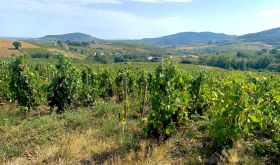
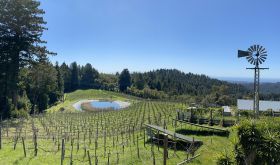
The annual cycle turns regardless of drought, bushfires and COVID-19. The wattles are in full blossom, the jonquils and daffodils are flowering, the magnolia and almond blossoms are just emerging and we are pruning Tiers Vineyard.
We are more than a month past the shortest day of the year and the plants have received their instructions from season control to begin a new cycle of growth, flowering, fruiting and finally senescence again. There is comfort in this inexorable cycle, the sort of certainty and predictability that is missing from the human condition currently, with more uncertainties than at any other stage of our generation’s lifespan and, by inference, for all human beings, bar perhaps the few who survived the Second World War and are still alive today.
Reflecting fleetingly on the months cradling the 2020 vintage and since, it would be understandable to feel victimised but the victims’ club is potentially large and not one that delivers much benefit to members.
It is more productive to put 2019–20 into historical perspective.
First and foremost among recent afflictions there is this particular coronavirus, killing hundreds of thousands of people around the globe, maiming many more and infecting more than 15 million people, spreading at an increasing rate. The economic consequences of containment of the virus will be visited on the next decades and likely transferred on to several future generations.
The only historical events that bear comparison were the Spanish flu of 1918–20 following on the heels of the carnage of the First World War, presaging the economically devastating Great Depression, which in turn sowed the seeds of the Second World War. Now that is a sequence of events that could lead to feelings of victimisation …
But no, those of us who grew up with grandparents and parents who survived all or part of that maelstrom of events know how tough-minded and resilient-bodied they were, how frugal of need, how cautious about over-ambition or any extravagance and how determined they were to make things better for future generations.
Well, here we are and to a very large extent they succeeded in their ambition. We are a fortunate cohort of Australians, largely owing to their hard work and innovative spirit, bestowing on their children and grandchildren the education never possible for themselves and succeeding in their determination to leave Australia a better place than they had inherited.
Vaccines and treatments for COVID-19 will be developed in this era of astounding technological achievement. Governments will coordinate their efforts to alleviate the economic hardships visited on their populations, and lessons will be learned even while we grieve for those who succumbed and nurse those who are damaged.
Pandemic aside (however hard that may be), the other demon unleashed on us Australians in 2019–20 were the bushfires. They have happened before in a recorded sequence of death and destruction across the Australian continent since European settlement and back through the 65,000-year tenure of the land by the first Australians. In 1981 and more ferociously in 1983 our vineyards were alight from Clare through the Adelaide Hills to Coonawarra. We were lucky to survive the 1983 fire at our Piccadilly Valley home site and winery.
I have been reading about some of my ancestors who settled at Narre Warren on the edge of the Dandenongs in the Yarra Valley and who were burnt out, along with most of Victoria, on Black Thursday 1851. I use this pervasive fire only as an early example of the many that have followed and that occur through our lifetimes on an all-too-regular basis.
Had governments listened to the Australian Bureau of Meteorology in 2019 they would have realised the inevitable and been better prepared to deal with the extraordinary sequence of fires across the south-east of Australia from September 2019 to February 2020. Again, there is cause for optimism as technology facilitates a better understanding and ability to predict short-term weather events, medium-term climate cycles and the long-term outlook of climate change.
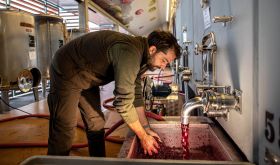
In 2020 we have endured the most disrupted vintage for 37 years and, like 1983, it was a small vintage due to failure of fruit set. Perhaps that is fortunate given the public perception surrounding the fires and the effect of smoke on the crop. It is difficult to convince bank managers of our good fortune.
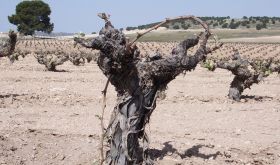
Back to the inexorable seasonal cycle. As the vines in Tiers are being pruned to ready them to deliver vintage 2021, their roots are already stirring, beginning the march to another harvest next year. The soil has a full belly of moisture after good early winter rains, and the possibility of a La Niña developing increases the chances of replete vines and a warm flowering followed by a moderate-temperature (maybe even cool) summer.
Good crops of high-quality fruit should be harvested, making great wines for a starved domestic market seeking quality and authenticity where supply has been limited by the successive small vintages of 2019 and 2020.
President Trump will calmly hand over power after November [are you sure, Brian? – JR] and once President Biden defuses the trade war with China, Australian wine will continue to flow into China.
The coronavirus will be controlled and restaurants will fully reopen. Consumers will value the local over overseas experiences and imports.
The vines will continue their inexorable cycle and the world will take a deep breath, better prepared for the future, while the benefits technology can deliver to fulfil our version of our ancestors’ promise to make the world better, with particular reference to the reduction of CO2 emissions.
Don’t tell me I am dreaming! The seasonal cycle will continue even if I am.