
Much of the worry about declining wine sales might be erased if only there were more wines like Salamandre.
There are two: the Rouge, the current 2022 a super-fresh red that’s all lilac and black pepper in scent and juicy black plums in flavour, and the Orange, the 2024 vintage a white wine that’s fully orange in colour but gently ‘orange’ in flavour and texture, with citrus notes and palate-whetting spice. Both are organically grown and screwcapped for freshness and ease; both beg to be toted along to your next picnic or barbecue or cracked open next time a friend stops in. And both pack more value into an under-$20/£20 bottle than any other similarly priced wine I’ve tasted this year.
That’s in fact the intention behind these wines, and all the wines in The Terroirs Project, a side project for UK importer Les Caves de Pyrène.
For those who aren’t familiar with them, Les Caves has been around since 1988, at first an outlet for ex-rugby player Eric Narioo to bring in wines from his homeland of Southwest France. It caught Jancis’s attention in 2008, when she went to a tasting and came out remarkably non-black-toothed – ‘Here was one small physical sign of the distinctiveness that the company aims for in its wine selection’, she wrote. By that time, Narioo and his business partner Doug Wregg had assembled a portfolio of small-production wines made with minimal inputs.
As she related, ‘The policy of “Les Caves”, as they call themselves, is to ferret out wines that are “never brands; they are not available in supermarkets; they are not mass-produced in wine factories. They are, instead, largely artisan products, because we believe that quality derives from attentive and caring farming methods.”’
With The Terroirs Project, they take their goal a step further. As Wregg put it in an email to me earlier this week, ‘We wanted low-intervention wines to be more affordable. These could be the new house or gateway wines on lists throughout the world.’
They began scouring the world, looking to their producers as well as co-ops and companies they hadn’t worked with yet, to find partners who could make delicious wine according to the following parameters:
- must be from organically farmed grapes (not necessarily certified but practising)
- hand-harvested and selected grapes
- fermented with native yeasts
- no additives to the must
- no inoculation
- minimal or zero filtration
- no added finings
- low addition of sulphites (zero in some cases)
Château St-Cyrgues is one of these wineries. A small estate in St-Gilles in Costières de Nîmes, it sits on the ruins of the Church of St-Cirice de Marge, where pilgrims following the Santiago de Compostela would stop by. Current owner Loïc Ferraud tells me that his father bought the estate in 2014 – the first time his family had the chance to have their own estate, though they’d been winegrowers for five generations. (They also happen to be judo champions – Ferraud tells me both his parents practised, and he started training at four years old; in 2024, he came third in the world championships.) They started converting the 36 ha (89 acres) to organic farming immediately, attaining certification by the 2016 vintage. They’ve since planted another 24 ha (59 acres), mainly to white wine grapes, and Loïc took the reins in 2018, although he stresses that the estate remains a family affair, with his father in charge of the vineyards and his partner running marketing while he leads winemaking.
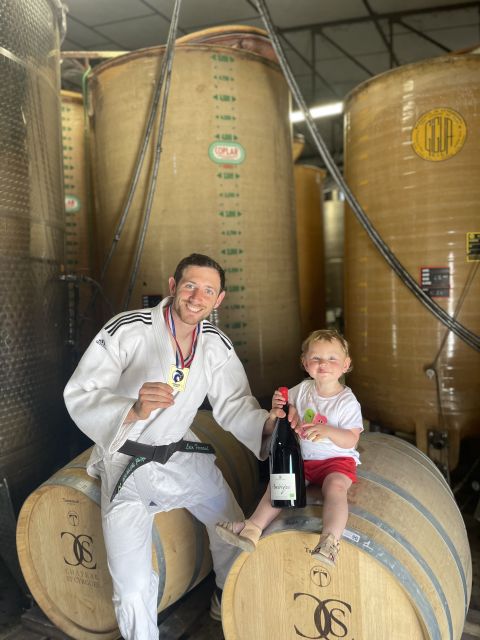
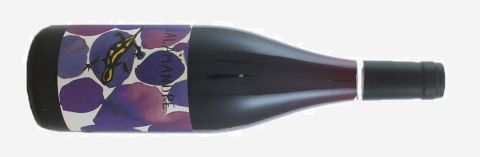
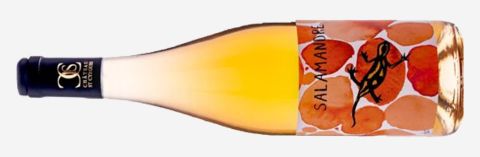
For the Salamandre wines, Ferraud and the Caves team work together to come up with wines that meet all the above criteria; once the final blend is decided, it’s bottled at the château and shipped from the winery’s cellar. Les Caves takes responsibility for the labels, working with three artists to ensure they are reflective of the wine inside. Having tased the wines, I can vouch for the fact that the Salamandre labels, designed by Antonella Libretti, evoke the flavours in the bottle in their saturated watercolour tones and sense of warmth channelled by the sun-seeking salamander winding across the colourful stone-shaped splotches.
The red is 100% Syrah (and thus must take the Vin de France appellation, as the Costières de Nîmes AOP requires a blend of grapes for both white and red wines) which Ferraud says they pick very early to ensure perfectly healthy grapes as they add no additives, not even any sulphites. The 2022 has the saturated purple flavour of just-crushed berries with the peppery spice that’s hallmark of the variety. If there’s one complaint, it’s that it clocks in at 14% but feels far lighter, making it dangerously easy to drink too much.
The white, on the other hand, is just 12.5% but no pushover: 100% Grenache Blanc, it’s a blend of two components: some of the fruit is whole-bunch pressed before the juice is fermented; the rest is destemmed and macerated with the skins for 10 days – just enough to give it an orange hue and some lovely skin spice, but not so much to make it bitter or tannic. You could call it a gentle entry into the world of orange wines, or just a white wine that has a little extra structure, weight and flavour – the sort that can take on a charcuterie platter or a bowl of chaat and a well spiced aloo gobi and yet also stand on its own.
Asked what connection he’s found between judo and winemaking, Loïc responds, ‘It has played a major role in shaping the values of a winemaker – namely, patience, respect for the vineyard, and courage’. However, he adds, ‘It is extremely difficult to balance the profession of a winemaker with that of a competitive judoka; consequently, my kimono will soon be put away for good!’ A loss for the judo world, but a gain for the wine world.
The Salamandre wines are well distributed in the UK and have just been picked up by Little Peacock Imports in the US, where they are quickly making their way onto wine-store shelves. They are also available in Belgium, Germany, the Netherlands and Poland.
Find out more about Costières de Nîmes and surrounding areas in The Oxford Companion to Wine and The World Atlas of Wine, and explore its wines in our tasting notes database.