Ten years ago something very exciting happened on the London wine scene. The wine trade crammed into the concrete basement of a Soho record shop to taste an array of wines from a crowd of about 40 hitherto unknown and demonstrably youthful producers from South Africa.
The event broke new ground in many ways. Steve Daniel, the man responsible for Oddbins’ wine range in its heyday, commented afterwards, 'I can't remember when I felt such energy at a trade tasting.' Importer Gus Gluck observed, 'What was so great about it was the feeling of friendliness. No one was at anyone else's throat for once.'
These Cape new-wavers had been assembled by Robin Davis and Damon Quinlan of wine retailers Swig. As Quinlan puts it now, ‘We'd been increasingly aware for 10 years or more that a new breed of (mostly) young winemakers were making incredible wines, often from lesser-known regions and old vines, that hadn't until then been recognised for their potential.’
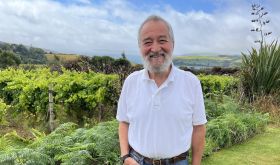
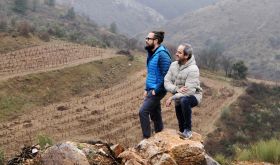
The likes of Chris and Suzaan Alheit, Adi Badenhorst, Peter-Allan Finlayson of Crystallum, Marc Kent of Boekenhoutskloof and Porseleinberg, Samantha O’Keefe of Lismore, Chris Mullineux, Donovan Rall (pictured above in leather) and Duncan Savage are all winemaking superstars now but back in September 2015 most of them were showing their wines to British palates for the first time.
Two more similar tastings were organised, the third one in 2019 being so popular that Quinlan recalls, ‘The venue wasn't big enough for everyone that tried to attend – the first, and possibly last, time that a UK trade tasting event had had to operate a “one out, one in” door policy!’ I was there and can confirm that quite a queue built up outside Soho’s Vinyl Factory.
A sense of community is a hallmark of South African winemakers, especially prevalent among these new-wave producers. So when Mark Dearing of Justerini & Brooks and UK-based Master of Wine Victoria Mason came up with the idea of doing a 10 Years On blind tasting of their 2015s, they were met with enthusiasm from the South Africans – even if not all could provide 10-year-old bottles.

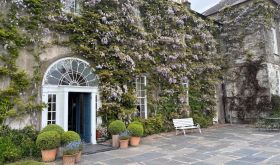
As a result, 16 of us wine professionals spent a day in May in Berry Bros & Rudd’s well upholstered cellars (above) tasting blind 78 2015s grouped in 12 suitable flights – not unlike the annual so-called Southwold tasting of four-year-old bordeaux. (The organisers called it Steenwold, a reference to the old name for South Africa’s signature grape Chenin Blanc.) The aim was to see whether the wines had aged well – rewarding evolution being recognised as the hallmark of quality in a wine, even if today’s wine drinkers tend to seek more immediate pleasures.
The exercise was a success. The great majority of the wines were still in good shape and 2015 versions of the ones listed below were downright delicious. Such unexpected disappointments as there were, were generally the result of faulty stoppers. Admittedly, wine professionals tend to be pickier about even mild infections of TCA, the compound associated with mouldy corks, than most consumers but the overall failure rate of 30% would be unacceptable today. Fortunately, wine producers are now much more aware of the need for serious quality control of stoppers (see Back to basics below), and I’m sure that the failure rate in future Steenwold tastings will be much lower.
As usual for South African wine, with the caveat that some corks let the wines down, the whites outshone the reds, with those of the Swartland, the hot, dry farmland with myriad old vines well north of the traditional wine centre of Stellenbosch, shining particularly brightly. The region was virtually ‘discovered’ by, and became synonymous with, the new-wave wine producers, although it was old-timer Charles Back of Fairview who first saw the Swartland’s potential for fine wine. (See this overview map of South African wine regions.)
Chenin Blanc is the country’s most-planted grape variety, and features strongly in its unique Old Vine Project certification scheme. The Swartland Chenin flight and that of white blends, in which Swartland Chenin was often a component, were the two most consistent and exciting of the entire day.
There’s a strong argument that in South Africa there is a much wider range of styles and flavours of Chenin Blanc than there is in its homeland the Loire, and strong links have been forged between Loire vignerons and their counterparts in South Africa. The Cape Chenins offered, variously, flavours of honey, green vegetation, hickory smoke and citrus peel as well as the structure of many white burgundies and, in some, a certain fashionable minerality or salinity. Among some thrilling Swartland Chenins, I particularly loved The Liberator Episode 16 Perfectly Flawed that had been aged under flor yeast.
Alex Starey’s single-vineyard Keermont, Riverside, was one of two stars of the distinctly variable flight of Stellenbosch Chenins. The other was the Alheits’ Radio Lazarus. All samples of the Alheits’ Magnetic North and Cartology were out of condition – a great shame since recent vintages have been stunning.
As for the white Cape blends, Palladius, a blend of Chenin with 10 other grape varieties from the Sadie Family, was a standout, the 2015 being made one year after Eben Sadie’s very public admission in 2014 that he had been barking up the wrong tree in trying to make his wines as ripe as possible. (Sadie, pronounced Sardy and now joined by his sons, is seen as one of the earliest pioneers of the Swartland, also a champion of the ancient vines to be found on mixed farms up the west coast, and is one of very few South African wine producers to have established a real presence, and high prices, in both the UK and US.)
Donovan Rall is an established superstar of Cape wines and his eponymous white blend from several different vineyards was one of the whites that still seemed to have a glorious and complex future ahead of it, as did Marelise Niemann’s Momento blend of Chenin Blanc and Verdelho from Bot River and the Paardeberg.
The other tasters were more taken by the flight of Chardonnays than I was, perhaps because I had participated in a tasting of 22 South African Chardonnays only a few days before and my expectations had been too high. That said, I gave pretty good scores to Crystallum, Clay Shales; Lismore, Estate Reserve; Restless River, Ava Marie; and Storm, Vrede. A significant proportion of these wines, along with the Pinot Noirs, had been grown in the relatively young vineyards of Hemel-en-Aarde in the hinterland of the cool south coast (shown on this World Atlas of Wine map). We can look forward to even greater things in the future, presumably.
The final white-wine flight, the last of the day, was devoted to Sauvignon Blancs and/or Semillons (typically written without an accent in South Africa). Semillon was once South Africa’s most-planted grape variety by far and there is still a plot of particularly ancient vines in Franschhoek. Marc Kent of Boekenhoutskloof has long taken advantage of this in his rich-but-snazzy Semillon bottling, which still has another two or three years of life in it, while John and Tasha Seccombe of Thorne & Daughters base their Paper Kite Old Vine Semillon on very similar vines.
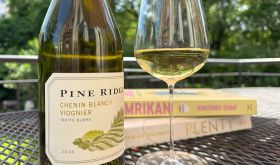
Two whites were served (labels visible) with our buffet lunch because they didn’t fit into any flight. They proved that Chris Williams of The Foundry was already making fine examples of Rhône varieties Roussanne and Viognier in 2015. His Stellenbosch Grenache had been the star of a red flight that morning devoted to ‘Mediterranean varieties’. The renaissance of Cape Grenache was still in its infancy in 2015 and producers then were still scouting out the best plantings. In the next flight of ‘Mediterranean red blends’, Eben Sadie’s sophisticated Columella blend of southern French varieties from the Swartland really stood out.
We’d started the day with a flight of Pinot Noirs, a variety that proved the most vulnerable with an extremely high proportion of those shown let down by their closure. Today’s Cape Pinots, most from the Cape South Coast region, are much more impressive, even if it is only recently that South Africa has become a serious Pinot Noir producer.
Syrah of the northern Rhône has been challenging the Pinot Noir of Burgundy as the South Coast’s signature red-wine grape and Sam O’Keefe’s Lismore Reserve and all three wines from Master of Wine Richard Kershaw, identified by the codes of their clones, were tremendous. The Stellenbosch Syrahs were more variable than those from the cooler South Coast but there was a humdinger from De Morgenzon.
But it was Swartland Syrah that was the red-wine star performer, with a pair of outstanding wines, one rich and one racily energetic, from each of Porseleinberg and the Mullineux. Kudos to Marc Kent of Boekenhoutskloof in Franschhoek for putting Callie Louw in charge of his Porseleinberg offshoot in the Swartland.
The reds from Bordeaux varieties were not as thrilling though the three from Boekenhoutskloof stood out. One grape variety was very obviously missing from this reprise of a revolution, South Africa’s unique Pinotage. But it was presumably regarded by most of these revolutionaries as irredeemably old school.
New-wave South Africans
Whites
The Liberator, Episode 44 Mudlarking 2023 Piekenierskloof 13.5%
£23 Woodwinters
Rall White 2023 Coastal Region 13%
£27.46 Justerini & Brooks
Lismore Chardonnay 2021 Cape South Coast 13%
£30–£32 VINVM, Fintry, Hic!, NY Wines
Alheit, Cartology 2021 Western Cape 13%
£35.95 Thorne Wines, £36 Vin Cognito
Boekenhoutskloof Semillon 2022 Franschhoek 13.2%
£39 Berry Bros & Rudd, Roberson
Keermont, Riverside Chenin Blanc 2020 Stellenbosch 13.5%
£41 Swig
Sadie Family, Palladius 2022 Swartland 13.5%
£88 The Sourcing Table, £93.30 Four Walls Wine Company
Crystallum, Clay Shales Chardonnay 2021 Hemel-en-Aarde Ridge 13%
£100 Cru World Wines
Sadie Family, Palladius 2016 Swartland 13.5%
£127 Cru World Wine
Reds
Mullineux & Leeu Family Wines, Mullineux Granite Syrah 2018 Swartland 13.5%
£69 London End
Kershaw, Deconstructed Syrah Groenland Bokkeveld Shale SH9c 2019 Elgin 14%
£78 Cru World Wine
Porseleinberg Syrah 2017 Swartland 14%
£79 Cru World Wine
Sadie Family, Columella 2020 Swartland 13.5%
£90 Hatton & Edwards
Back to basics
| How should wine be stoppered? |
|
This tasting of 10-year-old wines illustrated vividly the importance of bottle closures. The choice today is between natural corks, so-called technological corks (chiefly Diams made from agglomerated cork particles) and screwcaps, although some producers are fond of glass Vinolok stoppers.
Natural corks have the advantage of green credentials and their failure rate has reduced dramatically in recent years. Some of the more expensive examples are guaranteed TCA-free. Diams are designed to be free of cork taint, too, and now come in several different versions designed for different ageing periods. To compete with natural corks’ eco image, Diam has launched a range that is ‘bio-sourced, eco-designed, and committed to biodiversity’. Beat that, screwcaps!
Screwcaps can give wine producers absolute consistency and now offer various ranges of permeability as wine likes to have a tiny amount of oxygen as it ages.
As a consumer, I still encounter TCA too often with natural cork, find Diams extremely difficult to reinsert in an opened bottle, and love the convenience of a screwcap but am worried about aluminium’s carbon footprint. |
Image credit Richard Bray.