
The Jancis Robinson Story | Mission Blind Tasting | Wine writing competition

The MW exam revisited

• 3 min read
MW
Institute of Masters of Wine logo

As our Sam Cole-Johnson and 216 others prepare for next week’s MW exams, we look back at the very first exam, set in 1953.

When writing yesterday’s FT article about the wine relationship between the British and the French, I wanted to research the original MW syllabus as I’d heard that it concentrated on France, plus the two fortified wines that were very common then, port and sherry, and the German wines that were so much more popular in the 1950s than today. So I asked the Institute of Masters of Wine’s executive director Sarah Harrison for details of the initial syllabus and she responded by sending me the first set of exam papers.

What struck me immediately was that these pre-dated the formation of the Institute of Masters of Wine because the papers were headed ‘The Worshipful Company of Vintners and The Wine and Spirit Association of Great Britain (Incorporated)’, the two UK trade organisations that originally fostered this now world-famous professional qualification. It was restricted to members of the UK wine trade until 1984 (when I was the first person outside the trade to qualify) and four years later was opened out to international candidates, in time for Michael Hill Smith of Australia to become the first non-British MW, each of us having passed exams very different from the original ones.

On the morning of Monday 11 May 1953 the handful of candidates then were asked to sit Paper IA on ‘Cultivation of the vine’ followed by an hour-long practical exam involving six faulty wines and several corks, all of which had to be assessed. In the afternoon came Paper IB entitled ‘Production of Wine’.

Tuesday morning’s paper was the most fascinating to me, Paper II on ‘The technique of handling wines, and general cellar procedure’ reproduced below. This clearly shows that most wine then arrived in the UK in cask, making adulteration and fraud much more likely, or at least possible, than today. The job of a UK wine importer in the 1950s (and 1960s) crucially involved treating bulk wine and bottling it. Even in the 1970s I remember encountering at least five working wine cellars under the streets of central London.

The fact that so much emphasis was put on wine faults in the first practical paper also indicates how common they then were. I can attest to the fact that when I started drinking wine, as a student in the late 1960s and early 1970s, only one bottle in three on average was free of such flaws as an excess of sulphite additions or oxidation. Whites were particularly prone to faults since temperature control was still relatively rare. Wine drinkers today are so much more fortunate.
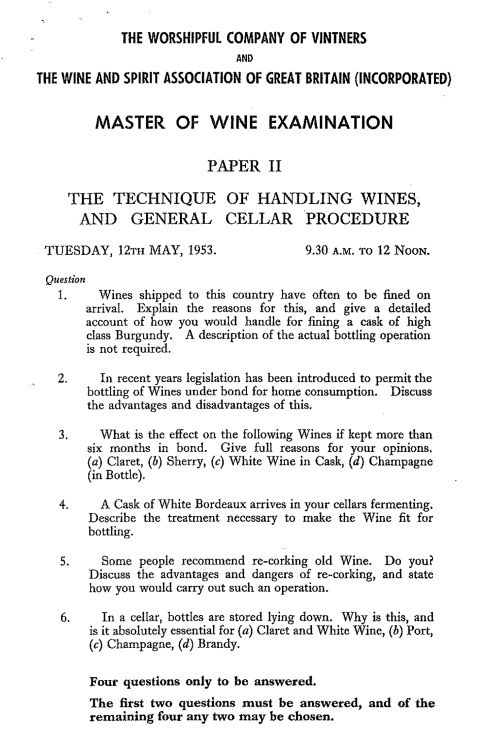
Paper II from the 1953 MW exam
Paper II from the very first (1953) MW exam

The second practical paper at the end of Tuesday morning involved identifying six white wines and matching a range of bottles to types of wine – again indicating how important bottling then was in the UK wine trade. The Tuesday afternoon paper was on ‘The history of wine and the Wine Trade’ (Wine Trade always capitalised!).

The exams finished at 1 pm on Wednesday after a morning paper entitled ‘General regulations affecting the sale of wine and marketing methods’ (hogsheads were mentioned several times even in this paper) and the third and final practical exam involving identifying six reds and a range of wine-related objects, all doubtless related to treating wine that arrived in barrel. See the Oxford Companion entries on château bottling and domaine bottling for a survey of when wines started being bottled at source.

As for the thrust of my initial enquiry, I was completely wrong in my assumption that the original MW syllabus was entirely focused on Europe. South Australia is mentioned twice and the Australian state of Victoria once in this set of 1953 papers. 

Best of luck to all those attempting the 2026 versions!

Book now for the Institute of Masters of Wine 2027 International Symposium to be held 15–18 April 2027 in Adelaide, Australia.

Choose your plan
Member
$135
/year
Save over 15% annually
Ideal for wine enthusiasts
  • Access 295,883 wine reviews & 16,110 articles
  • Access The Oxford Companion to Wine & The World Atlas of Wine
  • Access askJancis, our AI wine assistant
Inner Circle
$249
/year
 
Ideal for collectors

Everything in “Member”, plus:

  • Early access to the latest wine reviews, 48 hours in advance
  • Early access to the latest articles, 48 hours in advance
Professional
$299
/year
For individual wine professionals
  • Access 295,883 wine reviews & 16,110 articles
  • Access The Oxford Companion to Wine & The World Atlas of Wine
  • Access askJancis, our AI wine assistant
  • Early access to the latest wine reviews & articles, 48 hours in advance
  • Commercial use of up to 25 wine reviews & scores for marketing
Business
$399
/year
For companies in the wine trade

Everything in “Professional”, plus:

  • Commercial use of up to 250 wine reviews & scores for marketing
  • Access to submit wines for review
  • Offer memberships to your employees and manage them from a single place
  • API access available for an additional fee
Pay with
Visa logo Mastercard logo American Express logo Logo for more payment options
Join our newsletter

Get the latest from Jancis and her team of leading wine experts.

By subscribing you agree with our Privacy Policy and provide consent to receive updates from our company.

More Free for all

Ronan Sayburn MS, Sarah Abbott MW and Hannah Tovey at Icons tastings 2026
Free for all Take 27 Chardonnay ‘icons’ from around the world and serve them up to 18 accredited tasters … A version of...
WWC26 post-submission graphic
Free for all Great pairings – so many to choose from! A big thank you to all from Team JR. This year’s wine...
Kullabergs Vingård © Terra Skåne/Jan Kivissar
Free for all According to Star Wine List, a guide with more authority than most. Above, food and wine mavens gather at Arilds...
Mont Ventoux seen from Les Deux Cols at dawn
Free for all It’s not all turbo-charged Grenache down south. A version of this article is published by the Financial Times. See also...

More from JancisRobinson.com

Ried Kellerberg in autumn
Wines of the week Summer dreams in a limy, zesty white wine from Austria, from €9.90, £18.37, $19.99 . Above, the Kellerberg vineyard, one...
Diemersdal winemaking team
Tasting articles Great buys available in the UK and farther afield – including some naturally lower-alcohol wines. Above, left to right: Reon...
Alder Springs vineyard
Tasting articles Some of California’s most exciting wines are coming from a vineyard far from any other. Above, Alder Springs vineyard (credit...
Judges for Chardonnay Icons at 2026 London Wine Fair
Tasting articles Australia, and England, triumphed at this year’s blind tasting of icon wines at the London Wine Fair. The wine professionals...
Poggio di Sotto vineyard
Tasting articles If you appreciate wines that reflect vintage and terroir, the top 2020 Brunellos are well worth buying. Above, the Poggio...
Wine & War book cover
Book reviews A reminder of wine’s power to restore humanity, humour and hope in times of conflict. Wine & War The French...
Flowers in the Meinklang vineyard
Wines of the week A magical sparkling wine from Austria, from €9, £15.50, $16.95. It is, some say, the time when magic is strongest...
Dalla Valle vineyard
Tasting articles A banner vintage. Above, Dalla Valle Vineyards in Oakville produced two of Sam’s highlights of this vintage (image courtesy of...
Wine inspiration delivered directly to your inbox, weekly
Our weekly newsletter is free for all
By subscribing you're confirming that you agree with our Terms and Conditions.











