
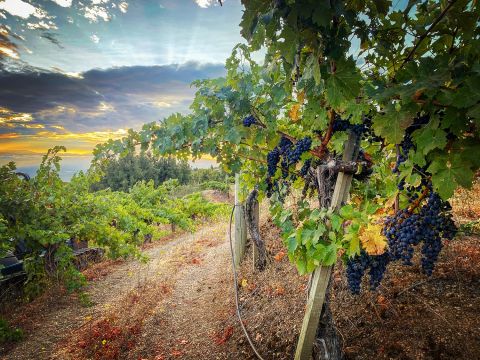
Thanks to the perennially outstanding wine from Ridge’s Monte Bello vineyard (seen above overlooking Silicon Valley), California’s Santa Cruz Mountains have been associated with high-quality Cabernet Sauvignon in the minds of many wine lovers since at least the famous Paris Tasting of 1976. The grape’s history in the region goes back to 1940, when Martin Ray planted the first cuttings at what would become Mount Eden Vineyards on the eastern flank of the Coast Range above Silicon Valley.
Monte Bello’s reputation notwithstanding, in the decades that followed, the Santa Cruz Mountains have become better known for Pinot Noir and Chardonnay than for Cabernet. A few dedicated producers – such as Kathryn Kennedy and Mount Eden – have never wavered in their commitment to producing excellent examples of the grape. But for every Cabernet producer in the appellation, there are now five or six making burgundian varieties.
In the last decade, however, new bottlings of Santa Cruz Mountains Cabernet have been appearing with greater frequency, often from smaller, well-known producers based elsewhere in California. Some of these wines are reminding California wine lovers that Cabernet comes in more flavours than just ‘Napa’ – and that the elegant, lower-alcohol, herb-inflected wines of the late 1970s and early 1980s aren’t impossible, even in a warming climate.
Two plates, two geologies, two climates
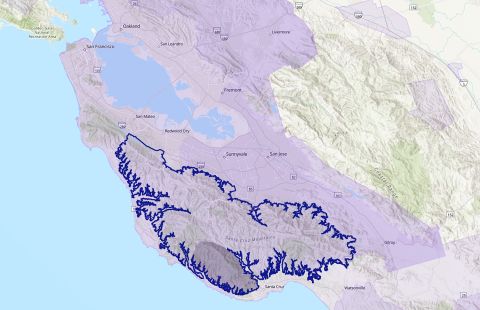
The coastal range at the heart of the Santa Cruz Mountains AVA was formed by the slow collision of the Pacific and North American tectonic plates between 28 and 30 million years ago, which compressed the sedimentary layers of ancient seabeds into the steep mountains we see today. In some ways, that collision is still playing out in the (occasionally disastrous) movement of the San Andreas Fault, which almost – but not quite – divides the east and west sides of the range.
‘I get in trouble for saying this’, chuckles David Gates, VP of vineyard operations for Ridge Vineyards, ‘but the easiest way to understand the Santa Cruz Mountains is that everything on the west side is Pinot country, and everything on the east side is Cabernet country.’
As with any generalisation about geography and winemaking, exceptions abound. But east versus west remains a solid starting point for understanding how an AVA famous for exceptionally cool-climate Pinot Noir and Chardonnay (to the point of being marginal in many places) can also ripen Cabernet Sauvignon.
The redwood-forested west side, directly exposed to Pacific winds and frigid fogs, can receive up to 50 inches (127 cm) of rain annually. Just over the ridge on the east side, vegetation quickly shifts to chaparral, as a rain shadow reduces rainfall to less than 15 inches (38 cm), and thermal inversions from nearby San Francisco Bay keep things considerably warmer.
Soils, too, vary dramatically. On the east side, contributed by the North American plate, soils are hundreds of millions of years older and prominently feature Franciscan shale and mudstone that have weathered into clay, providing crucial water-holding capacity, slightly higher pH, and lower fertility – all factors that help moderate Cabernet’s naturally vigorous tendencies.
Millions of years of landslides, faulting, volcanic activity, and even the scattered presence of limestone (most notably beneath Monte Bello) have created a highly heterogeneous soil profile. This complexity is further shaped by the steep topography captured in the AVA’s boundaries, which are defined entirely by elevation – above 400 ft (121 m) on the west, and 800 ft on the east – one of only three such AVAs in California.
Local style
Fifty years ago, the stylistic differences between Napa Cabernet and Santa Cruz Mountains Cabernet were minimal. Today, a wide gulf separates them.
‘Our founding fathers in modern times – people like Ken Burnap, David Bruce and David Bennion – started their passion for wine in the sixties and seventies’, explains Marty Mathis, long-time winemaker and president at Kathryn Kennedy Winery. ‘When they got together, they had great bottles of bordeaux and they knew what it was about. So when they started making Cabernet from this region, they kept to a more restrained, ageworthy, even sophisticated style. They were willing to make wines that were austere in their youth but would develop into something like bordeaux.’
Anyone who has tasted early 1970s Cabernet from producers like Charles Krug, Inglenook or Clos du Val knows that Napa began in the same stylistic place. But as temperatures rose, rootstocks changed and vertical shoot positioning revolutionised Napa viticulture, the allure of higher-pH wines with opulent textures, greater ripeness – and the scores that followed – pushed Napa away from the herbaceousness that still characterises the leaner, lower-alcohol style of the Santa Cruz Mountains.
While climate change hasn’t ignored this region, the moderating effects of water on both sides of the range temper extreme summer heat. Elevation plays a role as well: some vineyards sit at 2,600 or even 2,800 ft (853 m) – well above most mountain vineyards in Napa.
‘Our slightly cooler temperatures preserve that natural acidity and keep the pH lower for Cabernet’, continues Mathis. ‘When it’s extremely hot, we get this cooling effect off the Bay. It provides a more moderate quality, and we stay a bit more Mediterranean than Napa, which tends to bake. This gives winemakers what I call more “delineated” fruit, which makes for a long, supple mouthfeel, and a wine that tells a story in an elegant way without knocking you over the head.’

Many of the best Cabernet vineyards here look nothing like Napa. Instead of neat, trellised rows, you’ll often find sprawling, head-trained bush vines.
‘Vine training makes a huge difference when it comes to Cabernet’, says local viticulture consultant Ken Swegles. ‘Head-trained or basket-trained vines will produce many more pyrazines, which over time turn into some spectacular tertiary aromatics.’
None of the Cabernet vineyards in the Santa Cruz Mountains is flat, and few come anywhere close to forming a regular rectangle. Most drape across steep hillsides with exposures to three or even four cardinal directions, resulting in naturally uneven ripening – a feature most producers embrace which also serves to moderate alcohol levels.
With Napa Cabernets regularly clocking in above 14.5% alcohol (a recent tasting of over 100 2021 Napa Cabernets – a cooler year – averaged 14.7%), Santa Cruz Mountains bottlings stand in stark contrast. The wines tasted for this article average 13.88%.
As in any region, quality varies, and some producers seem intent on mimicking Napa’s style. But by and large, Santa Cruz Mountains Cabernets offer understated elegance that aligns with global trends toward lighter, more refreshing wines.

Producer proliferation
For weeks, I’ve tried to determine exactly how many acres of Cabernet are planted in the Santa Cruz Mountains. I’ve come up empty-handed. No official records exist – not from government agencies or even the Santa Cruz Mountains Winegrowers Association.
The last comprehensive survey, conducted in 2003, counted 239 acres (97 ha) of Cabernet Sauvignon among the AVA’s 1,300 planted acres. Current best estimates suggest the region now has about 1,500 planted acres total, most of which are Pinot Noir and Chardonnay. That puts Cabernet likely somewhere north of 300 acres, but almost certainly under 400 (162 ha).
Pinning down how many producers make Santa Cruz Mountains Cabernet is equally difficult. CellarTracker shows 35 producers with 2003 vintage bottlings and 48 for 2021, but several producers whose wines I tasted don’t appear there, and I’m aware of more than a dozen others missing from the database entirely.
Everyone I spoke with in the region agreed: more bottlings of Santa Cruz Mountains Cabernet are showing up. Most credited this to the efforts of Swegles and fellow vineyard consultant Prudy Foxx, who works with the largest (and one of the oldest) commercial Cabernet vineyards in the AVA: Bates Ranch.
‘Definitely one reason you’re seeing all these different bottlings is that we opened up Bates [Ranch], and we started to produce more fruit and higher quality fruit’, says Foxx, who began working there in 2012 after the vineyard’s long-time fruit buyer ended their contract.
‘The vineyard wasn’t particularly being well cared for at that time’, Foxx continues. ‘Things like canopy management and long-term mildew issues hadn’t been addressed.’ She also oversaw the planting of four new acres of Cabernet in 2014.
As she restored the vineyard, Foxx made sure people knew that more than 20 acres of Cabernet were available for purchase. ‘Part of what I do as a vineyard consultant is connect vineyards with winemakers that I think are a good fit’, she says.
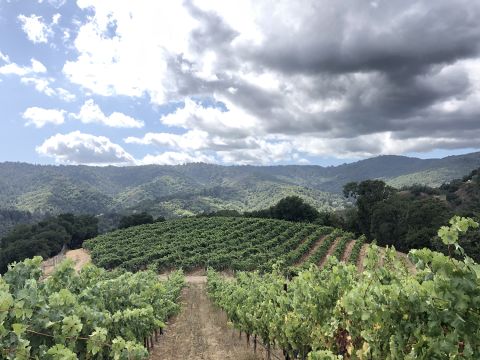
Since she took over, Ridge Vineyards has become a buyer. But Foxx’s specialty may be sniffing out talented young producers, and consequently, newer wineries such as Sandar & Hem and Ashes & Diamonds are now bottling single-vineyard Cabernets from Bates.
Swegles, too, has an eye for young talented winemakers, and while he doesn’t have access to a property as large as Bates Ranch, he works across a patchwork of smaller properties scattered throughout the suburban edges of the AVA.
‘A Silicon Valley exec likes nothing better than to drive his Ferrari down a driveway lined with Cabernet on his way to work. That happened a lot in the last 30 years’, says Mathis, laughing.
These ‘backyard’ vineyards – planted by wine-loving and/or status seeking mansion-owners in Woodside or Portola Valley – often disappeared into garage winemaking or were quietly brokered into larger commercial operations. Many of those owners, and some vineyard managers, have grown tired of the hassle and expense. In their search for relief, they’ve turned to Swegles.
‘Historically, a lot of these vineyards have been farmed pretty lackadaisically’, says Swegles. Today, he manages dozens of these sites, farming organically with a focus on quality and connecting the fruit to a growing list of winemakers across Northern California.
‘I get calls all the time’, he says. ‘Maybe someone just wants one or two bins of fruit – but the first thing they’re asking is whether it’s organic.’
Thanks to Foxx and Swegles, more winemakers are getting access to Santa Cruz Mountains fruit – and thanks to those wines, more drinkers are taking notice.
For now, these vibrant, fresh, claret-style Cabernets still qualify as hidden gems. But maybe not for long.
For an extended version of this article including Alder's tasting notes on 74 Santa Cruz Cabernets, please visit JancisRobinson.com.