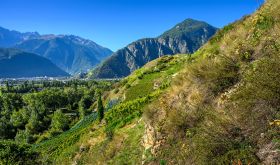
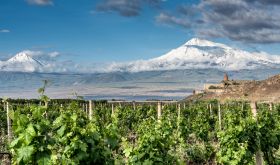
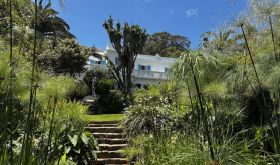
This year’s harvest in Santorini is one for the history books, but for all the wrong reasons. Total production is expected to hover just above 350–400 tonnes. For a world-famous wine appellation, this is a symbolic, almost negligible volume, when the average over the last decade ranged between 2,500 and 3,000 tonnes, and as recently as 2003 reached 5,000.
Vines at their limits and the economic dimension
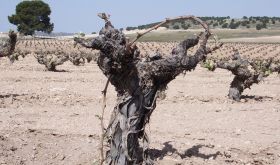
The vineyard crisis did not appear overnight, comments Stefanos Koundouras, Professor of Viticulture at Aristotle University of Thessaloniki. ‘It is largely the result of decades of neglect. A walk through the island’s southern vineyards towards Akrotiri reveals disappointing images: old basket vines left for decades without proper care, without strengthening prunings, without renewal or investment’, he explains. When three consecutive years of prolonged drought and hail were added, these historic vines could not endure. Today, we see bare vineyards, with yields often not exceeding 10–20 baskets per hectare, when they once produced many times more.
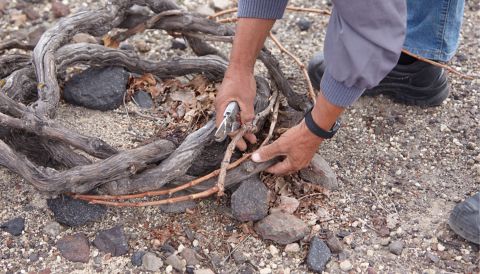
The economic dimension is equally dramatic. Grape prices have soared from €0.85/kg in 2010 to €10–12/kg this year, and may even reach €15 as harvest progresses to higher-elevation vineyards. A 750-ml bottle of Santorini wine requires around 1.4 kilos of grapes, making it increasingly difficult for producers to remain commercially viable in international markets. The vicious cycle is clear: growers raised prices to a point to survive, and wineries entered into a bidding war, offering whatever it takes to secure fruit. The fragmented landholding (about 0.5 ha/1.2 acres per grower on average) exacerbates the problem, as most wineries reinvest very little in the vineyard.
Institutional inertia
Yet the crisis is not only natural or economic. It is also institutional. As Petros Vamvakousis, president of the Santorini Winemakers Association representing 10 of the 18 wineries on the island, points out, today’s situation ‘is mainly due to the inertia of wineries and their inability to function collectively, in a vineyard that is geographically compact and defined by the grape varieties cultivated’.
Already in 1993, the newly founded Interprofessional Association of Winemakers and Growers identified the future weaknesses of the PDO Santorini. However, the effort was short-lived and ultimately dissolved, resulting in the loss of valuable time. In 2010, a new attempt at collective action was made, but once again the Association remained inactive for a decade, until its restart in 2023. As Vamvakousis stresses, ‘over three decades, institutional failures and the absence of a unified strategy contributed decisively to the weakening of the vineyard’.
Meanwhile, growers split their time into other activities – as hoteliers, taverna owners, contractors, even boatmen – while uncontrolled off-plan construction transformed parts of the vineyard into plots. ‘Illegal buildings never saw a bulldozer but were legalised through fast-track systems, turning fertile vineyard land into villas and short-term rental houses’, Vamvakousis adds.
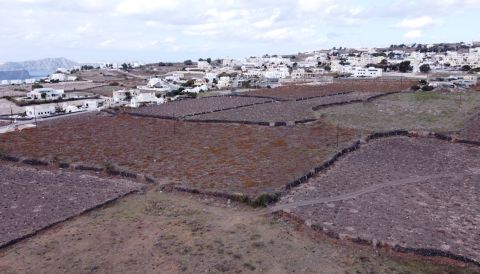
Thus, the vineyard ceased to be a priority until today’s collapse of production and soaring grape prices brought the issue to the surface. The question is straightforward: who can reverse the trend? Who will provide incentives for young growers, invest in know-how, and restore perspective to a vineyard at risk of disappearing?
At this point, Stefanos Koundouras reminds us that ‘Santorini’s vineyard has always been in danger, and with climate change we all knew it would be among the first to be tested’. As he stresses, ‘Santorini is a case where all stakeholders – wineries, growers, scientists, the state – did not act as they should. And only recently did we realise the scale of the problem and the bleak future. Everyone ignored it. No one is blameless: we all carry our share of responsibility.’
For him, however, the priority is not conclusions but action: ‘Now, the only thing we can do is what should have been done many years ago: to create a broad group of scientists, producers and people who genuinely care about the island.’
The looming threat of desertification – and the picture of the future
The biggest issue lies on the horizon: the desertification of the vineyard. From around 3,000 ha (7,400 acres) a few decades ago, today, on paper, only about 1,200 remain (in reality, approximately 1,000 ha). If the trend continues, in five years we may be talking about a vineyard of just 500 ha, with a massive loss of Assyrtiko’s invaluable genetic material, which boasts unique diversity.
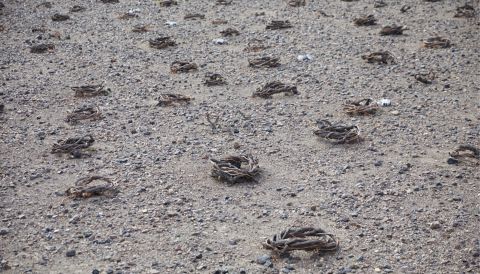
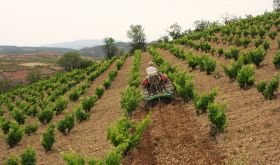
The picture of the future may not resemble today’s landscape of basket-trained vines. Still, it could involve fewer traditional basket-trained vines and more plantings with more modern bush-trained systems, denser ‘goblets’ that promise better water management and higher productivity. The question is whether this transition will be organised and planned, or chaotic, as a result of necessity.
‘The wineries have not really invested’
Winemaker Matthew Argyros of Estate Argyros, who cultivates 120 ha (297 acres) of land, does not mince his words: ‘Most wineries have not really invested in vineyards. They depend almost entirely on growers, with self-produced fruit representing a tiny percentage. The truth is simple: if each winery had invested in 100–150 stremmata [10–15 ha/25–37 acres], we would not be in the situation we are in today.’
He also raises the issue of unhealthy competition: ‘Instead of decreasing, unfair competition between wineries is increasing, with the result that grapes which should normally be €6 per kilo have reached €10–12. This additional margin could have been channelled as an incentive to growers through a restructuring programme. Quality cannot be upgraded by looking at the grapes one day before harvest.’
Argyros is emphatic that growers must be supported: ‘We must help and support the grower, not blame him unfairly. At Estate Argyros, we have grafted more than 50 ha of grower vineyards and planted more than 20 ha for them.’
Outstanding quality but a brand in crisis
The paradox is that while quantity collapses, quality remains outstanding. It does not necessarily mean that it will continue to be under this level of vineyard stress. But for now, the extremely low yields give breathtaking intensity and concentration, with Assyrtiko continuing to express the island’s unique terroir with purity and strength. Yet such small amounts of high-quality wine cannot sustain the market or keep the wine economy alive.
Santorini is not simply experiencing a challenging year; it is at a tipping point. Although it has proven its endurance many times, the brand alone is insufficient. Strategic decisions and coordinated interventions are needed now, from replanting and strengthening vineyards to genuine policies balancing tourism and viticulture. There is no single ‘remedy’ such as water, despite the recent focus; what is needed is a change in mindset and philosophy, a holistic management model. Otherwise, this unique vineyard, shaped by fire, wind and sea, risks moving from symbolic production to complete extinction.
This article first appeared in the Greek newspaper Proto Thema and is reprinted with permission.
All photos by Nikos Koustenis from The Wines of Santorini by Yiannis Karakasis MW and used with permission.
For more background on Santorini and its wines, see The Oxford Companion to Wine entry as well as our many articles, including Julia's account of Karakasis's annual Great Greek Wines tasting.