In the little puddle of life that is the world of wine there is fierce competition between trade fairs, with Europe, the most important wine-producing continent, being the most obvious location. Vinexpo in Bordeaux once reigned supreme, then gave way to Prowein in Düsseldorf’s extensive but unlovely showground. Taking place last week, Wine Paris is now snatching the international wine-trade-fair crown from Prowein, the City of Light having more obvious and varied attractions than Düsseldorf (plus better transport and more options for affordable accommodation).
Barcelona Wine Week is cunningly timed for the week before Wine Paris so that international visitors can combine the two. I spent a long day there for the first time this year and met wine merchants, sommeliers and wine educators from the US, Colombia and Czechia inter alia. In fact, it is just three days, and strictly focused on Spanish wine, but this sixth edition attracted 1,350 wine producers, a third of the country’s total.
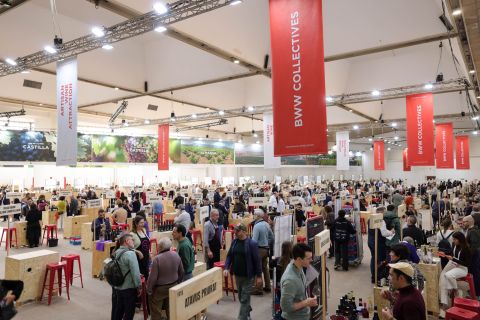
The nearly 26,000 attendees (I felt the full force of them as I tried to move around the two vast exhibition halls off the Plaça d’Espanya) were far more numerous than previously. Perhaps the world’s wine glut means that producers and traders have to work even harder. In his speech at the opening of the fair, Spain’s Minister of Agriculture highlighted India, South America and Indonesia as key export targets.
Many of the those exhibiting did so under the banner of their local denomination or wine-producing group rather than individually, each one on a modest plywood stand (democratically the same size for every individual exhibitor).
The Spanish sparkling wine capital is in the hinterland of Barcelona and for many years Cava ruled supreme. That was before the rise and rise of Prosecco from northern Italy (whose third most important export market after the US and UK, I was surprised to learn recently, is France). Cava has somewhat lost its way, along with market domination, and its giants Codorníu and Freixenet are no longer even Spanish-owned. The smaller, most quality-oriented producers have been keen to distance themselves from Cava and have developed their own brand Corpinnat, with much stricter production rules than Cava.
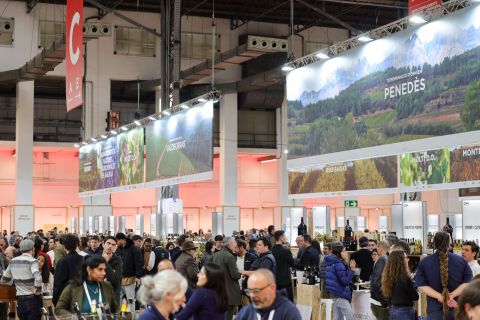
I was intrigued to see at the Barcelona wine fair that the Corpinnat stand seemed every bit as big as the Cava one, even though there are only 21 members of the Corpinnat collective, as opposed to well over 300 producers of Cava in Catalunya alone. Below is the Penedès section.
As with most trade fairs, there was an associated programme of presentations and wine tastings, which was why I was there. Our Barcelona-based Spanish specialist on JancisRobinson.com Ferran Centelles and I had been asked to host a tasting of six hand-picked wines to represent the glory of Spanish wine, a tall order. But the first wine was made by a founding member of the Corpinnat initiative, one of the most respected.
Ferran, known locally as Fredi, is a very special character. He is so popular in Spanish wine circles that it is almost impossible to make any progress through a wine-minded crowd with him, so many people want to salute him. I lost count of the number of people who came up to me at the fair prefacing their remarks, ‘I’m a friend of Fredi.’
He started out in hospitality when he was 17, as a commis waiter at the seminal El Bulli restaurant on the Costa Brava run by the world-famous chef Ferran Adrià with Juli Soler as manager. On the day he turned 18 his mother called the restaurant and asked to speak to Ferran, ‘because she wanted to congratulate me and see how I was doing. Of course, the phone was passed to Adrià right in the middle of a very stressful service. From that day on, Juli Soler changed my name to Fredi.’
He rapidly worked his way up to becoming El Bulli’s somm and worked there until its closure in 2011. I remember well on one of our visits there his proposing a range of sherries to go with our (typically extraordinary) meal. His extreme charm and enthusiasm stood out even then. By 2006, when he was only 24, he was voted Spain’s best sommelier in the Ruinart Challenge. Today he is Adrià’s wine man, writing enormous books with him and for the elBullifoundation, as well as teaching and presenting wine in an unusually creative way.
His personal tasting before our joint one at the fair was designed to demonstrate that there was no written evidence that, as legend has it, Tokaj was ‘the wine of kings and king of wines’, but that Spain could field many documented alternatives such as Rueda, Cariñena and Alicante wines. To that end he had ferreted around in many an archive, hired a well-known Catalan actor in full period costume to act out the part of King Philip II of Spain, and persuaded one of Barcelona’s top sommeliers to dress up similarly and hand out sweetmeats with King Felipe’s portrait on them to every attendee.
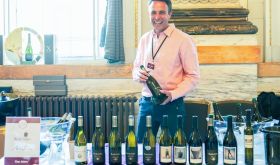
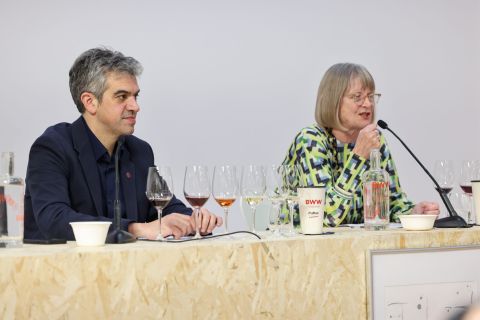
Our tasting, pictured above and below, was a rather more conventional affair. Ferran/Fredi had combed through our database of nearly 14,000 Spanish tasting notes to identify the highest-scoring wines and came up with current versions of six tip-top representatives of Spanish wine: a sparkling wine, two dry whites, an oak-aged rosado and two reds, including the latest vintage of Spain’s most famous wine Vega Sicilia Único.
Tempos Vega Sicilia’s CEO Pablo Álvarez was sitting in the front row, and two more of the producers featured were there too, which was a bit nerve-wracking. Would I get the percentage of new oak right? Ferran, bless him, had briefed me well beforehand.
The top wine of Gramona, Celler Battle 2015, was a sparkling gem, made from the classic Spanish sparkling wine grapes Xarello and Macabeo grown biodynamically. The Gramona family were early exponents of holistic farming with sheep, hens and horses as common as vines. They’re also distinguished by their classical way of making sparkling wine, using natural corks instead of the much more common crown cap on the bottles as the wine is aged on the lees of the second fermentation for a full nine years, and riddling and disgorging the bottled by hand (see Back to basics below).
Then there was Rafael Palacios’s Valdeorras from his favourite vineyard O Soro and the ‘dream vintage’ 2023, based on the local Godello grape that, in hands as meticulous as Rafa’s, can produce wines every bit as refined and long-lasting as a serious white burgundy.
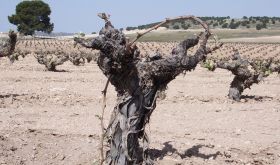
The third wine was one with which I feel a particular affinity because I came across it even before Ferran did. I’ve always been fascinated by boiling-hot La Mancha in south-central Spain, Don Quixote country that has traditionally supplied some of the cheapest bulk wine and grape concentrate in the world (see this World Atlas of Wine map of Spain). Elias López Montero was born into a family wine business there and contacted me in 2019, sending samples of some wines he made from particularly old vines. He then came to London to tell me all about them, and the unusual La Mancha wine business. His pride and joy is a fascinatingly complex, multi-vintage dry white made from the local Airén variety. The vines are exactly as old as I am (ancient), their produce aged in his family’s historic clay jars, once used for storing brandy. The particular wine we showed was a non-vintage blend (CVC on the label in Spain, ie conjunto de varias cosechas) made substantially of 2023 with a little oaked 2022 and 2021.
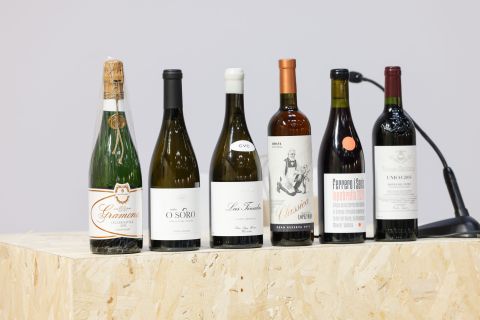
Oaked rosé is not a common style but Rioja has a long tradition of making complex rosados aged for many years in the same old oak barrels as its famous reds, thereby qualifying as Gran Reservas. The easiest to find is the more expensive version from López de Heredia but Ferran chose an extremely well-priced 2013 from López de Haro – scored highly by three of us – in order to prove that big companies can make fine wine, too.
He suggested including a representative from a ‘new’ Spanish wine region that he has been lauding on our site. Terres dels Alforins is not an official denomination but a group of villages in the hills 90 km inland of Benidorm capable of making wines of unexpected delicacy. Our 2024 from Celler del Roure was also based on local grape varieties, supremely adapted to a hot, dry, Mediterranean climate, the sort of vines the rest of the world increasingly needs.
And finally, Único 2016, the first, slightly subtler, vintage for which the new winemaker Gonzalo Iturriaga was wholly responsible.
We could have chosen so many more wines: examples of transparent Garnacha, thrilling white Albillo, all the distinctive excitement of the Canary Islands, and decades-old red Rioja just for starters. But arguably the most glaring omission was sherry, Spain’s unique gift to the world.
Some Spanish superstars
Below I give the wine we served, in bold, followed, where judged possible, by a less expensive version of a similar wine.
Gramona, Celler Batlle 2015 Vino de España/Corpinnat 12%
€67.60 Vinosonline.es
Gramona Innoble Cuvée 319 NV Vino de España/Corpinnat 12%
£38.50 The Wine Society
Rafael Palacios, Sorte O Soro, Val do Bibei 2023 Valdeorras 14%
£1,800 per case of 6 ib Farr Vintners, VinQuinn
Rafael Palacios, Louro do Bolo 2023 Valdeorras 14%
£24 London End Wines
Verum, Las Tinadas Cuvee Especial CVC Vino de la Tierra de Castilla 12.3%
€68.99 bodegasverum.com
Verum, Las Tinadas Airén 2022 Vino de la Tierra de Castilla 11.5%
£27.50 The Great Wine Co
López de Haro, Clàssica Rosado Gran Reserva 2013 Rioja 13%
£37 The Wine Society
Celler del Roure, Ferrero I Senis Laprebella 2024 Valencia 13%
2023 is £139 per case of 6 in bond VinQuinn
Celler del Roure, Les Prunes, Les Filles d’Amàlia Rosado 2023 Valencia 12.5%
£19 92 Or More
Tempos Vega Sicilia, Único Gran Reserva 2016 Ribera del Duero 14.5%
£836 per case of 3 ib Fine Wine Direct
Alión 2022 Ribera del Duero 14.5%
£76 Lay & Wheeler
For tasting notes, scores and suggested drinking dates, see our tasting notes database. For international stockists, see Wine-Searcher.com.
Back to basics
How do you make wine sparkling? |
|
The bubbles in wine are created by the carbon dioxide that’s a routine by-product of alcoholic fermentation. So the trick is to create a second alcoholic fermentation by introducing a mix of yeast, plus sugar for it to work on, to a still base wine and to keep the result under pressure so as to retain the dissolved carbon dioxide.
It is the contact between the wine and the dead yeast cells, or lees, that adds interest to the base wine. So, generally, the longer and closer that contact, the more complex the sparkling wine. A sparkling wine made in tank under pressure (the so-called tank of Charmat method) and kept there for a few months will be infinitely less interesting than a wine whose second fermentation took place in individual bottles (the traditional method) and was then kept in contact with the lees for years, in bottles laid on their sides and usually stoppered with a metal crown cap. Obviously the quality and character of the base wine plays a significant part, too. Champagne is made by the traditional method and has to be aged on the lees for at least 15 months.
In both cases, unless the wine is to be sold as a fashionably cloudy pet-nat, the sparkling wine is separated from the lees. In the tank method it’s simply filtered under pressure. With individual bottles, it’s a bit more fiddly and the process is called disgorgement. The bottles have to be gently upended so that the sediment gathers in the neck, a process called riddling and nowadays usually done in large, computer-controlled metal crates (first embraced in Catalunya, incidentally). The necks of the bottles are then frozen so that the sediment shoots out in a neat pellet, the bottle is topped up, typically with a little sugar dissolved in wine called the dosage, and a champagne cork and muzzle applied – all under pressure.
For even more detail on this topic, see the Oxford Companion to Wine entry on sparkling winemaking. |